Cultural center
Aarwangen Castle

Aarwangen Castle is a castle in the municipality of Aarwangen in the Swiss canton of Bern. It is a monument of regional importance. It is located on the south bank of the Aare river near the Aarwangen bridge on the main road from Niederbipp to Langenthal.
History+
Aarwangen Castle was built by the Lords of Aarwangen, Kyburg ministerial nobility, in the 13th century to secure the important river crossing. Knight Burkart von Aarwangen is documented as the first lord of Aarwangen Castle. Subsequently, the castle remained in the possession of the Lords of Aarwangen. In the second half of the 13th century and the first half of the 14th century, the Lords of Aarwangen were among the leading families in the Oberaargau and at the Kyburg court in Burgdorf. After the extinction of the Aarwangen line with the death of Johann von Aarwangen in 1350, the village and lordship fell to the Grünenberg family. After the takeover of Burgdorf in 1384, the Bernese sphere of influence gradually shifted eastward. After the Confederates wrested Aargau from the Habsburgs in 1415, Bern bought Aarwangen Castle and lordship from Wilhelm von Grünenberg in 1432. This laid the foundation for the bailiwick in Aarwangen Castle, which remained in existence until the end of the Bernese city-state in the spring of 1798. A total of 75 bailiffs resided in the castle. Afterwards, the castle was sold to private individuals. It had special tasks to perform during the Peasants' War in 1653. It also served additional functions as a horse-changing station for Bernese express messengers and as an armory. In 1803, Aarwangen again became the district capital, and in 1805, Bern bought the castle back. Since then, the castle has served the Bernese administration as a chancellery, court, and prison.
History in the 20th and 21st Century+
In 1997, the smaller judicial districts in the Canton of Bern were merged as part of a first judicial reform, for example, Wangen an der Aare and Aarwangen into the Aarwangen-Wangen judicial district. And finally, the 13 judicial districts thus formed were reduced to four regional courts in the second judicial reform in 2010. The Aarwangen District Court and its court presidents moved to Burgdorf in 2012 as part of this reform. Since then, Aarwangen Castle has stood empty. In view of this second judicial reform, the Bernese government put Aarwangen Castle up for sale for 3.8 million. Thereupon, the Oberaargau Grand Councillors and the Government Governor advocated to the government that Aarwangen Castle should be preserved for the Oberaargau. The government stuck to the sales option due to a lack of alternatives. In an effort to present an alternative, an ideas group (IG) Schloss Aarwangen was founded in 2012, when the court had moved out, on behalf of the Identität Oberaargau association, to clarify whether and how Aarwangen Castle could be preserved and further used as an important cultural asset. Although options were developed, the efforts had to be discontinued in March 2014 given the purchase price of 1.366 million demanded for the IG and the large presumed investment requirement. After several further attempts, new project ideas and concept developments, as well as numerous discussions with the responsible offices and persons of the Bernese government, the desired breakthrough was achieved in 2019. On September 3, 2019, Grand Councillor Patrick Freudiger submitted a motion signed by all 13 Oberaargau Grand Councillors with the requests that further sales efforts, in particular a renewed public tender, be waived, that Aarwangen Castle instead be dedicated free of charge to the foundation to be established, and that the costs for the installation of the lift and the remediation of damage and pollutants be borne by the canton. The motion was adopted by the Grand Council with 143:0 votes. On November 3, 2020, the foundation was established in the castle and the dedication contract was signed.
Architectural and Art History+
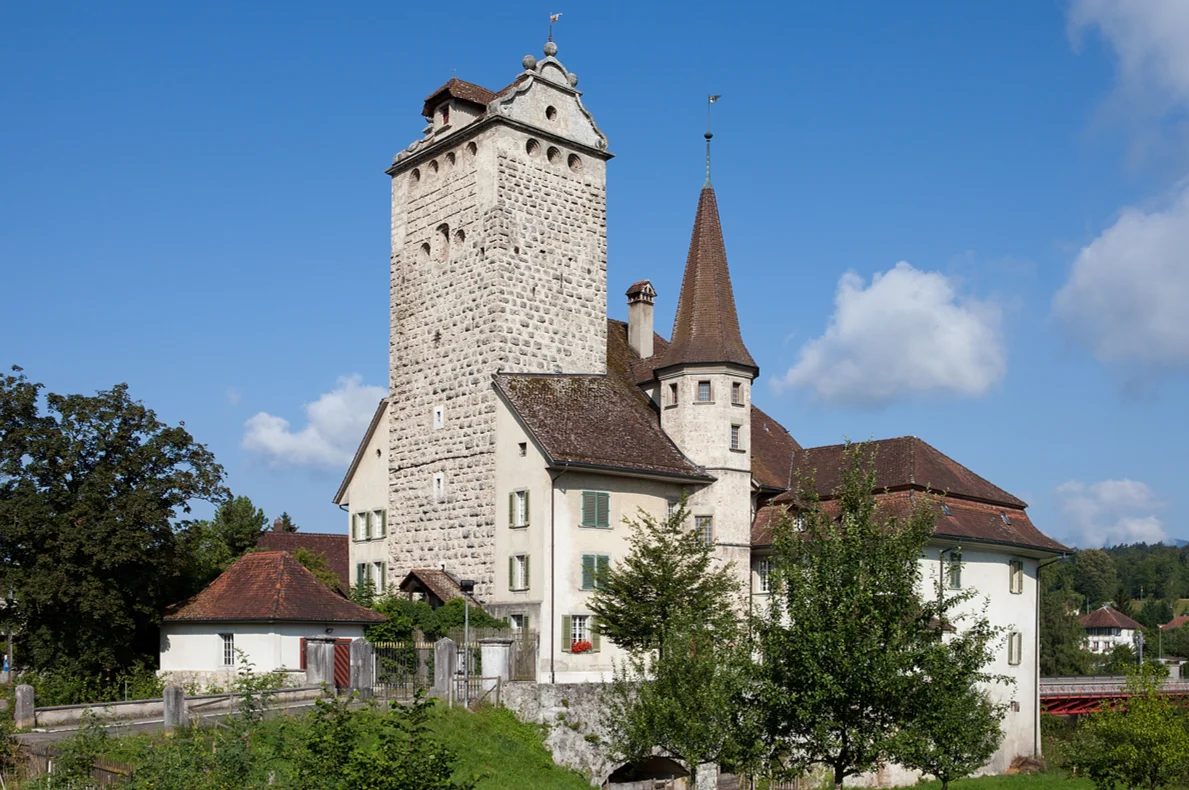
Aarwangen Castle is a striking building complex, dominated by an early Gothic main tower and renovated in Baroque style, located directly at the river crossing. The horseshoe-shaped curtain wall, formerly with a moat open towards the Aare, is visible in the southern and western sections, as is the corner tower near the bridge. Dominant is the nine-story, uninhabitable main tower from the 13th century, built of very well-maintained ashlar masonry. In 1624, the uppermost floor and the beautiful volute gables were added in a remarkable adaptation to the medieval structure. Residential buildings surround the tower on three sides, medieval in core, with numerous alterations up to the 20th century. Stair tower 1643. Furnishings from the 17th and 18th centuries. Aarwangen, along with Trachselwald, possesses the most beautiful and well-maintained medieval castle tower, a special feature of which is its staircase recessed into the wall thickness. Aarwangen Castle was originally a moated castle. The castle was open to the east, with a square tower covering the access. Above the Aare bank to the north, the palas rose parallel to the river, separated from the tower by a narrow courtyard, which was built over in the 18th century. Also horseshoe-shaped, a moat about 15 meters wide separated the curtain wall from the foreland. An additional obstacle was formed by a series of large ponds on the mountain side. In the center of the castle ring stood the massive keep, originally an uninhabitable defensive tower, with its walls up to 2.5 meters thick.
Current Use+
After the canton of Bern dedicated the castle to the Aarwangen Castle Foundation, the foundation began its work. With the mission to preserve, maintain, and make the historic castle complex publicly accessible, and the vision to develop the castle into a place of encounter and experience in the Oberaargau, a usage concept was developed. In August 2023, the renovation and conversion work began, and in May 2025, the converted castle was put into operation. Today, Aarwangen Castle presents itself as a meeting point in the Oberaargau, directly on the Aare. Visitors can immerse themselves in the castle's past through multimedia, images, and objects, and learn about the lives of bailiffs and their households. The economic history of the Oberaargau is also a theme. In the spirit of knowledge transfer, guided tours and workshops are offered, also for school classes. The VR experience allows visitors to virtually immerse themselves in earlier castle life. The old prison cells have been converted into escape rooms. A platform is offered to artists from the region as part of cultural events.
Take Mobile History with you
You are reading this text for free. Premium adds what matters on the road: descriptions read aloud, sites found through your camera, whole regions taken offline.
- Every description, including the ~17,700 Premium sites
- Audio guide: have descriptions read to you on location
- AR finder: see sites through your camera, with distance and bearing
- Unlimited saved sites
14 days free, then from €2.99 a month. Cancel anytime.
Source: Wikipedia · Licence: CC BY-SA 4.0 · Image: https://upload.wikimedia.org/wikipedia/commons/8/82/Aarwangen-Schloss.jpg
This description draws on the facts documented in the linked Wikipedia article; Wikipedia content is licensed under CC BY-SA 4.0. Wording and editing: Mobile History.
Location: 47.2457, 7.7634