Monastery tours available
MonasteryVillars
Abbaye de Boschaud
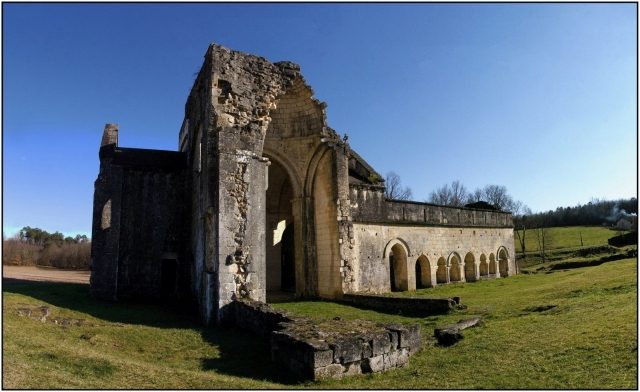
The Boschaud Abbey (Boscum Cavum) is a former Cistercian abbey in the present-day commune of Villars in the Dordogne department in the Nouvelle-Aquitaine region of France.
Etymology+
The place name Boschaud is derived from the Latin boscum cavum, meaning "cleared forest" (boscum = "bush", "small forest" and cavus = "empty", "hollowed out"). The former monastery is still found today in a clearing in the forests located between Villars and Quinsac.
Geography+
The present-day abbey ruin lies in the still relatively pristine forest solitude about 15 km northwest of Brantôme en Périgord or 2 km west of Villars near the hamlet of Boschaud on a ridge about 175 m above sea level. It can be reached via a communal road, which branches off to the left from the D 98 (Villars-Quinsac) shortly after the center of Villars and then follows a dry valley running northwest for 1.5 kilometers uphill. After crossing a wooded area, a larger clearing opens up with the monastery and the associated hamlet. The road then reaches the ridge line at about 200 meters altitude and there again merges into the D 98, which then leads down to Quinsac. The monastery was built on redeposited river gravels from the Pliocene or Pleistocene, but the building blocks – predominantly white rudist limestones from the Angoumien (Turonian) – first had to be sawn out by hand in more distant quarries and then transported.
History+
The monastery was founded in 1145 by Géraud de Salles on the site of an older hermitage and joined the Cistercian Order in 1163 – according to unconfirmed information as a daughter monastery of Châtillon Abbey in Lorraine. In any case, it belonged to the filiation of the primary abbey of Clairvaux. Its economic situation is said never to have been brilliant.
Source: Wikipedia · Licence: CC BY-SA 4.0 · Image: Michel Chanaud
This description is a machine translation of an excerpt from the linked Wikipedia article. The source text was written by its authors, the translation is by Mobile History; like the original it is licensed under CC BY-SA 4.0.
Location: 45.4225, 0.7319