The Abbey can be visited
MonasteryChancelade
Abbaye Notre-Dame de Chancelade
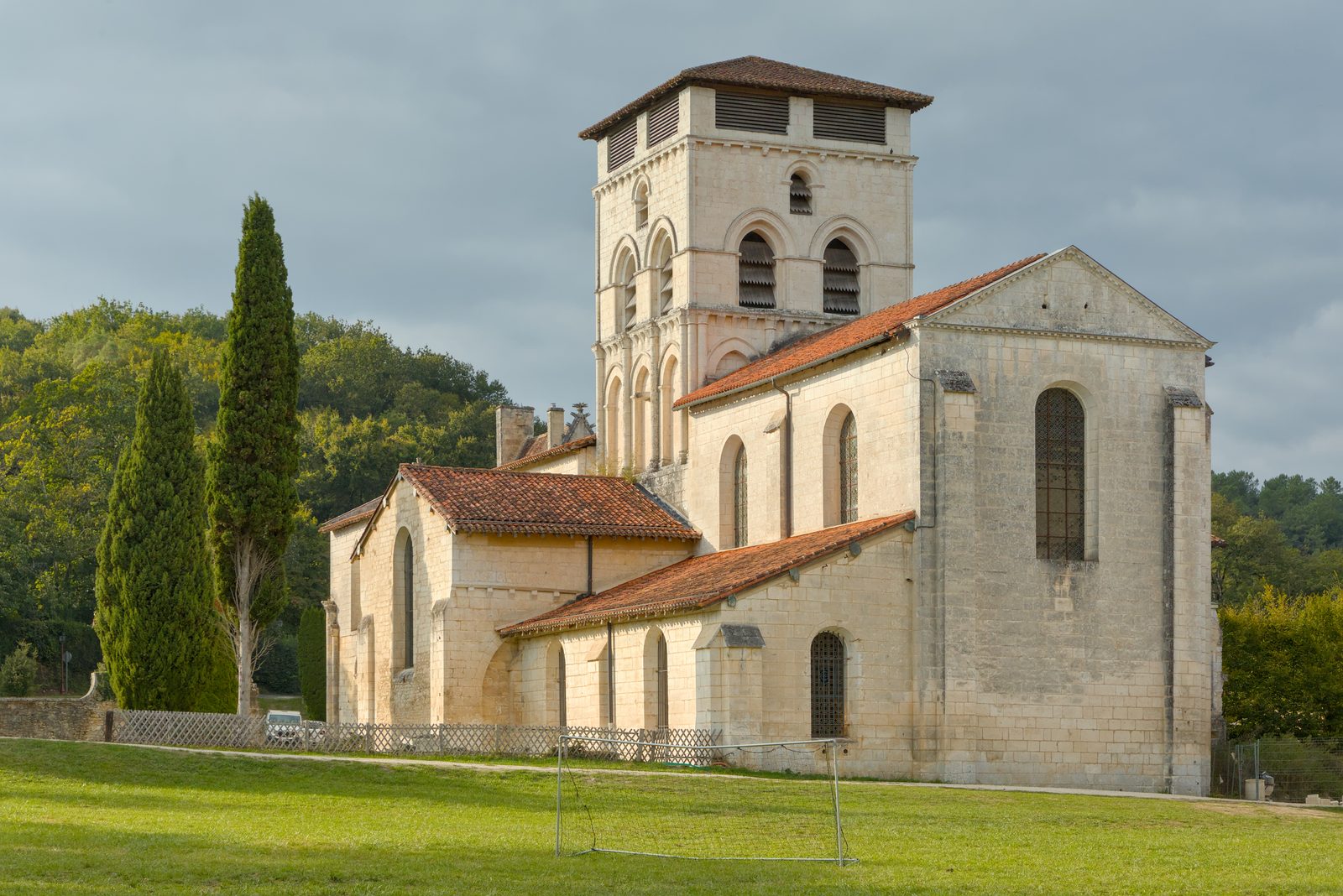
Chancelade Abbey is located in Chancelade, a French commune in the Dordogne department in the Nouvelle-Aquitaine region.
The Abbey of Chancelade, also known as Notre-Dame Abbey of Chancelade, in French Abbaye Notre-Dame de Chancelade, is located in the commune of Chancelade, about 5 kilometers northwest of the city center of Périgueux.
History+
Foundation+
In 1096, Pope Urban II wanted to affiliate the monks of Saint-Pierre de Cellefrouin Abbey with Charroux Monastery. As this meant a transition from the Augustinian rule to the Benedictine rule, Abbot Foucault opposed this decision and settled as a hermit in Fons Cancellatus, the Latin name for the spring of Chancelade. This is considered the founding date of the later abbey. The location of the spring is marked by a memorial plaque to Alain de Solminihac.
Other monks then joined Abbot Foucault, forming a community. The first abbot of Chancelade, Gérard de Montlau, was blessed in 1128 by Guillaume d’Auberoche, the Bishop of Périgueux. The monks then decided to build a monastery. They built the abbey church along with the enclosed convent buildings, as well as a small parish church in the immediate vicinity. Both churches were consecrated on October 12, 1147, by Raymond de Mareuil – the abbey church to the Virgin Mary and the parish church to Saint Mary Magdalene. Around 1140, Geoffroi de Cauzé gifted the lands of Merlande to the abbey. The monks built a chapel at the spring there, which was soon expanded and developed into its own priory. In 1360, the abbey had 22 religious members. As it placed itself under the protection of Cardinal Hélie de Talleyrand-Périgord, it received 3800 guilders from him as a gift and was thus able to recruit another 38 clerics.
Status+
Since 1133, Chancelade Abbey has been an abbey committed to the rules of Saint Augustine, its monks belonging to the Augustinian Canons. In 1635, Alain de Solminihac opposed the Congrégation de France founded by Cardinal Rochefoucaud. Although his reform efforts were prohibited, Chancelade Abbey nevertheless received permission to continue as an independent congregation.
Wars, Plunderings and Destructions+
From 1360 to 1367, the English occupied Périgueux. They drove out the monks and quartered their own garrison in the monastery. After his return from Spain, Bertrand du Guesclin was able to recapture the abbey. However, as soon as he left it again, the English advanced once more and remained until the 15th century. Around 1440, the community made a new beginning under the patronage of Arnaud de Bourdeille and thanks to its abbot Geoffroy de Pompadour. During the Huguenot Wars, Périgueux was conquered by the Huguenots in 1575. Langoiran then seized the abbey, which was plundered and burned. Of the abbey church, only the crossing with its dome and the bell tower survived. The vault of the nave and the Romanesque choir were destroyed.
New Beginning+
When Alain de Solminihac took over the abbey in 1614, only four monks remained. After receiving the blessing from Monseigneur de la Béraudière in Saint-Front Cathedral in Périgueux in 1622, he began rebuilding the half-destroyed abbey church and reconstructed the cloister, the residential wing, and the convent buildings. At the same time, he carried out reforms and recruited new religious members. Alain de Solminihac was appointed Bishop of Cahors by Pope Leo XIII on June 17, 1636. In 1638, he returned to Chancelade to consecrate the rebuilt abbey church (on October 4, 1981, Alain de Solminihac was beatified by Pope John Paul II, his remains are in Cahors Cathedral). In the 18th century, Abbot Jean IV Antoine Le Gros de Beler (1730–1763) encouraged his monks to study, and the library was enriched with maps and 4000 books. Intensive work was carried out in the scriptorium – manuscripts were copied, texts and documents classified. It was here that Father Prunis discovered Montaigne's travel diary, hidden in an old suitcase in the library tower. It was then published in Rome in 1774.
Temporary Loss of Former Religious Functions+
During the French Revolution in 1790, the abbey was sold as national property. Numerous documents were thus transferred to the Bibliothèque nationale de France and are now available there as 183 volumes. Several hundred works are found in the city library of Périgueux, including a copy of the cartulary. At the beginning of the 19th century, the abbey church became a parish church.
Reopening+
After the renovation of the farm buildings by Mr. and Mrs. Caignard, which began in 1955, the abbey opened its doors to pilgrims and the public in 1975. After another temporary closure from 2004 to 2009, it has been open again since 2010. From 1998, a group of Augustinian Canons settled in Chancelade Abbey. In 2004, the diocese transferred the abbot's house and park, purchased from the Caignard family, to the group to establish a spiritual center there.
Source: Wikipedia · Licence: CC BY-SA 4.0 · Image: Benjamin Smith · Wikimedia Commons · CC BY-SA 4.0
This description is a machine translation of an excerpt from the linked Wikipedia article. The source text was written by its authors, the translation is by Mobile History; like the original it is licensed under CC BY-SA 4.0.
Location: 45.2072, 0.6671