Monastery tours available
MonasteryBrantôme
Abbaye Saint-Pierre de Brantôme
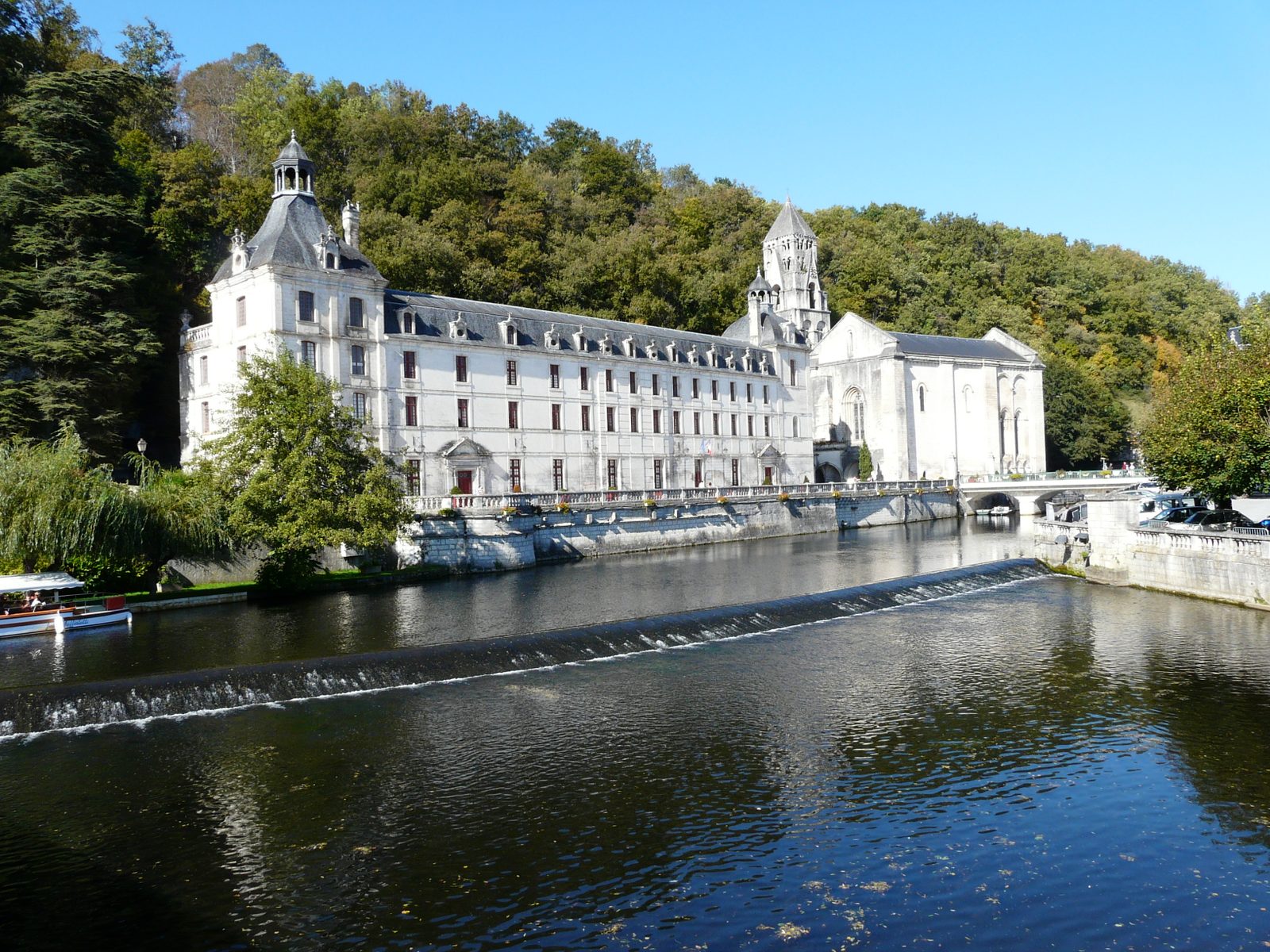
The Abbey of Saint-Pierre de Brantôme in the Dordogne department is a former Benedictine abbey, founded in 769 by Charlemagne in the Diocese of Périgueux. It was dissolved during the French Revolution. Today, the abbey church (11th and 13th centuries), part of the cloister (14th century) and the monastic buildings (18th century), which house two municipal museums and the town hall of Brantôme, still exist.
Historic Monument+
The abbey church was already classified as a "Monument historique" in 1840, the pavilion known as the "Guardhouse" (or "Renaissance Pavilion") and the tower belonging to the former abbey were listed as historical monuments on March 2, 1891. The curved bridge and the three Renaissance repositories located in the former abbey were listed as historical monuments on January 13, 1912, while the 14th-century cloister, the ground-floor rooms facing the cloister, the facades and roofs, the carpentry, and the staircase inside the 17th-century monastic building were not listed until 1957. The "Medici Fountain" and the "Porte des Réformés" were added to the list of historical monuments on January 12, 1931. The abbey caves, as well as the garden and the mill (now a restaurant), were listed as historical monuments after 1957. On November 15, 2021, further parts of the former abbey (in addition to those already classified) were registered as historical monuments, including the presbytery, the interior and backyard of the abbey building, the forecourt between the abbey and the Dronne river, the abbot's garden, and the "Jardin des Reposoirs".
History+
The Abbey of Brantôme was built in an exceptional location. It is situated at the foot of a crescent-shaped cliff, above which lies a wooded area, on the banks of the Dronne river, which surrounds the medieval town and protects it from prevailing winds. Since the 8th century, the monks, who followed the Rule of Saint Columbanus of Luxeuil, lived in the caves, as the rock offered them protection and high-quality raw material for the construction of the abbey. According to tradition, it was Charlemagne who consecrated it by depositing there the relics of a child martyr, one of the Holy Innocents, Saint Sicarius. Two gilded wooden panels from the 17th century in the church choir depict the donation and the massacre. The Abbot of Brantôme participated in the Synod of Aachen in 817, convened by Charlemagne to reform monastic life in his empire. Nothing remains of this first monastery, not even knowledge of its exact location. The first abbey was plundered twice by the Normans and finally destroyed by the Vikings in 848 and 857. Around 900, Bernard, Count of Périgord, returned the properties inherited from his father to the Abbey of Brantôme. The monks gradually built a new monastery. From the 10th century, the abbey regained some prosperity. At this time, the cage-shaped bell tower with gables in the Limousin Romanesque style (11th century) was built. Grimoald, Abbot of Brantôme, was appointed Bishop of Angoulême in 991. He retained the abbatial title of Brantôme and, thanks to these revenues, was able to build the new Cathedral of Angoulême, consecrated in 1017. In this first century of the new millennium, monastic discipline in Brantôme had somewhat relaxed. Elias, Count of Périgord, ceded his rights over Brantôme to the Abbot of La Chaise-Dieu Abbey in 1080. This change led to the reform of the community, freed it from secular power, and gave the abbey a new development that would continue in the 12th and 13th centuries. The town flourished and became a stopover for pilgrims on their way to Santiago de Compostela. The religious buildings, partially destroyed by the Anglo-French wars, were rebuilt during the Renaissance. The Hundred Years' War caused the greatest damage in Brantôme. The Abbey of Brantôme was devastated by the troops of Raymond II of Montaut, the ruler of Mussidan, in 1382 and restored before being converted into a kind of castle by the English in 1480. The destroyed abbey church was not rebuilt until 1465, the cloister in 1480. In 1501, the community numbered only 13 monks, and internal disputes arose during the election of the abbot, leading to the appointment of two abbots. The crisis lasted 3 years and ended with the transfer of the abbey to Cardinal d'Albret, the first commendatory abbot of the abbey. When he died in 1520, new unrest broke out, and five candidates contended for the office for eighteen years. Finally, in 1538, Pierre de Mareuil, Bishop of Lavaur, was recognized as abbot and endeavored to restore monastic life and peace in his abbey. He affiliated Brantôme with the Congregation of the Abbey of Saint-Pierre de Chezal-Benoît. The integration was completed in 1559, and five years later the community numbered 37 religious. The abbey also had its commendatory abbots in this congregation. The most famous of them was the historian Pierre de Bourdeille, known as "Brantôme" (abbot from 1558 to 1614). His tenure saved the abbey during the Huguenot Wars. Twice Protestants came to the monastery, which opened its doors to them. They respected the abbey, which was then rich and prosperous. In 1636, the community of Chezal-Benoît joined the Congregation of Saint-Maur. Brantôme was one of the first to accept this integration. At this time, the abbey was in a morally and materially deplorable situation. The Maurists restored or rebuilt the buildings. In 1768, Brantôme numbered no more than eight monks. The abbey was dissolved during the Revolution.
Architecture+
From an architectural point of view, Brantôme is a Romanesque abbey. However, the church vaults, rebuilt in the 15th century, are Gothic. The bell tower of the abbey church (11th century) is probably the oldest bell tower in France. It was not built on the church, but on the 12-meter-high rock above it. Its four-story architecture is unusual. The abbey is partly built into the rock. A dozen rock caves housed the heating room and the washing area of the monks, the abbey mill, and the cave dovecote. The "Grotto of the Last Judgment" (see below), built in the 15th century, contains bas-reliefs. In 1850, the French state commissioned the Perigordian painter Jacques-Émile Lafon to create a mural for the Chapel of Our Lady. Over the centuries, the abbey was repeatedly redesigned and rebuilt. The church was rebuilt in the 12th century and redesigned a century later. After the Hundred Years' War, it was rebuilt in the 15th century. At this time, between 1465 and 1539, the cloister was also rebuilt. Subsequently, the abbey church was extensively renovated by the architect Paul Abadie, a student of Eugène Viollet-le-Duc, from 1850 onwards. In 1858, the architect had three galleries of the cloister removed. The buildings traditionally flanking the cloister were redesigned in the 17th century by Abbé le Prestre, a relative of Sébastien Le Prestre de Vauban. The so-called Vauban staircase, a stone staircase with a bay window, dates from this period. The staircase provided access to the part of the abbey that housed guests and pilgrims, and the infirmary was also located here. The dilapidated abbey castle was completely removed in 1744, and the existing building was extended in its place.
Pictures of the Church+
Exterior Renovation of the Abbey+
Caves+
The remains of the first Benedictine monastery of Brantôme (8th century) were carved into the limestone rock and are now partly covered by the monastic buildings of the abbey. Remains of dwellings and living quarters, which have been altered several times over a millennium, dovecotes carved into the limestone rock, and a miraculous well dedicated to Saint Sicarius, whose relics were allegedly given to the abbey by Charlemagne and are still preserved in the abbey church, can still be seen in the rock. There are also the remains of a fish farm where young salmon were raised. One of the large "caves" (actually large chambers carved into the limestone), called the "Cave of the Last Judgment", contains two monumental bas-reliefs. The underground part of the abbey can be visited without a guide, but with explanatory panels. The visit can be combined with the Fernand Desmoulin Museum, which is located opposite the cliff.
Grotto of the Last Judgment+
In the northwest of the cave complex is the Grotto of the Last Judgment with two remarkable bas-reliefs. The most imposing sculpture is that of the Last Judgment, dominated by the silhouette of God the Father. On the right side is the second bas-relief, which is said to date from the 17th century and depicts the Crucifixion of Jesus, at whose feet stand Mary Magdalene, the kneeling Virgin Mary, and the Apostle John, with a kneeling cleric on each side.
Take Mobile History with you
You are reading this text for free. Premium adds what matters on the road: descriptions read aloud, sites found through your camera, whole regions taken offline.
- Every description, including the ~17,700 Premium sites
- Audio guide: have descriptions read to you on location
- AR finder: see sites through your camera, with distance and bearing
- Unlimited saved sites
14 days free, then from €2.99 a month. Cancel anytime.
Source: Wikipedia · Licence: CC BY-SA 4.0 · Image: Père Igor · Wikimedia Commons · CC BY-SA 3.0
This description is a machine translation of an excerpt from the linked Wikipedia article. The source text was written by its authors, the translation is by Mobile History; like the original it is licensed under CC BY-SA 4.0.
Location: 45.3643, 0.6470