The Abbey can be visited
MonasteryArles
Abbaye Saint-Pierre de Montmajour
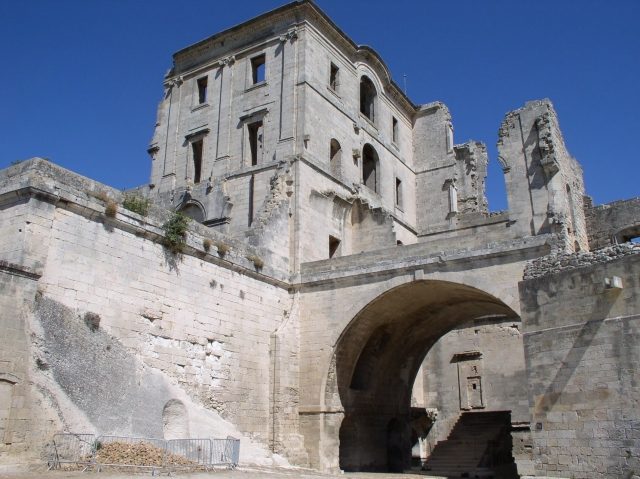
Montmajour is a former abbey in the French department of Bouches-du-Rhône, a few kilometers northeast of Arles.
History+
Montmajour arose on a rocky hill surrounded by marshland, which King Conrad III the Peaceful of Burgundy (937–993) had designated as a public cemetery. The chapter of the Church of St. Trophime in Arles sold the site to a noblewoman in 949.
Benedictine Monastery+
Thanks to a donation from the noblewoman, Benedictine monks first built the Hermitage of Saint-Pierre, a pre-Romanesque chapel half-hewn into the rock. Construction of Saint-Pierre began in 1016, followed by the construction of an abbey church. In 1030, the abbey received the right to grant indulgences. The relic of the True Cross of Christ was kept in the crypt of the abbey church. Due to the large number of pilgrims, Sainte-Croix was built as a reliquary chapel east of the cloister in the 12th century. The "Pardon de Montmajour" pilgrimages took place on May 3, the day of the Finding of the Cross. The abbey's income was also used to drain the surrounding marshes. In the 11th century, the abbey became the burial place of the Counts of Provence. By the end of the 13th century, the spiritual, political, and economic influence of the abbey extended over up to 56 priories from Grenoble (Isère valley) to the Mediterranean Sea. During the Hundred Years' War, the abbey was fortified with a fortress wall and a defensive tower.
Maurist Monastery+
In 1618, a reform movement emerged in the Parisian Abbey of Saint-Germain-des-Prés, which also encompassed the great Benedictine monasteries of France and founded the Congregation of Saint-Maur. The active Congregation of Saint-Maur ensured strict adherence to the Rule of Saint Benedict. The Maurists expelled the Benedictine monks from Montmajour, founded the Maurist monastery of Monastere Saint-Maur, and had a palace built in the classical style. The monastery became a center of spiritual and scientific work. With its monumental architecture, it appeared imposing and was soon referred to as the "Monks' Castle" in the area. It particularly highlighted the center of the new congregation. For liturgical life, the Maurists used the medieval abbey church. The new monastery buildings were erected under the direction of Pierre Mignard from 1703 to 1719. After a devastating fire, Jean-Baptiste Franque directed the second construction phase from 1726 to 1728. Two further construction phases in 1747 and 1776 gave the monastery its final character. The Affair of the Diamond Necklace involving Cardinal and Archbishop of Strasbourg Louis de Rohan, who was also titular abbot of Montmajour, disrupted developments. King Louis XVI had the abbey closed in 1786.
Decay and Monument Protection+
During the Revolution, the monastery was sold as national property in 1790, its roof dismantled, and its walls used as a quarry. Multiple sales of the complex led to further decay; the painter Jean-Jacques Réattu (1760–1833) acquired the watchtower. In 1840, it was placed under monument protection and restored from 1862. Since 1945, it has been state property. It was partially restored in 1994.
Layout of the Complex+
the hermitage (11th century) with the pre-Romanesque chapel Saint-Pierre, a relief of the Apostle Peter at the entrance, the tombs: graves hewn into the rock, the defensive tower Pons de l’Orme (1369; 26 m high), …
Source: Wikipedia · Licence: CC BY-SA 4.0 · Image: Daniel Pelletier
This description is a machine translation of an excerpt from the linked Wikipedia article. The source text was written by its authors, the translation is by Mobile History; like the original it is licensed under CC BY-SA 4.0.
Location: 43.7056, 4.6639