The Abbey can be visited
MonasteryChantelle
Abbaye Saint-Vincent de Chantelle
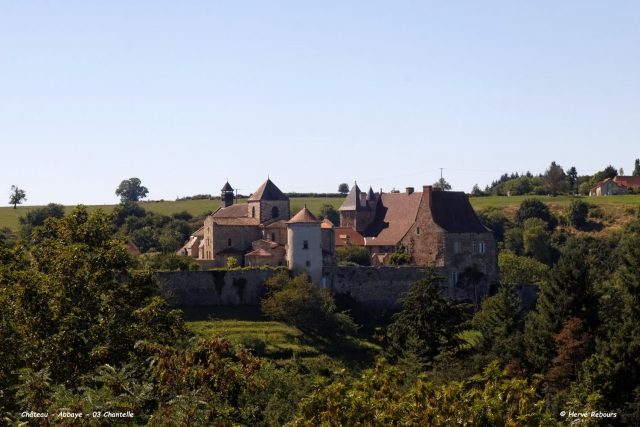
In Chantelle, a location in the French department of Allier, is the Abbaye Saint-Vincent de Chantelle. This Benedictine nunnery, surrounded by the walls of a former ducal castle, is today a place of contemplation and artisanal production.
History+
The origins of the monastery date back to 937, when Ainaud and Rothilde founded a community dedicated to Saint Vincent of Valencia for regular canons. The founding charter, now preserved in the archives of Puy de Dôme, was witnessed by Odo of Cluny. In the late 11th century, the monks erected the Romanesque church, still preserved today. In the 15th century, the monastery buildings were extensively renovated in the late Gothic style. The monastery was located on a rocky outcrop above the Bouble River, surrounded by the fortress of the Bourbon dukes, from where Anne de Beaujeu ruled for her underage brother Charles VIII between 1483 and 1491. The ducal castle was razed in 1635 by order of Louis XIII and Cardinal Richelieu, with only some fortress walls, two towers, and remnants of the moat remaining, which now serve as gardens. The monastery itself was spared. During the French Revolution, it was dissolved and the church was used as a warehouse. On October 11, 1853, monastic life was revived by 17 Benedictine nuns from Pradines, who restored the dilapidated monastery. They initially ran a girls' school, but this ended in 1905 with the law on the separation of church and state. During World War II, the sisters supported children from Paris. For 165 years, Benedictine nuns have lived in Chantelle, cultivating hospitality alongside choral prayer and producing natural cosmetics since 1954 to support themselves and maintain the listed buildings.
Location+
The Abbaye Saint-Vincent de Chantelle is located in the commune of Chantelle in the department of Allier, in the Auvergne region of France. It is situated at an elevation of approximately 306 meters above sea level.
On site+
The monastery is accessible to visitors. The community of Benedictine nuns continues to live within the walls and maintains the buildings.
Take Mobile History with you
You are reading this text for free. Premium adds what matters on the road: descriptions read aloud, sites found through your camera, whole regions taken offline.
- Every description, including the ~17,700 Premium sites
- Audio guide: have descriptions read to you on location
- AR finder: see sites through your camera, with distance and bearing
- Unlimited saved sites
14 days free, then from €2.99 a month. Cancel anytime.
Source: Wikipedia · Licence: CC BY-SA 4.0 · Image: Hervé Rebours
This description is a machine translation of an excerpt from the linked Wikipedia article. The source text was written by its authors, the translation is by Mobile History; like the original it is licensed under CC BY-SA 4.0.
Location: 46.2421, 3.1519