The castle ruins can be visited.
CastleAvella
Castello di Avella
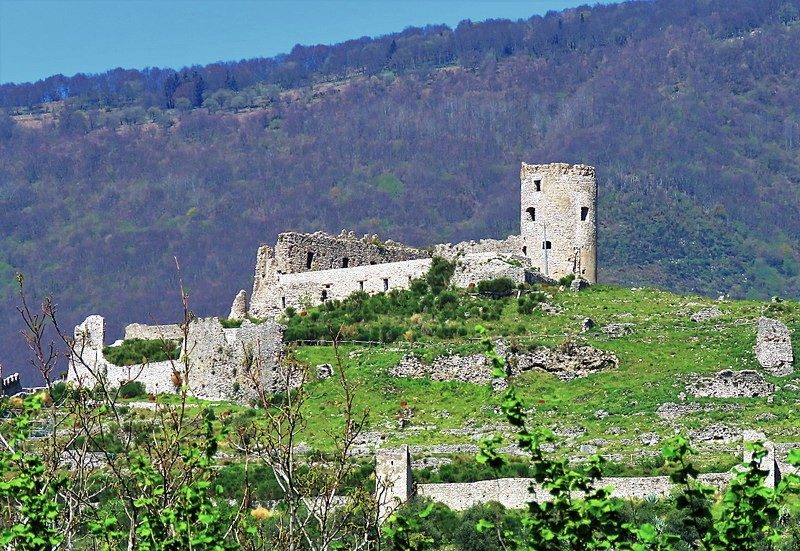
The Castello di Avella, also known as Castello di San Michele, is a ruined castle from the 7th century in Avella in the Italian region of Campania.
Even though the first documented mention of the Castello di Avella dates back to the 9th century, when the building was subjected to various attacks by the Saracens, such as in 883, it was already built in the 7th century by the Lombards and dedicated to the Archangel Michael. The role of the castle on the top of a hill was to control the neighboring border between the Duchy of Naples and the Principality of Capua, as well as the connecting road between the plain of Campania and the Adriatic Sea in Apulia. Furthermore, there are few records of activities around this castle from that period, only those concerning a village protected by a defensive wall. With the conquest of Avella by the Byzantines from Naples around 887, Landolfo, whom 'Guaimario I of Salerno' had entrusted with the command of the castle, was captured. With the arrival of the Normans in the 11th century, the castle was rebuilt by the incorporation of a keep and the addition of a second defensive wall, which also led to the expansion of the settlement. The first feudal lord is attested for the year 1087, namely "Aldoyno, Count of Abelle and one of Abersano's soldiers", who presumably belonged to the Mosca family. This family retained control of the castle throughout the Norman period: Riccardo d'Avella, who was murdered in 1256 during a siege of the castle, and his son, Rainaldo IV d'Avella, who came into close contact with the House of Anjou in Naples, are worth mentioning; the Mosca dynasty died out in 1371 with the death of Francesca. In the 15th century, the castle fell to the Orsinis. During this period, it was devastated by two earthquakes, in 1456 and 1466. The castle fell into disrepair until it was described in 1529 as:
“Forteleza con una terraiunta disabitata; sobre un monte sta el castello, mal tratado dunque antiguamente era bello y grande.“ (Eng.: Fortress with uninhabited territory; on a mountain stands a castle, badly treated, although it was formerly beautiful and large).
This crisis situation did not change until the arrival of the Colonnas in 1534. After several changes of ownership, the castle fell to the Spinellis. Carlo Spinelli had it restored in 1553. The last active phases extended over the period between the end of the 16th and the beginning of the 17th century. The castle housed only a prison and an apartment for the castellan. In 1603 it was described as:
“Vi è (...) sopra un monte dalla parte di occidente lo castello con la cittadella e palazzo (...) nel quale vi è una torre grande con cortiglio. Una sala con otto camere in piano e molta altra comodità. Questa cittadella è murata con dodici altre torrette attorno dette mura per combattere e dentro vi sono da circa cento fochi distrutti e disabitati. Vi è anco la Parrocchia e cisterna grandissima, nella quale al presente vi è acqua freddissima, lo quale castello è fatto con grande artificio con mura altissime e grossissima spesa (...) vi sta lo castellano e vi si ponevano li carcerati di mala vita.“ (Eng.: There is (...) on a mountain on the west side the castle with the citadel and palace (...) in which there is a large tower with a courtyard. A hall with eight rooms on the level and many other amenities. This citadel is walled with twelve other turrets around the said defensive wall for combat and inside there are about one hundred destroyed and uninhabited hearths. There is also the parish and a very large cistern, in which there is currently very cold water, this castle was built with great [craftsmanship] with a very high wall and enormous expense (...) there is a castellan and the prisoners were housed in the underworld.)
The eruption of Vesuvius in 1631 ended the use of the castle, which was partially demolished for the construction of the new town center of Avella further down.
Description+
The castle ruin is located on a hill at an altitude of about 320 meters, to the right of the Clanio river. Of the building, the keep remains, characterized by a cylindrical tower with a truncated cone base and a trapezoidal inner courtyard and two rings of walls. The first ring of walls dates back to the Lombard period and encloses an area of about 10,000 m²; it is characterized by twelve half-towers, five of which have a truncated cone base, four a pyramidal base, and one is integrated into the northern corner of the keep. The second ring of walls, created in Norman times, between the 11th and 12th centuries, and restored in the following century, encloses an area of about 21,000 m² and has nine towers, eight of which have a rectangular plan and one, in the southwest corner, has a pentagonal plan. In this ring of walls there is a gate for wagons. Between the two rings of walls, the remains of the village houses are preserved. The best preserved structure is a cistern. According to Abbot Remondini, the Cippus Abellanus, a stone tablet in Oscan language, which was used as a threshold in the historic center of Avella and which in turn came from reused material in the castle, is said to have originated from the castle.
Legend+
The legend concerning the castle tells of two young people, Cofrao, a Persian prince, and Bersaglia, a peasant girl, who, prevented from their love due to the girl's low birth, fled their homelands and sought refuge in Avella. Well-liked by all, they built a castle. But Bersaglia fell ill and died: The prince was desperate and decided to return home, but a little outside the castle walls he heard the sound of his beloved's lyre and singing. As he turned back, the horse he was riding shied and he fell to the ground. Before he fainted, he saw a cloth with the inscription: "As in life, so we will love each other in death." When Cofrao awoke, he no longer found the castle, but instead a series of graves, one of which was empty. He fell into it and died on the spot. The inhabitants of this place began to plant agave seeds near the castle to commemorate the resentment that had prevented the love of the two young people. The legend says that at night one can still hear the sounds of the lyre and the singing of Bersaglia, and that two shadows creep around among the remains of the castle.
Take Mobile History with you
You are reading this text for free. Premium adds what matters on the road: descriptions read aloud, sites found through your camera, whole regions taken offline.
- Every description, including the ~17,700 Premium sites
- Audio guide: have descriptions read to you on location
- AR finder: see sites through your camera, with distance and bearing
- Unlimited saved sites
14 days free, then from €2.99 a month. Cancel anytime.
Source: Wikipedia · Licence: CC BY-SA 4.0 · Image: Gianfranco Vitolo · Wikimedia Commons · CC BY 2.0
This description is a machine translation of an excerpt from the linked Wikipedia article. The source text was written by its authors, the translation is by Mobile History; like the original it is licensed under CC BY-SA 4.0.
Location: 40.9684, 14.5926