Monastery operations
MonasteryVilshofen an der Donau
Schweiklberg Abbey
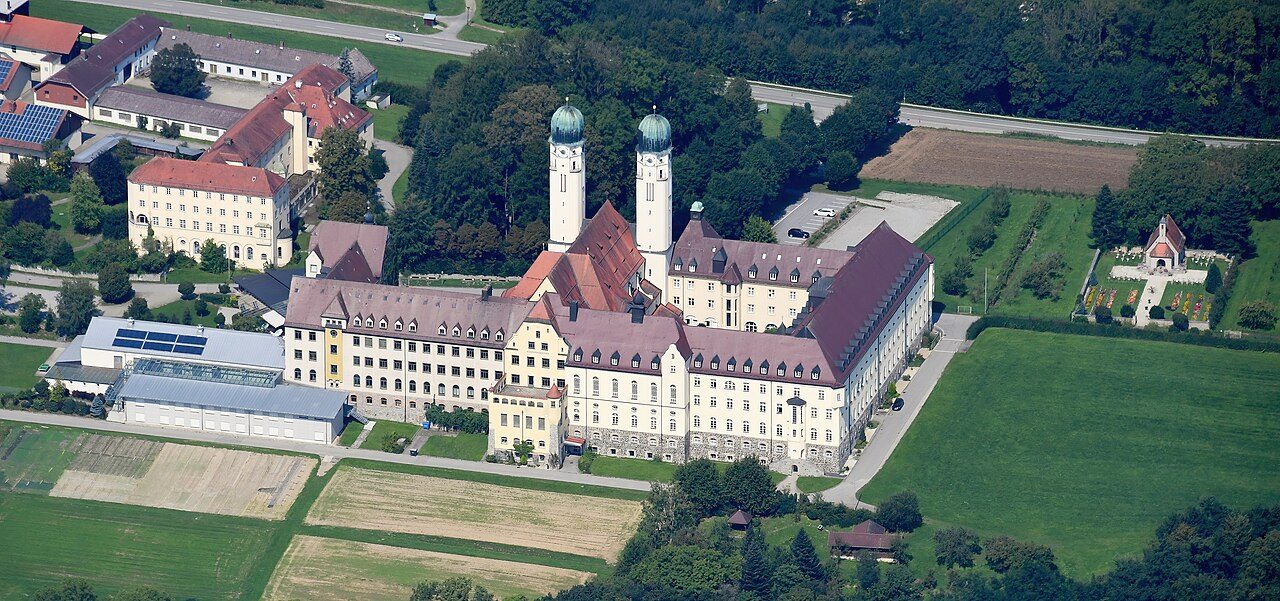
Schweiklberg Abbey is a monastery of the Benedictine Congregation of St. Ottilien in Vilshofen an der Donau (Lower Bavaria). The main mission of the monastery is missionary work.
In 1904, Schweiklberg Monastery was founded by Father Coelestin Maier (1871–1935) from St. Ottilien. The main task of the monastery was and still is the training of missionary Benedictines and the financial support of missionary work. The monastery buildings and the church were built between 1905 and 1925. In 1914, the former Priory of Schweiklberg was elevated to an abbey. At the same time, the founder of the monastery, Coelestin Maier, became the first abbot of the growing monastic community. On April 2, 1941, the abbey was dissolved by the Gestapo and returned to the religious community in 1945 after the collapse of the Third Reich. A monk from Schweiklberg, Father Cyprian Mayr, founded the Secular Institute of St. Boniface in 1949.
Mission+
The Congregation of St. Ottilien is a missionary Benedictine congregation. Since its foundation in 1884 by the Swiss P. Andreas Amrhein, the monks have been active in missions in Africa, South America, and Asia. Many Schweiklberg monks have also been active in missions and still are today, with approximately 10 monks in South Africa, Colombia, Kenya, and Tanzania. Their main task is the founding of monasteries and parishes according to the Benedictine model and the construction of hospitals and schools. The monastery also operates a mission association that primarily supports the mission financially. For this purpose, a mission flea market is held once a month in Schweiklberg, the net proceeds of which are entirely used for the mission. The missionary congregation currently operates approximately 50 monasteries worldwide.
Trinity Church+
History and Architecture+
The abbey church, built between 1909 and 1911 in Art Nouveau style, was consecrated to the Holy Trinity in 1925. The architect of the church was Michael Kurz. After a first redesign of the interior in 1971, the appearance was renewed again in 1998 with a touch of Art Nouveau. The choir area was adorned with African carvings by Benson Ndaka (Kenya), depicting the Stations of the Cross. A crypt is located beneath the choir area. Externally, the church was redesigned in 1982. On the two towers, each 51 meters high, there are eight clock faces, one of which shows the position of the moon and the other the position of the sun.
Organs+
In 2000, the new Klais organ with 87 stops and 5769 pipes was also inaugurated. The main organ of the abbey church has 52 stops on three manuals and pedal. The key actions are mechanical, the stop actions are electric.
Couplers: Normal couplers: II/I, III/I, III/II, I/P, II/P, III/P Superoctave couplers: II/I, II/II, III/I, III/III Suboctave couplers: II/I, II/II, III/I, III/III Accessory stops: Rain, Thunder Playing aids: 1000-fold setter system, programmable crescendo roller The choir organ system was also built by the Klais organ building company. The slider chest instrument dates from 2000 and was installed in two cases (epistle side and gospel side). It has a total of 36 stops on three manual divisions and pedal. The key and stop actions are electric, with the exception of the key actions on the gospel side, which are mechanical.
Couplers: II/I, III/I, III/II, I/P, II/P, III/P
Bells+
The monastery church has a six-bell carillon made of Brilon special bronze from the Albert Junker bell foundry, acquired in 1950. The bells were consecrated on August 20, 1950. The original carillon from 1911 fell victim to armaments production in World War II; three smaller bells cast in Regensburg in 1948 were unsatisfactory.
The Christ the King bell, weighing 4.1 tons, is located in the west tower. The other five bells, with a total weight of 6.6 tons, are in the east tower.
Monastery+
The monastery building, which houses the convent, is connected to the church on the eastern side and is very visible from the city due to the high location of Schweiklberg. It is firmly imprinted on the silhouette of Vilshofen. This building was completely renovated externally and internally between 1999 and 2002. The entire roof and the exterior facades were renewed, and inside, all monk cells were equipped with bathrooms and technically modernized. The monastery houses a library with approximately 150,000 books. During the occupation by the Gestapo, however, many anti-Nazi and Jewish books were sorted out. The monastery also has its own infirmary, where old and sick monks are cared for. On the ground floor, in addition to the refectory, the cloister around the two courtyards, the sacristy, the gate, the administration, and the premises of the mission association, there is also a choir chapel where the monks pray daily.
Convent+
Before World War II, the monastery experienced its heyday with 155 monks. Although 35 monks died in this war, the monastery experienced another flourishing period in the 1960s with over 130 members. In 2019, 21 monks lived there.
Abbots+
1914–1935 Cölestin Maier (1871–1935) 1935–1941 Thomas Aquinas Graf 1941–1967 Willibald Margraf 1967–1982 Anselm Schulz (1931–2012) 1982–2007 Christian Schütz (* 1938) 2007–2017 Rhabanus Petri (* 1963) 2017–2019 P. Benedikt Schneider as Prior-Administrator Since December 16, 2019 P. Richard Multerer (* 1940) as Prior-Administrator
School+
One of the first institutions established by founding abbot Coelestin Maier was the school and boarding school. However, the boarding school attached to the Gymnasium was dissolved in the 1990s. Since 1999, a six-grade Realschule (secondary modern school) was established, and at the same time, the Gymnasium, which only went up to the tenth grade, was dissolved. In 2004, the last Gymnasium students left the school, and already in 2005, the first Realschule students in Schweiklberg completed their Realschule diploma. Between 2003 and 2004, the entire old building was completely renovated and brought up to the latest technical standards. In the course of the renovation measures, a completely new building was also added to the school building in 2002, which now houses a spacious break hall and the science classrooms. Gerhard Pichler has been the director of the boys' Realschule since January 1, 2026. The school, which was attended by approximately 350 students in the 2024/25 school year, offers tutoring, a brass band class, a football class, an open all-day school, and special sports promotion.
Bergfried+
The property is already mentioned in documents in the 16th century as "Meierhof beim Oberhaus" (farmstead at the Oberhaus) and belonged to the respective Bishop of Passau. The property, demonstrably called Landrichterhof (district judge's court) since 1707, served as an economic farm for the Oberhaus. After the Prince-Bishop of Passau separated from this farm in 1784, the owners changed frequently, especially in the 19th century. One of them, engineer Müller, opened a so-called "Stahlbad" (steel bath) on the Landrichterhof in 1901 and named it "Bergfried". It continued to exist after Müller's death in 1907, but its operation was discontinued in connection with the outbreak of the First World War. In January 1918, Schweiklberg Abbey, under Abbot Coelestin Maier, bought the former Bergfried steel bath to accommodate its pupils who attended the last classes of the local humanistic Gymnasium in Passau. Bergfried served this purpose until 1986. Afterwards, it was run as a student dormitory. In 1996, the house changed from a study college to a house of silence and contemplation. In this way, the abbey – in accordance with its missionary mandate – enabled individual guests and groups to find silence and prayer. In November 2006, the Christkönigshaus Bergfried, as it had been called since 1996, had to close its doors due to a lack of staff.
Schweiklberger Geist+
Schweiklberger Geist is a herbal distillate that is now known far beyond the borders of Schweiklberg. Approximately 50,000–60,000 bottles are produced annually in the monastery's own distillery and shipped worldwide. The secret recipe was acquired in the early days of the monastery by founding abbot Coelestin Maier.
Africa Museum+
The Abbey's Africa Museum (also: Black Africa Museum) publicly displays a variety of exhibits of traditional African art and ethnology. These come from returning missionaries, donations, and acquisitions from private collections. A total of over 800 objects from various African tribes are presented in the standing and display cases.
Take Mobile History with you
You are reading this text for free. Premium adds what matters on the road: descriptions read aloud, sites found through your camera, whole regions taken offline.
- Every description, including the ~17,700 Premium sites
- Audio guide: have descriptions read to you on location
- AR finder: see sites through your camera, with distance and bearing
- Unlimited saved sites
14 days free, then from €2.99 a month. Cancel anytime.
Source: Wikipedia · Licence: CC BY-SA 4.0 · Image: Carsten Steger / CC BY-SA 4.0 via Wikimedia Commons
This description is a machine translation of an excerpt from the linked Wikipedia article. The source text was written by its authors, the translation is by Mobile History; like the original it is licensed under CC BY-SA 4.0.
Location: 48.6294, 13.1757