The remains of the ancient town can be visited
Ancient BuildingNin
Aenona (Nin) Ancient Settlement
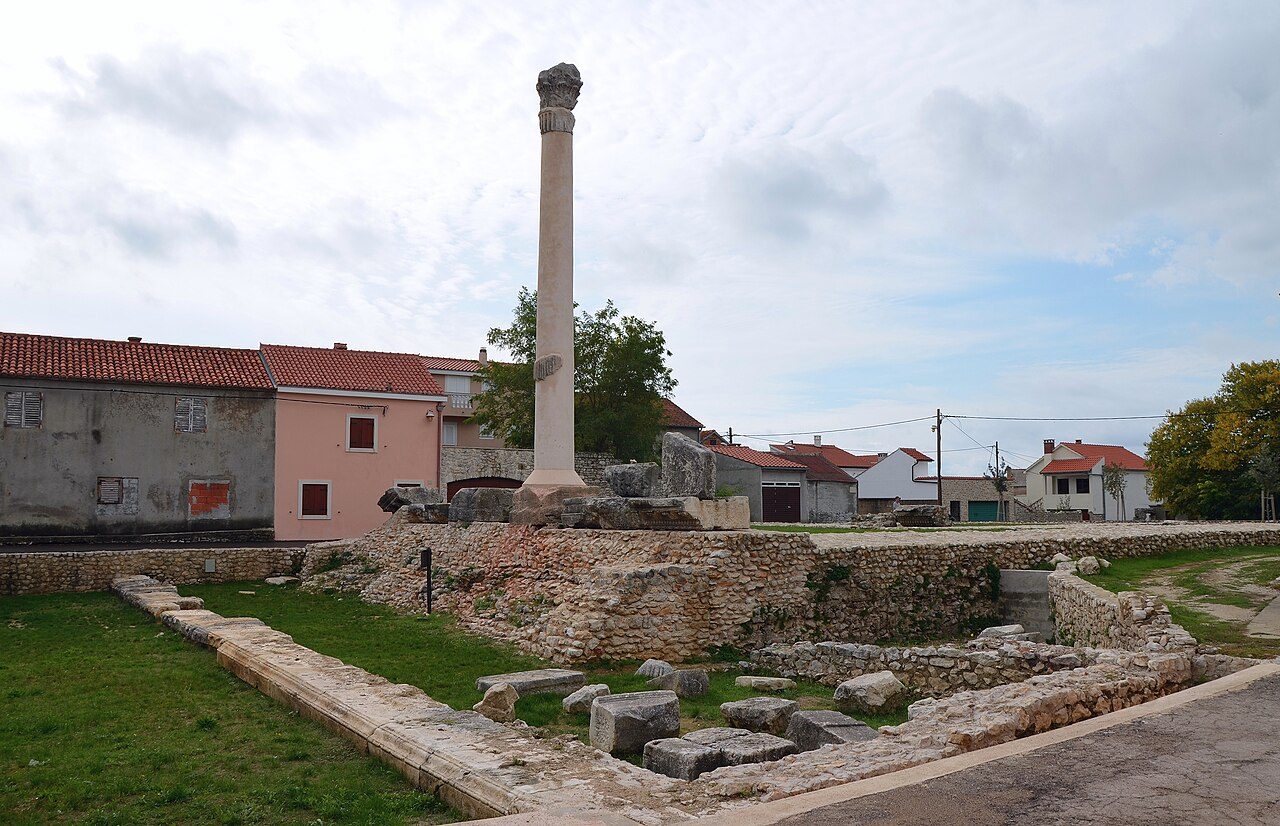
Aenona is the ancient settlement at the site of modern-day Nin on a small island in the shallow lagoon of Nin Bay. The Liburnians, an Illyrian tribe, founded the place in the 9th century BC as an important maritime and trade center on the eastern Adriatic. The name appears in Greek sources as Ainon or Emionoi and is handed down in Roman as Aenona or Enona; from this later developed the Croatian name Nin. Under Roman rule, Aenona became a municipium and was urbanized, with an orthogonal street network, forum, aqueduct, and port facilities. Remains of the forum and the large temple (probably dedicated to Diana or the imperial cult, second half of the 1st century AD, dimensions approximately 45 × 21.5 m, one of the largest on the eastern Adriatic), statues of emperors of the Julio-Claudian dynasty, as well as finds from necropolises of the Liburnian Iron Age and the Roman period (1st–3rd century) have been preserved. The city walls partly rest on older Liburnian foundations and were later built over in the Middle Ages.
The settlement continuity extends into the early Middle Ages, when Nin became an early Croatian center and bishopric. The ancient remains are protected as archaeological heritage and are freely visible in the city area or presented in the Museum Ninskih starina and the Archaeological Museum Zadar.
Take Mobile History with you
You are reading this text for free. Premium adds what matters on the road: descriptions read aloud, sites found through your camera, whole regions taken offline.
- Every description, including the ~17,700 Premium sites
- Audio guide: have descriptions read to you on location
- AR finder: see sites through your camera, with distance and bearing
- Unlimited saved sites
14 days free, then from €2.99 a month. Cancel anytime.
Image: Carole Raddato from FRANKFURT, Germany / CC BY-SA 2.0 via Wikimedia Commons
Location: 44.2428, 15.1844