CastleWittstock/Dosse

Wittstock Castle

Wittstock Castle

Museum

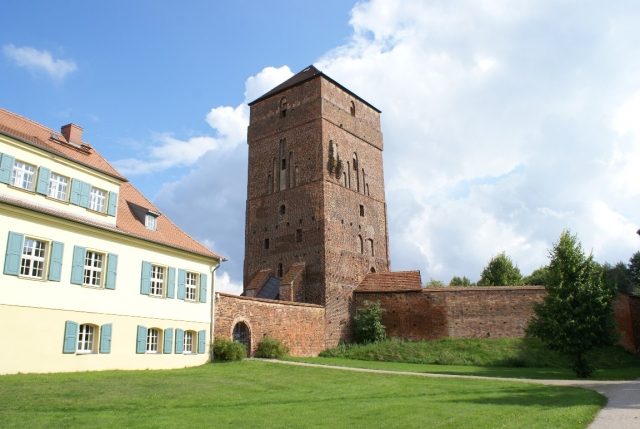
The Alte Bischofsburg (Old Bishop's Castle) is a castle in Wittstock/Dosse in the district of Ostprignitz-Ruppin in Brandenburg.

The history of the castle is closely linked to the history of Wittstock/Dosse. Wittstock/Dosse originated from a Slavic settlement before the year 946. Construction of the castle began in 1244. In 1248, Wittstock received its town charter. The over thousand-year-old city in Ostprignitz was particularly shaped by the Bishops of Havelberg, who lived there from 1271 to 1548 and expanded the castle into their residence.

Until the Thirty Years' War (1618 to 1648), the castle was impregnable. In the late Middle Ages and especially during the Thirty Years' War, the castle began to decay.

The Thirty Years' War+

The Thirty Years' War was a religious war and at the same time a classic state conflict. In the Battle of Wittstock at Scharfenberg on October 4, 1636, the Swedes defeated the imperial troops and Saxony. The population of Wittstock had to endure great sacrifices as a direct consequence of the war. In 1638, Wittstock was also struck by the plague, which was then called "The Black Death". Over 1500 people died, more than half of Wittstock's population.

Current Use

From 1995 to 1998, the castle complex was restored, reconstructed, and redesigned as part of a European funding project. Today, the Alte Bischofsburg houses the Ostprignitzmuseum and the Museum of the Thirty Years' War. In addition to the history, landscape, and the city of Wittstock/Dosse, the Ostprignitzmuseum also focuses on crafts and the way of life in the region. The Museum of the Thirty Years' War was opened in 1998 and is unique in all of Germany. As an anti-war museum, it depicts not only the causes of the war but also the suffering of the soldiers and, above all, the civilian population. Furthermore, a historical classroom from "Old Times" can be rented by school classes for teaching lessons.

Layout+

The castle was part of an imposing city wall system. The over 2.5-kilometer-long brick wall still encloses almost all of Wittstock today. It offered citizens protection from the Slavs, whose territory began immediately behind the city wall. Originally, the wall was nine to eleven meters high; today it is only four to seven meters. At that time, the Bishop's Castle was considered one of the most beautiful and strongest castles in the Mark Brandenburg. Only the gate tower from the 13th century, with its eventful history as an official residence, cattle stable, grain storage, and youth hostel, ultimately remained as part of the Ostprignitzmuseum.

Take Mobile History with you

You are reading this text for free. Premium adds what matters on the road: descriptions read aloud, sites found through your camera, whole regions taken offline.

  • Every description, including the ~17,700 Premium sites
  • Audio guide: have descriptions read to you on location
  • AR finder: see sites through your camera, with distance and bearing
  • Unlimited saved sites

14 days free, then from €2.99 a month. Cancel anytime.

Source: Wikipedia · Licence: CC BY-SA 4.0 · Image: Roland Neubert, Halle (Saale)

This description draws on the facts documented in the linked Wikipedia article; Wikipedia content is licensed under CC BY-SA 4.0. Wording and editing: Mobile History.

Location: 53.1591, 12.4859