CastleNeustadt-Glewe

Neustadt-Glewe Castle
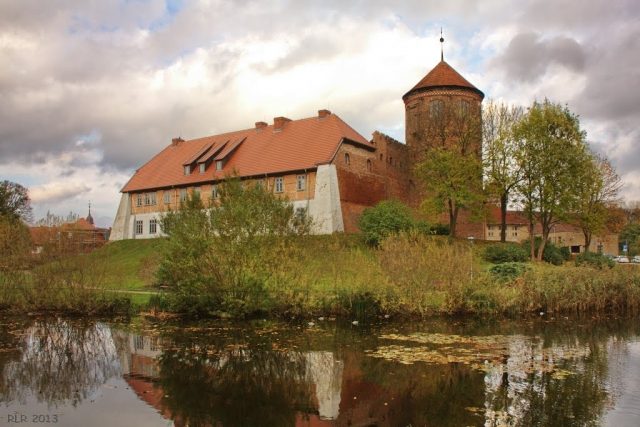
Neustadt-Glewe Castle

Museum
Cafe

The Alte Burg (Old Castle) is the oldest surviving fortified castle and at the same time one of the best-preserved castles in Mecklenburg and a landmark of the city of Neustadt-Glewe. It is also believed to be the oldest existing building in the city.

The Alte Burg is located in the southwest of Mecklenburg near the city center of Neustadt-Glewe on the southern edge of the Lewitz. At the foot of the edifice flows a right tributary of the Elde, where the hydroelectric power plant and a boat landing are also located. To the northwest of the castle grounds lies the Kiez district.

The first parts of the castle were built at the instigation of the Count of Schwerin in the middle of the 13th century on a natural Elde dune. Excavations found no connection to use by earlier Slavic settlers. The first documented mention of the building dates from 1331. The purpose of the castle was the military protection of the southern and southeastern border of the County of Schwerin. Border disputes and conflicting secular and ecclesiastical interests between the County, the County of Dannenberg, and the bishoprics of Havelberg and Ratzeburg were commonplace, some of which were settled in armed conflicts.
Since 1358, the Alte Burg, which was rebuilt and extended several times over the centuries, served as a bailiwick, and until the 18th century as a secondary residence of the Mecklenburg dukes. In 1882, the Neustadt Technical College was founded at the castle, and teaching took place within its walls until 1920. Until 1954, the "New House" served as a stallion depot for the Redefin stud farm. During GDR times, the castle housed a youth hostel and apartments. From 1994 to 1998, renovation work took place, during which excavations provided further insights into the origin and construction phases.

Today, a museum offers insights into the castle's history.

Layout+

Floor Plan and Structure

The Alte Burg is a perimeter house castle. The basic shape, typical for German castles, is rectangular and measures approximately 50 x 35 meters. The castle complex consists of the Old House, the New House, the curtain wall with gates and battlements, and the keep.

The gatehouse, a drawbridge, the castle chapel, the stables, and the castle forge are no longer preserved. Of a side arm of the Elde, which surrounded the castle as a moat, only a pond on the southwest side remains.

Keep

The 28-meter-high castle tower was built at the beginning of the 15th century on the foundations of a square structure from an earlier settlement phase. After initial modifications in the 16th century, the tower comprised three stories in 1576 and had a conical spire, around which a walkway and a defensive wall were arranged. In the 16th or 17th century, the current upper floor was added. The seven large arched windows testify that this floor, used for residential purposes, equipped with a fireplace and stone side benches, and now called the Knight's Hall, no longer fulfilled any defensive function.

The deepest room of the circular edifice, the dungeon, is only accessible via a floor hatch from the former guardroom above it. The latter also contains two small rooms that may have served as prison cells. The upper floors were once only accessible via the battlements of the wall. A staircase was only added later. On the second upper floor, which is at the height of the battlement of the castle wall, was the former defensive room with seven niches and two rows of firing openings, through which both close-range defense and long-range shots were possible. For personal needs, the latrine bay windows preserved on both upper floors were used. From the west side, in the direction of the main gate, the tower clock with bell can be seen in a gable dormer of the keep's roof.

Old House

The Old House was the residence of the castle bailiffs and servants. It contained a brewery and bakery, a kitchen, a wool room, storage rooms, and a malt floor. When the castle no longer served defensive purposes, windows were subsequently installed on the outside. In the past, the building was the domicile of the technical college, a residential building, school, warehouse, and youth hostel.

During construction work in January 2002, the Old House collapsed; reconstruction took place from 2005 to 2006.

New House

The New House is first mentioned in 1576. Inventories from 1592 and 1714 are available. The first report speaks of wooden floors, bricks or rammed earth, walls equipped with seating, open fireplaces, hot air ducts, which were uncovered in 1998, and "Windelböden," a ceiling plastered with clay between the ceiling beams. The furnishings included bedsteads, tables, and chests. In 1714, the inventory reveals higher demands. The Duke's "Logiment" was lined with high-gloss silk fabric, and the dining hall had woolen wallpaper. The Duchess's antechamber was clad in gold leather.

In 1612, the building was structurally divided into an antechamber and court rooms. Until the completion of the New Palace at the beginning of the 18th century, the New House served as accommodation for the dukes when the court was in Neustadt; later it was used as stables, storage, shed, and barn. Until 1954, it housed a stallion depot of the Redefin stud farm.

Today, the building houses a multi-purpose room and cafe, and the castle museum is located on the upper floor.

Regular Events+

Every year, on a weekend in June, the Castle Festival takes place with a medieval market, knight tournament, show fights, and the appearance of the "Castle Nobility." The Easter Festival and the Fairy Tale Castle in December also have a historical theme.

Take Mobile History with you

You are reading this text for free. Premium adds what matters on the road: descriptions read aloud, sites found through your camera, whole regions taken offline.

  • Every description, including the ~17,700 Premium sites
  • Audio guide: have descriptions read to you on location
  • AR finder: see sites through your camera, with distance and bearing
  • Unlimited saved sites

14 days free, then from €2.99 a month. Cancel anytime.

Source: Wikipedia · Licence: CC BY-SA 4.0 · Image: Rainer Gindele

This description draws on the facts documented in the linked Wikipedia article; Wikipedia content is licensed under CC BY-SA 4.0. Wording and editing: Mobile History.

Location: 53.3817, 11.5858