Museum
CastleBamberg
Alte Hofhaltung Bamberg
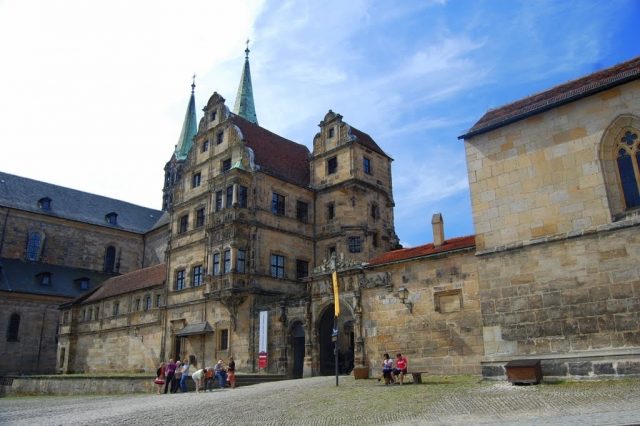
The Alte Hofhaltung is a historic building complex in Bamberg. It consists of former residential and economic buildings of the episcopal court, which were built from the 15th century on the site of the palace of Emperor Henry II. Previously, there was a castle of the Babenbergs on the Bamberg Cathedral Hill, the Castrum Babenberg. In 1003, this became the palace of the Duke of Bavaria and later Holy Roman Emperor Henry II. After the founding of the Diocese of Bamberg, it became the bishop's residence of the Bamberg bishops in 1007. After the buildings on the Cathedral Hill were completed, the Alte Hofhaltung, which still contains remnants of the palace and chapel from the 11th century at its core, stood between the cathedral in the south and the New Residence in the north. After the prince-bishop moved to a new palace, the buildings were used as chancery, library, and council chamber. Today, the Historical Museum of the city is housed there, and the cathedral workshop is located in the Henneberg wing. In summer, the Calderon Festival takes place in the courtyard. From 1865 to 1936, the Erthal Monument in honor of Prince-Bishop Franz Ludwig von Erthal (1730–1795) stood in front of the Alte Hofhaltung.
History+
After the death of Adalbert of Babenberg from the House of Popponen, his fiefs became the property of the crown and remained there until the year 973. In that year, they were granted as a fief to Duke Henry the Quarrelsome. During the time as crown property, the Castrum was also used as a state prison. Here, the deposed King of Italy and Margrave of Ivrea Berengar II and his wife were imprisoned. From the time of Emperor Henry II, the consecration inscription of the Thomas Chapel has been preserved. It reveals that in the year 1020 Pope Benedict VIII consecrated this chapel in honor of Mary and St. Thomas. The no longer existing St. Andrew's Chapel also dated from the 11th century. According to legend, Empress Cunigunde submitted to the ordeal of God here by walking over glowing plowshares. For the results of the excavations, see Cathedral Hill (Bamberg). In the 16th century, Henry II's palace was demolished; some window arches inside the Renaissance wing have been preserved.
15th Century+
Under Prince-Bishop Philipp von Henneberg (1475–1487), the southeastern and eastern wings were built. The coat of arms of Henneberg is located above the rear entrance gate. Remarkable are the painted eaves boards under the gutters. Under the reign of his successor Prince-Bishop Heinrich III Groß von Trockau (1487–1501), a fire destroyed the kitchen wing of the court. As a result, this part was rebuilt during Heinrich III's reign. Above the entrance gate on the north side is one of the most beautiful preserved coats of arms in Bamberg.
16th Century+
Under the reign of Prince-Bishop Veit II von Würtzburg (1561–1577), parts of the palace from the time of Emperor Henry II were demolished or integrated into the Renaissance wing. The building was constructed from 1570 under the direction of Erasmus Braun, who immortalized himself below the bay window. Below the windows on the bay window, coats of arms of noble families are carved. The facade of the Renaissance building was originally painted in color. As a representative entrance, sculptor Pankraz Wagner created the "Beautiful Gate" in 1573. The relief of Mary is flanked by Henry and Cunigunde, who hold a model of the cathedral behind the Virgin Mary. It shows the cathedral in detail as it looked until 1764. Further out, on the left is Saint Peter and on the right Saint George, and next to them two bishops, Saint Otto and probably Kilian, the "Apostle of the Franks." The reclining figures on both sides symbolize the Main and Regnitz, the two rivers of the city. On this relief, the Würzburg coat of arms crowns the entrance portal inserted between the Renaissance wing and the "Hohe Warte."
18th Century+
In 1777, the court was significantly altered by the demolition of the buildings dividing the courtyard, especially the nave of the Thomas Chapel, the partial demolition of the Hohe Warte, and the demolition of the octagonal St. Andrew's Chapel at the beginning of Domgasse. Today, one enters Domgasse through the former interior of the demolished St. Andrew's Chapel.
Source: Wikipedia · Licence: CC BY-SA 4.0 · Image: Maciek Wegrzyn
This description is a machine translation of an excerpt from the linked Wikipedia article. The source text was written by its authors, the translation is by Mobile History; like the original it is licensed under CC BY-SA 4.0.
Location: 49.8911, 10.8814