The Castle can be visited
CastleBamberg
Altenburg Castle
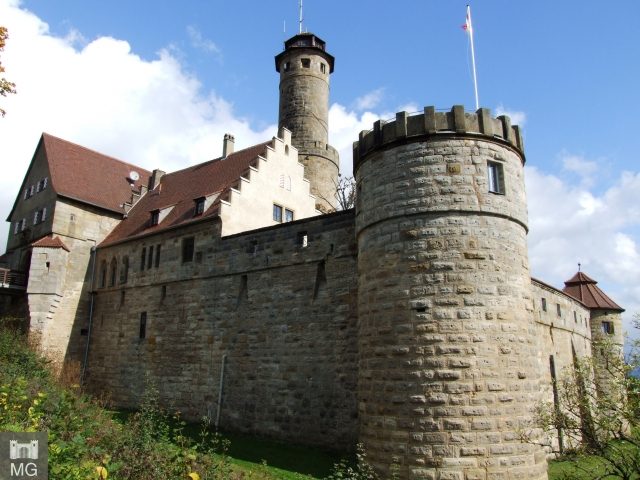
The Altenburg is a medieval hilltop castle in the west of the independent city of Bamberg in the Bavarian administrative district of Upper Franconia. Its tower, at an altitude of about 400 m above sea level, offers a magnificent view of the city and the surrounding Franconian countryside.
History+
The Altenburg was first mentioned in a document in 1109, in which Bishop Otto of Bamberg transferred the castle complex to the collegiate church of St. Jakob. From 1305 to 1553, the castle was the second residence of the Prince-Bishops of Bamberg. The castle reached its current dimensions in the early 15th century. During the Peasants' War in 1524/1525, the Altenburg was besieged, but neither captured nor are serious destructions recorded. In the Second Margrave War of 1553, the castle was not taken by storm, but was abandoned to destruction after its surrender to the army of Margrave Albrecht Alcibiades of Brandenburg-Kulmbach. A landslide destroyed parts of the eastern wall in the last quarter of the 18th century. These walls were only rebuilt in exposed concrete at the beginning of the 21st century. In 1801, the castle, with the exception of the fortifications, was sold by the Prince-Bishopric of Bamberg to Adalbert Friedrich Marcus. This Bamberg doctor furnished the still-standing gatehouse as a residence. E. T. A. Hoffmann, who was friends with Marcus, was so attracted to the castle that he temporarily sought recreation in one of the wall towers. After Marcus's death, this property also became part of the bankruptcy estate. Postmaster Anton von Grafenstein auf Krummennaab initiated the founding of the Altenburg Preservation Society, the first monument protection society in Bavaria, in 1818. Since another part of the eastern wall was in danger of collapsing at the beginning of the 20th century, it was demolished and rebuilt set back. The original rectangular layout is no longer present.
Keep+
The round keep in its characteristic "butter churn shape" is the landmark of the castle and can be seen in all historical city views of Bamberg. Its core was built around 1400 to 1414. Prince-Bishop Friedrich Karl von Schönborn had the uppermost floor added in 1743 by master builder Johann Jakob Michael Küchel; it bears the Schönborn coat of arms created by Leonhard Gollwitzer on the north side. The current Welsche Haube (Welsh cap) was added in 1902. The stone stair tower was renewed in 1864/65 in the form of its predecessor from 1579/80.
Iron Basket+
An iron basket, the so-called fire basket, hangs on the castle tower and is said to have served as a signal transmitter with the Giechburg near Scheßlitz. A very similar basket on a cantilever arm on the keep can already be seen in an engraving after Friedrich Bernhard Werner (around 1730); the assumption that the basket was only an addition to the reconstruction around 1900 is therefore not true, at least for the basic form. A written source for the original function is not known; nor is its use for the festive lighting of the Altenburg festival in 1897 documented in contemporary reports.
Palas+
The current palas was built in 1901/02 on the still partially preserved cellars of the original residential building with financial support from shoe manufacturer Heinrich Manz. The architect of this romanticizing building was Gustav Haeberle. The original interior is preserved in the Knights' Hall. The mural of a knightly tournament on the west side was created by Wilhelm Reutter. One of the riders bears the features of the then second mayor of Bamberg, Josef Valentin Herd.
Castle Chapel+
A castle chapel was consecrated in 1124 by Bishop Otto I in honor of Saints Walburga, Philippus, and Jacobus. The location of this chapel is unknown. Successor chapels were destroyed during the plundering by Margrave Albrecht Alcibiades of Brandenburg-Kulmbach in 1553. Since 1617, church services on the castle plateau have been documented. For this purpose, a linen chapel was erected annually. In 1755, the still-standing crucifixion group was created by Georg Adam Reuß, and the church services held there continue the tradition of 1124 according to canon law. A new endowment for the church service on May 1st was donated by the Grafenstein siblings in 1824.
The current chapel, with its entrance in the gatehouse, was established in 1834/35 in an existing room with a late Gothic vault (around 1450). The architect for the entire complex was Bernhard Solger, a student of Karl Alexander Heideloff and Friedrich von Gärtner, later an influential city architect in Nuremberg. The renovation of the room into a Gothic vaulted space was supervised by the royal building inspector Friedrich Panzer. The altar, whose tympanum was originally intended for the entrance of the church of Tiefenpölz, was created by the sculptor Adam Joseph Schäfer based on a design by Heideloff. The room has an old vault that was extended to the south around the choir. The keystone of this vault shows the city knight from the Bamberg city coat of arms. Gravestones from secularized churches in Bamberg found a place in the chapel. The chapel was consecrated one year after the first mass on May 1st, 1836, by Franz Seraph Freiherr von Lerchenfeld.
The original stained glass paintings were removed in the 1960s and are in the depots of the Historical Museum.
Well+
The castle well was located in a square well house, which was demolished in 1893. At that time, the Altenburg Society had the still-existing well structure with a small roof and grating erected by the architect Gustav Haeberle. The shaft is about 30 meters deep. The usable stones from the demolition of the well house were used to modify the northwest corner tower.
The Hermitages+
E.T.A.-Hoffmann-Hermitage
The hermitage is named after E.T.A. Hoffmann, who lived in Bamberg from 1808 to 1813. He is one of Bamberg's literary figures. He often resided in the hermitage and adorned the interior walls with caricatures of Bamberg personalities.
Amalien-Hermitage
Named after Amalie of Oldenburg, Queen of Greece, who lived in exile with her husband Otto I in Bamberg until their deaths.
Sculptures+
The tomb of Adalbert von Babenberg from the House of Poppo, presumably made in 1727, came to the Altenburg after the dissolution of the Theres monastery. During the last restoration (approx. 1980), the sculptor Leitherer discovered older parts within the sculpture. The tomb of Heinz Fuchs von Bimbach († June 15, 1539) comes from the St. Anna Church of the Franciscan monastery in Bamberg. The tomb of Wolf Christoph von Streitberg († March 29, 1560) bears the year "1562" and "KS", the monogram of the sculptor Kilian Sorg. It also comes from the St. Anna Church and, like the Fuchs tomb, came to the chapel via its first storage location in the cathedral cloister. The tomb of Martin von Redwitz († April 27, 1505) from the St. Christoph Church of the Dominican monastery was probably made by the workshop of Tilman Riemenschneider. The tomb of Georg von Schaumberg auf Lauterburg († January 5, 1527) from the Dominican Church was made during his lifetime in 1520 by the sculptor Johann Daucher. However, Georg von Schaumberg is buried in the Moritzkirche in Coburg. Two lions holding coats of arms at the gatehouse come from a house on Grüner Markt, which was rebuilt around 1880 and its facade altered. Above the entrance to the restaurant is a 15th-century crucifixion relief, whose origin is unknown. At the Amalienklause, the remains of a coat of arms of the von Werdenstein family from Aufseßgasse, originally about one third larger, can be seen. It shows, in addition to the main shield, agnate coats of arms on both sides. It is completely depicted in Johann Sebastian Schramm's Aurifodina Bambergensis. To the left above this Werdenstein coat of arms is a smaller family coat of arms, and to the right of it is the Prince-Bishopric's coat of arms; their origin is unknown. The remains of the tomb of Leypold Truchseß von Wetzhausen auf Dachsbach († November 19, 1516) at the E.-T.-A.-Hoffmann-Klause are attributed to the Master of the Order of the Swan Knight, Jörg Armpauer. The origin of the crown at the E.-T.-A.-Hoffmann-Klause, probably the remnant of a coat of arms, is unknown. On the east side is a reclining lion. Two lions of the same kind are in private ownership, another is attached to an archway between Martinskirche and Martinsapotheke. These four lions were originally in Obere Königstraße.
Source: Wikipedia · Licence: CC BY-SA 4.0 · Image: Mobile Geschichte
This description is a machine translation of an excerpt from the linked Wikipedia article. The source text was written by its authors, the translation is by Mobile History; like the original it is licensed under CC BY-SA 4.0.
Location: 49.8806, 10.8692