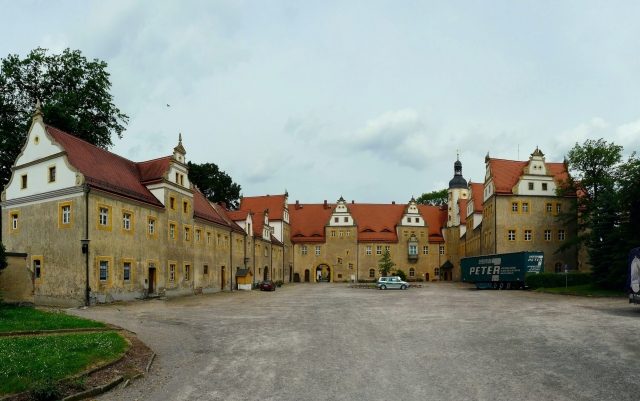
CastleWermsdorf

Wermsdorf Castle

Wermsdorf Castle

Municipal offices

In the heart of Wermsdorf, surrounded by mighty old trees, stands the Old Hunting Lodge. The castle never played as significant a role in history as Hubertusburg Hunting Lodge, just a few steps away. Its interior and representation were also rather modest. But without this Old Hunting Lodge, Hubertusburg would probably never have existed.

Since 1565, the development of Wermsdorf has been closely linked to the Saxon ruling house of the Wettins. They recognized early on that the local area was excellently suited for extensive hunts. Inspired by the abundance of game in the Wermsdorf forests, Elector Christian II had a two-story hunting lodge built between 1608-10 on the site of an old knight's estate. As it was very simple, the Elector initially rejected it. From 1617-26, under Elector Johann Georg I, the master builder Simon Hoffmann then transformed the castle in the style of the German Renaissance. He added the east wing and the originally shorter west wing to the north wing. The half-timbered upper floor of the north wing was removed and rebuilt in solid construction. This created a stately three-wing complex that initially met the high demands of the court.

In the turmoil of the Thirty Years' War, the building temporarily lost its function. Only Elector Johann Georg III used it again as a hunting lodge. August the Strong later had the castle further expanded. From 1696-1716, Wermsdorf Castle was the seat of the Governor of Saxony, Prince Egon von Fürstenberg. After the construction of Hubertusburg, however, the Old Hunting Lodge increasingly lost its importance and served only as a guesthouse and accommodation for servants.

In 1873, after the castle had served as the seat of various administrations for almost 200 years, King Albert of Saxony took it over and rebuilt it as a hunting quarter. The rooms were decorated with paintings and hunting trophies, and a magnificently carved wooden ceiling was installed in the dining room. In 1918, the entire furnishings were moved to Moritzburg or auctioned off. The rooms were mostly converted into apartments. Today, the building houses the municipal administration and a riding stable.

The three-winged Renaissance building stands out with its two-story dormer windows with volute gables, a bay window with elaborate sandstone work, and the stair tower with a Welsch cap and lantern.

The castle courtyard with its large lime tree annually hosts a traditional "Renaissance Festival" on a September weekend.

Take Mobile History with you

You are reading this text for free. Premium adds what matters on the road: descriptions read aloud, sites found through your camera, whole regions taken offline.

  • Every description, including the ~17,700 Premium sites
  • Audio guide: have descriptions read to you on location
  • AR finder: see sites through your camera, with distance and bearing
  • Unlimited saved sites

14 days free, then from €2.99 a month. Cancel anytime.

Source: Wikipedia · Licence: CC BY-SA 4.0 · Image: Thomas Eichler

This description draws on the facts documented in the linked Wikipedia article; Wikipedia content is licensed under CC BY-SA 4.0. Wording and editing: Mobile History.

Location: 51.2825, 12.9398