ResidenceBerlin-Mitte

Old Palace Berlin
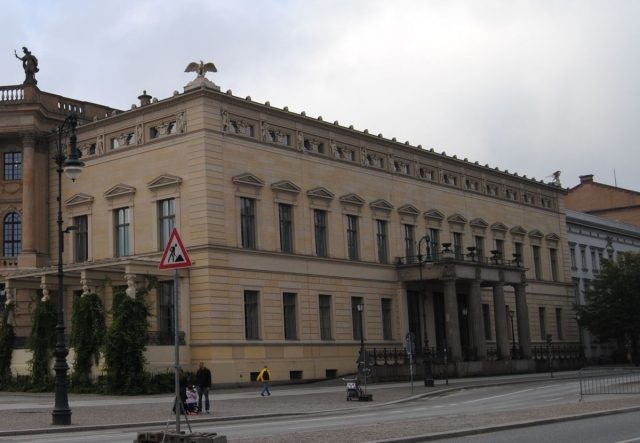
Old Palace Berlin

Humboldt University

The Old Palace in Berlin at Unter den Linden number 9 was the capital residence of the Prussian King and German Emperor Wilhelm I and today serves Humboldt University of Berlin as part of the Faculty of Law.

Previously, the site of the Old Palace was occupied by the townhouse of Colonel von Weiler, head of the Brandenburg Artillery, built between 1688 and 1692. His son sold it to Margrave Philipp Wilhelm of Brandenburg-Schwedt. His descendant, Margrave Friedrich Wilhelm, had it converted into a baroque palace by Christian Ludwig Hildebrandt. When Frederick II resumed work on his programmatic Forum Fridericianum in 1774, the palace's garden and rear buildings had to make way for the new library building. In 1817, Count Tauentzien, as head of the III Army Corps, acquired the house to use it as his residence and official seat. Prince Wilhelm became his successor in 1825 but only moved into the palace after his marriage to Augusta of Saxe-Weimar-Eisenach in 1829.

Meanwhile, the Prussian Crown Prince Friedrich Wilhelm planned a redesign of the Forum into a memorial complex for Frederick the Great. For this purpose, his favorite architect Karl Friedrich Schinkel intended to demolish the library and the Margravial Palace to erect an extensive two-towered palace for Prince Wilhelm. However, Wilhelm disagreed with the plan due to cost reasons and what he considered the disrespectful demolition of the library. He preferred a much more modest design by the Breslau architect Carl Ferdinand Langhans. Langhans solved the task set by Wilhelm, to erect a representative city palace on the limited plot, with the willing support of Schinkel, in a generally recognized, elegant manner.

The Palace until its Destruction+

Langhans erected the building between 1834 and 1837 in the Neoclassical style. It has 13 window axes facing the street with a covered portico-like driveway, is two stories high, and has a mezzanine floor, adorned with a continuous terracotta frieze featuring 18 figures and 16 coats of arms. Eagles soar at the corners. Towards Opernplatz, it received a green pergola. In the lower floor of the left part of the building, facing the street and a green inner courtyard, were Wilhelm's living and working rooms, and on the upper floor, Augusta's, connected by an intimate spiral staircase. In the central part were the vestibule, the representative staircase, and social rooms upstairs. In the right part, which extended as a much longer side wing along Oranische Gasse to Behrenstraße, were festive rooms, including the large circular ballroom. Towards Behrenstraße, around a second inner courtyard, were service and living quarters for staff, horse stables, and a coach house. In daily operation, the entrance on the narrow Oranische Gasse served as the main entrance and driveway.

For fifty years, in the months between the end of the autumn maneuvers in October and the spring parades in March, the palace was the residence and official seat of Wilhelm, who rose to Prince of Prussia in 1840, Regent in 1858, King of Prussia in 1861, and German Emperor in 1871. During the days of the March Revolution of 1848, when popular anger had driven Wilhelm out of Berlin, it escaped looting and devastation because well-wishers declared it national property. In the late 1850s, it became one of the most important venues of political life in the Prussian state, culminating in the unification of the empire in 1871. At the same time, it was the place where Wilhelm fulfilled his obligations as head of the Hohenzollern family and a member of the European high nobility. Every Thursday, Augusta filled the rooms with a company of renowned artists and scholars. Heinrich Strack re-equipped the building in 1854 to meet increased representational demands. In 1882, Wilhelm acquired the Dutch Palace as a guesthouse and connected both buildings with a glazed passage over Oranische Gasse.

The palace became one of Berlin's most significant sights. Wilhelm always appeared at the corner window of his study to observe the grand changing of the guard at the New Guardhouse diagonally opposite at noon. This regularly recurring event was mentioned in travel guides from the 1870s onwards and attracted numerous spectators.

With great public participation, Wilhelm I died in his palace on March 9, 1888. Subsequently, the corner window was permanently draped. After Empress Augusta also died here two years later, the house was made accessible to the public as a memorial to the imperial couple. After 1918, it remained the property of the Hohenzollern family. During the Nazi era, the name Old Palace became common instead of Emperor Wilhelm Palace.

The legend that the palace contained no bathroom, so that a bathtub had to be carried into the palace for Wilhelm from the opposite Hotel de Rome by two hotel servants upon request, is considered ineradicable. To this, Oberhofbaurat Albert Geyer remarked that a bathtub had been in Augusta's apartment from the beginning, which Wilhelm could reach via the spiral staircase. Only in 1885 did Wilhelm receive his own bathtub, which he, however, did not use.

The Palace since 1945+

The palace suffered internal destruction by fire in 1943 during World War II due to a bombing raid, while its exterior, including facade ornamentation, balcony, and pergola, remained intact. According to Ludwig Justi's wish, an exhibition "Reunion with Museum Goods" held in December 1946 in the Berlin City Palace was to be followed by another in the Old Palace, and its reconstruction was intended until the 1950s. However, the palace, expropriated without compensation by the Soviet occupation forces in 1945 and later owned by Humboldt University, decayed for two decades down to its outer walls.

Together with the Old Library, the palace was rebuilt in 1963-64. Fritz Meinhardt renovated the street facade of the Old Palace, which had been gutted down to its load-bearing walls, in the forms of 1837, while altering the floor plan and partly the room heights. The pergola and the eagles at the building corners were removed as too clear reminders of Emperor Wilhelm I. The rear part of the building, which had contained the large halls, and the buildings on Behrenstraße were demolished and replaced by prefabricated buildings. As a result of the overbuilding of Oranische Gasse with the house Unter den Linden 11, the palace is no longer freestanding towards the street. The modern institute buildings are connected internally.

Between May 2003 and August 2005, the Berlin Monument Protection Foundation renovated the building, and its Neoclassical facade was restored to its original appearance. In October 2007, the restoration of the pergola was completed.

Take Mobile History with you

You are reading this text for free. Premium adds what matters on the road: descriptions read aloud, sites found through your camera, whole regions taken offline.

  • Every description, including the ~17,700 Premium sites
  • Audio guide: have descriptions read to you on location
  • AR finder: see sites through your camera, with distance and bearing
  • Unlimited saved sites

14 days free, then from €2.99 a month. Cancel anytime.

Source: Wikipedia · Licence: CC BY-SA 4.0 · Image: http://schloesserrundschau.de/berlin/berlin02.html

This description draws on the facts documented in the linked Wikipedia article; Wikipedia content is licensed under CC BY-SA 4.0. Wording and editing: Mobile History.

Location: 52.5169, 13.3928