CastleNaundorf - Hof

Old Castle Hof

Old Castle Hof

Community center

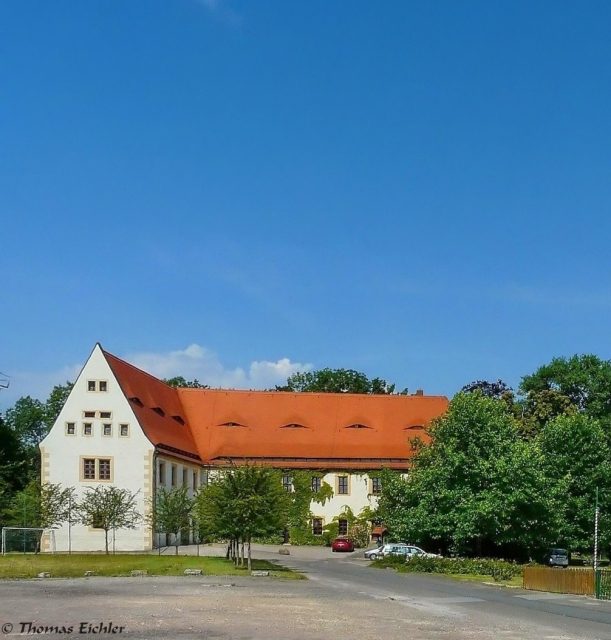
Located just a few kilometers south of Oschatz, the small village of Hof boasts two interesting castles. The newly restored Renaissance castle houses the municipal administration, while the Baroque castle opposite accommodates the village school. For many years, Hof was owned by the noble family von Schleinitz. Christoph von Schleinitz had the Old Castle built around 1540, an L-shaped, two-story building with a gabled roof. Only the rectangular window frames and a bay window on the west side stand out on the simple facade. The castle is crescent-shapedly surrounded by a small pond.

In 1690, the estate came into the possession of the Royal Polish and Electoral Saxon Privy Councillor Georg Ludwig Graf von Zinzendorf und Pottendorf through marriage. The comital family, originally from Austria, emigrated to Saxony in the 17th century due to their Lutheran faith. Nikolaus Ludwig Graf von Zinzendorf und Pottendorf gained particular renown for founding the Moravian Church in Upper Lusatia. On his estate in Berthelsdorf, he welcomed Protestant refugees from Moravia who were subjected to constant persecution.

Around 1750, Friedrich Christian Graf von Zinzendorf und Pottendorf had a new castle building erected next to the Old Castle. The facade of the two-winged Baroque building was originally adorned with illusionistic painting. On the east side, the painting has been reconstructed in a test axis. It gave the castle a distinguished character. A slender stair tower is arranged between the right-angled castle wings, which only received its onion dome in 1905, after the stair tower had burned out the year before due to a lightning strike.

Until 1774, Hof remained in the hands of the Zinzendorf comital family. Then Maximilian Erasmus von Zinzendorf und Pottendorf had to sell the property. Various Saxon noble families followed. The last owner of the estate was Rittmeister a.D. Georg von der Decken, who ran out of money in 1932. The manor was divided; the castles passed into the possession of the municipality. The Old Castle henceforth served as a residence. In the New Castle, the municipality established a school. However, for a long time, no value-preserving work was carried out on the building fabric. As a result, the Old Castle was so dilapidated in 1991 that the last tenants had to leave the building. But the municipality seized the opportunity and began restoring the Renaissance castle. Enormous sums have flowed into the building by 2003, and still not all rooms have been restored to their old splendor. It is to be hoped that the municipality will complete the work in the coming years.

A sprawling landscape park adjoins the castle grounds. In the mid-18th century, the park was laid out with precious sandstone figures from mythology.

A great surprise awaited the builders who restored the Old Castle in Hof in the 1990s: Beneath a suspended ceiling in the ballroom on the upper floor, they unearthed one of Saxony's most beautiful Renaissance ceilings. Between the profiled wooden beams, there are eight rows of eleven coffers each with emblem paintings from the 16th/17th century. The pictures were painted on canvases and then attached to the ceiling boards. They include garden and castle depictions, alternating with symbolic pictorial scenes.

Emblem painting is a typical mode of representation for religious, mythological, and allegorical themes in the 16th and 17th centuries. It follows a strict structure, where each emblem contains three elements: The lemma (motto) was usually a Latin phrase that contained an ethical demand, a rule of life, or a motto. The lemma was kept very short. Sometimes a single word was enough. Central was the icon. It is the pictorial part of the emblem, for which there were no narrow limits in terms of content or form. The third component is the epigram. Its task was to explain the often enigmatic combination of lemma and icon, or at least to facilitate the solution of the riddle. Classical languages, such as Greek or Latin, and forms of ancient poetry were mostly used. In the 17th century, didactic-moral content was increasingly used as emblems, for example, illustrations of well-known proverbs.

In addition to the painted ceiling, emblem painting can also be found in the niches of the walls and in the frieze adjoining the ceiling on the east and west walls. Furthermore, the fireplace surround and the western entrance were also artistically designed.

Take Mobile History with you

You are reading this text for free. Premium adds what matters on the road: descriptions read aloud, sites found through your camera, whole regions taken offline.

  • Every description, including the ~17,700 Premium sites
  • Audio guide: have descriptions read to you on location
  • AR finder: see sites through your camera, with distance and bearing
  • Unlimited saved sites

14 days free, then from €2.99 a month. Cancel anytime.

Location: 51.2374, 13.1895