To be privately owned
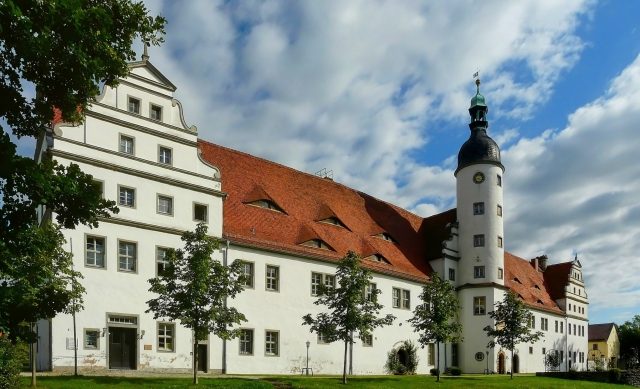
Old Castle Zabeltitz
Zabeltitz has always been closely linked to Saxon history. As early as 1200, an old manor house, probably belonging to a local family, stood on the site of today's palace. In the 14th century, Zabeltitz came into the possession of the von Köckeritz family and later the Lords of Hirschstein. Finally, Otto Pflugk acquired the property in 1412. In the middle of the 16th century, Nickel Pflugk converted the old moated castle into a Renaissance residential castle with a surrounding moat. 20 years later - in 1584 - he sold Zabeltitz to Elector Christian I, who intended to use the castle as a hunting lodge.
However, the stately residence was too small for the court. An additional building was needed to accommodate the retinue and the numerous horses. Master of Ordnance Paul Buchner, who had already laid out the Stallhof in Dresden, erected the stable building from 1588, which itself looks like a castle and is therefore called "Altes Schloss" (Old Castle).
The "Altes Schloss" is an elongated two-story Renaissance building with a projecting stair tower with a dome and lantern on the garden side. End buildings with stately gables enclose the building on both sides. On the ground floor, there is a two-aisled hall with a cross-rib vault and Tuscan columns. On the 1st floor were once the living quarters of the electoral hunting party.
Elector Christian II completed his father's plans. The castle was mainly used as a hunting lodge. Even after the Thirty Years' War, and some castle repairs in 1655, the Elector held hunting camps again in 1657 and 1659. Later, the castle served as a widow's residence for the mother of Augustus the Strong, Electress Anna Sophie. After Augustus the Strong had unsuccessfully attempted an exchange of Zabeltitz for Pillnitz with Countess Cosel, he gifted the manor, including the castle and park facilities, to his loyal companion and minister, Field Marshal August Christoph Graf von Wackerbarth, on February 16, 1728.
With the gifting of the manor to Count Wackerbarth, a new era began for Zabeltitz. Vigorous construction activity commenced; the entire complex was redesigned by the Count according to plans by the master builder Johann Christoph Knöffel in the Baroque style. The three-story palace received a flat hip roof and an illusionistically painted architectural articulation. A stone bridge crosses the moat in front of the palace on the courtyard side. Projecting corner buildings frame the recessed central part with the courtyard-side entrance. Above the balcony is the coat of arms of Dr. Arnold von Frege-Weltzien - a later owner.
On the park side, a dominant central risalit projects from the palace. The triangular gable is adorned with the coat of arms of the then owner, Field Marshal von Wackerbarth, beneath a count's crown.
After the death of Christoph Graf von Wackerbarth's adopted son, Josef Anton Gabaleon Graf von Wackerbarth-Salmour, the manor reverted to the possession of the crown. The new owner, Prince Xaver, was visited during this time (1766) by, among others, the Austrian Emperor Joseph II.
Neglected in the 18th century, the estate was acquired at the end of the 19th century by the chamberlain of the Duke of Saxe-Meiningen, Dr. Arnold von Frege-Weltzien, thus saving it from decay. The Reichstag member von Frege-Weltzien had the palace rebuilt in 1897 and the interiors redesigned by the architect Ernst Herrmann.
After 1945, the owners - as everywhere in the country - were dispossessed and expelled by the communists. A rural outpatient clinic was set up in the stable building; a further education facility of the Deutsche Reichsbahn opened in the palace. Even after the political change in the GDR, the palace initially remained with Deutsche Bahn. In the meantime, however, they have closed the training center. Today, the palace can be rented for various festivities.
The "Altes Schloss" houses apartments, doctor's offices, the registry office, and a restaurant.
Behind the palace is a large park, axially aligned with the palace by a water basin. Knöffel designed the Baroque garden with the 160 m long pond and several 18th-century sculptures. The two herms to the west of the mirror pond are works of Classicism and depict Apollo and Diana.
The palace park in Zabeltitz remains a sight to this day, where one can find peace and relaxation. Dominant is the "Spiegelteich" (Mirror Pond), which reflects the palace in its full size. Several small ponds, lined by tall trees, are grouped around this French-style part of the park. Sandstone figures stand in various places in the park; small pavilions and seating areas invite visitors to linger.
Take Mobile History with you
You are reading this text for free. Premium adds what matters on the road: descriptions read aloud, sites found through your camera, whole regions taken offline.
- Every description, including the ~17,700 Premium sites
- Audio guide: have descriptions read to you on location
- AR finder: see sites through your camera, with distance and bearing
- Unlimited saved sites
14 days free, then from €2.99 a month. Cancel anytime.
Source: Wikipedia · Licence: CC BY-SA 4.0 · Image: Thomas Eichler
This description draws on the facts documented in the linked Wikipedia article; Wikipedia content is licensed under CC BY-SA 4.0. Wording and editing: Mobile History.
Location: 51.3526, 13.4960