School
Old and New Castle Vorra

Old Castle
A manor or perhaps initially just an administrative seat was provisionally built in 1601/02 on the farmstead near the Pegnitz, which Carl Tetzel von Kirchensittenbach (1557–1611) had bought from Jobst Pamler. The adaptation of the single-story farmhouse took place after the Nuremberg patrician had acquired the Hofmark Vorra in 1597 from Georg Sebastian Stiebar von Pretzfeld and, after long-standing disputes with his brother Jobst Friedrich in Kirchensittenbach, probably wanted to dedicate himself to his own estate. The imperial city supported the acquisition with an interest-free loan of 4,000 guilders so that the manorial lordship located in its territory would come into Nuremberg hands, as the previous owner was not a citizen but registered in the Gebürg canton of the Franconian imperial knighthood.
In 1601, Carl Tetzel bought the Vorra tithe rights from the Bamberg St. Jakob Abbey, for which a large tithe barn was immediately built in the courtyard of the seat, which can be seen in older depictions directly south of the manor house. After his death on January 23, 1611, his widow Anna administered the Hofmark until February 2, 1618, when their son Hans Jakob Tetzel (1565–1646) took over the inheritance after a settlement with his two siblings. He began his work in Vorra with great vigor, not only having the "Vorracher Saalbuch" created, in which all goods, rights, and regulations of the Hofmark were compiled, but also beginning in 1618 with a renovation of the former Pamler house into a two-story manor house, as well as the construction of a small bathhouse and a courtyard wall that enclosed the previously unsecured seat.
No less than the Nuremberg draftsman and cartographer Hans Bien was commissioned ten years later to create a site plan of the Hofmark, which has survived to this day. It shows the then new manor house from a bird's-eye view as a two-story, almost square building with a transverse gable extending over the entire width of the house, which had been placed on the northern gable side. Since a counterpart was missing on the southern side, Vorra can be considered a special, and relatively young, variant of this typical Nuremberg roofscape. Bien also depicted the other buildings of the seat: south of the manor house, the large tithe grain barn from 1601, and attached to its west side, the castle barn. A residential house adjacent to the west of the courtyard could have been a Vogt- and/or official's house.
In the middle of the Thirty Years' War, Hans Jakob Tetzel acquired the knight's estate of Artelshofen from the Harsdorfer community of heirs in 1626 [cf. Artelshofen] and experienced the occupation of Vorra by Bavarian troops in 1631. It was not until 1635 that he managed to regain the confiscated possessions of Artelshofen and Vorra by raising allegedly 10,000 Reichstalers. After his death in 1646, Vorra fell to his son Philipp Jakob, who had been head of the imperial city's Engelthal office as Pfleger since 1660. The so-called Tiergarten (menagerie), which Tetzel had built for his amusement at that time, is still known there today. Here he was attacked and fatally wounded by a stag in 1669.
Thereupon, his brother Gustav Philipp, who had already bought Artelshofen from him in 1665, took over the administration of Vorra, which he handed over to his son Gustav Georg Tetzel in 1689, two years before his death. The latter had been married to Anna Maria Peller von Schoppershof since 1683 and, due to his great indebtedness, had to sell the Vorra estate to his father-in-law Jobst Christoph Peller (1638–1709) for 30,000 guilders in 1707. However, this led to fierce disputes, so after Peller's death, Vorra was returned to Tetzel in 1710, offset against Anna Maria's inheritance.
On August 2, 1728, the 68-year-old Gustav Georg Tetzel died as the last male descendant of his line in Vorra. His daughter Maria Helena, born in 1684, finally married the widowed Christoph Wilhelm Scheurl von Defersdorf in 1736 [cf. Schwarzenbruck I]. She had earned merit for Vorra with a charity foundation and other good deeds and died childless in 1743, her husband six years later. His son from his first marriage, Jacob Wilhelm Scheurl, inherited the estate in 1749. He had the manor house, which was destroyed in the devastating village fire on August 27, 1780, restored in a simplified form. The building, made of limestone rubble, no longer received its distinctive roof structure but has since been covered by a half-hipped roof.
After Jacob Wilhelm's death in 1783, his sons Christian Wilhelm (1763–1853) and Karl Jakob Scheurl inherited the lordships of Schwarzenbruck and Vorra and administered them jointly. In 1801, a lottery decided that Christian Wilhelm would take over Vorra. When he died in 1853 at the age of 90, he had experienced the incorporation of the Hofmark into the Kingdom of Bavaria in 1806, the temporary granting of patrimonial jurisdiction (1819 to 1837), and finally the legal abolition of manorial lordship in 1848. Even before the death of the last Scheurl zu Vorra, who left behind his daughters Dorothea Jakobina Wilhelmina (1788–1856), Sophie Maria Christina, and Helena Jakobina Karolina, the husband of the latter, Franz Ludwig Karl Julius Freiherr von Soden (1790–1869), is said to have participated in the administration; at least his regular summer stays in the manor house are documented. When his wife died childless in 1861, her inheritance fell to her sister Sophie Maria Christina, who was very dedicated to the poor population and founded the "Sophienstiftung" and the "Scheurlsche Weihnachtsbestimmung."
Already two years before she died in 1891 at the age of 92, her brother-in-law's nephew, Julius August Freiherr von Soden (1846–1921), designated in her will, took over the inheritance. With the construction of the new castle in 1890/91, the manor house lost its previous function and, after a renovation, was henceforth used as an annex. The building, now called "old castle," shared the fate of the stately estate as part of it, which finally led to the establishment of a school country home in 1955. This use continues to this day. With alterations that presumably significantly affected the historical substance, especially on the ground floor, the former manor house was adapted to the home's operations, and a craft room was set up on the ground floor, as well as overnight rooms for the home's guests on the upper and first attic floors. The plastered facades show no ornamentation, but inside there are still baroque two-panel doors with eared frames and stucco ceilings, presumably from the time of the reconstruction around 1781.
New Castle
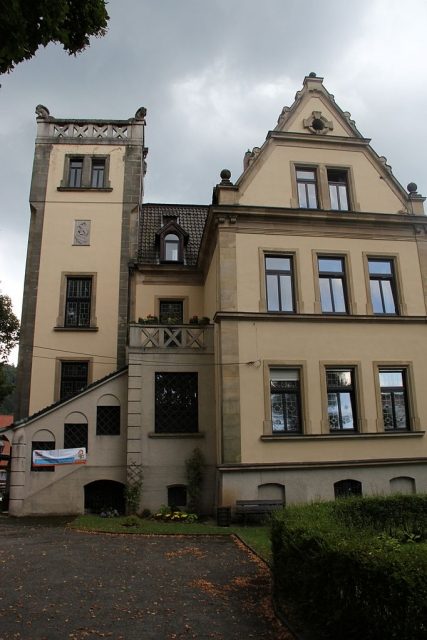
After Sophie Maria Christina Scheurl von Defersdorf had appointed Julius August Freiherr von Soden (1846–1921) as her heir, he began building a new castle even before his aunt's death in 1889/90. The builder, a imperial diplomat, had traveled the world on various missions and wanted to enjoy his retirement in Vorra in a residence befitting his status. For the construction of the new manor house, a hall and various outbuildings west of the old house were demolished. The high groundwater level and the unstable building ground caused problems from the outset, which eventually led to deformations, cracks, and the collapse of the tower in November 1890. After a change of master builder, stability was established, and construction was completed in 1891. The castle garden was also redesigned into an English-style park.
The three-story new building was constructed in a historicizing Renaissance style, which was particularly evident in the gables adorned with obelisks and other stonework finials, and a picturesque finish to the tower. Many of these details, however, fell victim to later alterations. A small altana with an exit at the height of the second upper floor was added to the slightly projecting risalit on the west side, which was originally decorated with figures. On the south side, a second, wide altana is attached for a terrace, from which a generous flight of stairs leads into the garden.
After the builder, who had once been governor of the then German colony of Cameroon, unexpectedly had to take on this position in German East Africa for another three years, he was only able to move into the new building in 1893, which was furnished with numerous hunting trophies and weapons from his former deployment locations. Initially, the castle was permanently inhabited, but since the baron's appointment as cabinet chief to the King of Württemberg and the move to Stuttgart in 1899, it served only as a holiday residence. In 1920, he sold the castle complex with both manor houses to the Royal Württemberg Major Otto Karl Alfred Alexander Freiherr von Ellrichshausen. The latter had some changes made to the new manor house as early as 1921, during which the tower lost its roof structure and was provided with an observation platform.
The new owner died in Munich in 1937. His son and main heir, living on the family estate in Argentina, had no interest in the property and sold it to the "Deutsche Arbeitsfront," which established a Gau school here. After their invasion, the American armed forces set up their local command post in the castle in 1945. From November 1945, Baroness Irmgard von Löffelholz leased the castle, first from the military government, then from the Bavarian state, to establish an evangelical country school home, a secondary school with a boarding school, here. In 1955, the Schullandheimwerk Mittelfranken took over the premises and carried out various alterations, which were completed by 1956. Another modernization took place in 1977, which presumably led to further changes to the historical substance. The use as a school country home continues to this day.
Take Mobile History with you
You are reading this text for free. Premium adds what matters on the road: descriptions read aloud, sites found through your camera, whole regions taken offline.
- Every description, including the ~17,700 Premium sites
- Audio guide: have descriptions read to you on location
- AR finder: see sites through your camera, with distance and bearing
- Unlimited saved sites
14 days free, then from €2.99 a month. Cancel anytime.
Source: Wikipedia · Licence: CC BY-SA 4.0 · Image: http://commons.wikimedia.org/wiki/File:Vorra_08.jpg
This description draws on the facts documented in the linked Wikipedia article; Wikipedia content is licensed under CC BY-SA 4.0. Wording and editing: Mobile History.
Location: 49.5573, 11.4936