To be privately owned
Pabenschwandt Manor

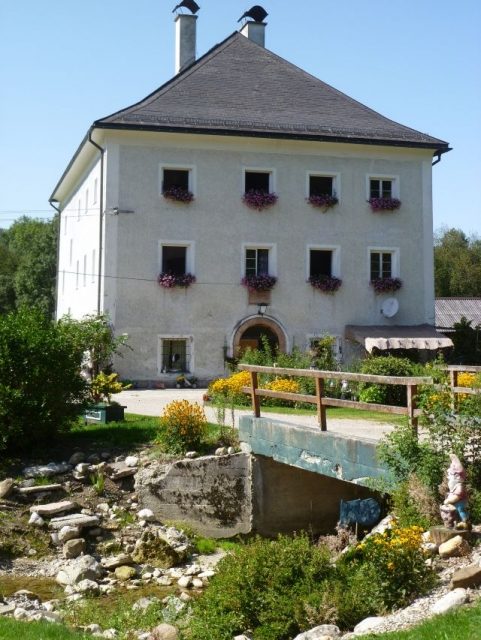
The Pabenschwandt manor is a single farm northeast of the village center of Plainfeld in Salzburg Land.
The earliest mention of the name Pabenschwandt from 1269 concerns a Konrad von Pabenswant, who vouched for the brothers Kuno and Konrad von Kalheim. On December 26, 1288, the aforementioned brothers, together with Heinrich von Kalham, handed over Gottfried von Pabenswant's wife, Hedwig, with her seven children, to the Salzburg church. In 1336, the Pawenswanter family is mentioned as landlords. The last member of this family, Eustach von der Alm, left Pabenschwant to his servant Sebastian Hartberger upon his death. After Sebastian also died without heirs in 1567, his family sold the farm to the "noble and steadfast Hanns Hess and Anna Copeindlin". Balthasar von Raunach acquired the farm in 1574, but had its administration transferred to Wartenfels. The administrator of Wartenfels, David Widmannster, had bought the estate in 1606 and then bequeathed it to his children. In 1678, Ferdinand Hueber bought Pabenschwandt. The farm, described as a "noble free seat" in 1688, was sold in 1705 by the Abtenau administrator Josef Pock von Arnholz to Abbot Placidus Mayrhauser of St. Peter's Monastery. St. Peter even wanted to build a larger chapel in honor of the Three Holy Kings with a daily mass license after purchasing Pabenschwandt Castle, but had to abandon the project after purchasing Goldenstein Castle.
On the occasion of its 300th anniversary, St. Peter's Archabbey and the Prangerschützen Plainfeld erected a chapel in honor of Saint Leonhard. After about six months of construction, it was consecrated on November 5, 2006, by Archabbot Edmund Wagenhofer.
Architectural Description+
In the 18th century, the estate consisted of a three-story, brick-built manor house with a bay window, octagonal annex, and house chapel. In 1844, the independently owned castle was fundamentally redesigned and converted into a farmhouse. The bay window, octagonal annex, and house chapel disappeared in the process. In 1927, the building was modernized again. Today, the farm has a cubic structure with a massive hip roof and a central corridor floor plan.
History of Pabenschwandt during the Nazi Era+
In 1941, the farm was confiscated by the Gestapo. From spring 1943 until April 25, 1945, Pabenschwandt housed an external camp of the Dachau concentration camp. Ten female prisoners were employed for work at the Pabenschwandt experimental farm; these were Jehovah's Witnesses from the Ravensbrück concentration camp. Furthermore, a Frenchman, a Pole, and a Polish girl also worked in the external commando. The external camp was placed under the command of the Dachau concentration camp on December 1, 1944.
Under SS staff doctor and researcher Dr. Karl Fahrenkamp (* April 20, 1889, in Aachen), a protégé of Heinrich Himmler, who moved to Pabenschwandt in spring 1943, nutritional experiments were conducted there. Heinrich Himmler visited Pabenschwandt several times for lectures. Fahrenkamp, who previously worked on the plantation in Dachau, died by suicide on December 21, 1945, near Pabenschwandt.
Today, on the west side of the Pabenschwandt Chapel, there is a memorial inscription to the Nazi prisoners from the Dachau concentration camp.
In 1947, the farm was returned to St. Peter's Monastery and is now a prosperous enterprise.
Take Mobile History with you
You are reading this text for free. Premium adds what matters on the road: descriptions read aloud, sites found through your camera, whole regions taken offline.
- Every description, including the ~17,700 Premium sites
- Audio guide: have descriptions read to you on location
- AR finder: see sites through your camera, with distance and bearing
- Unlimited saved sites
14 days free, then from €2.99 a month. Cancel anytime.
Source: Wikipedia · Licence: CC BY-SA 4.0 · Image: http://commons.wikimedia.org/wiki/File:Ansitz_Pabenschwandt.jpg
This description draws on the facts documented in the linked Wikipedia article; Wikipedia content is licensed under CC BY-SA 4.0. Wording and editing: Mobile History.
Location: 47.8371, 13.1891