The remains of the ancient town can be visited
Ancient BuildingAmfípolis (Αμφίπολη)
Ancient City Amphipolis (Ἀμφίπολις)
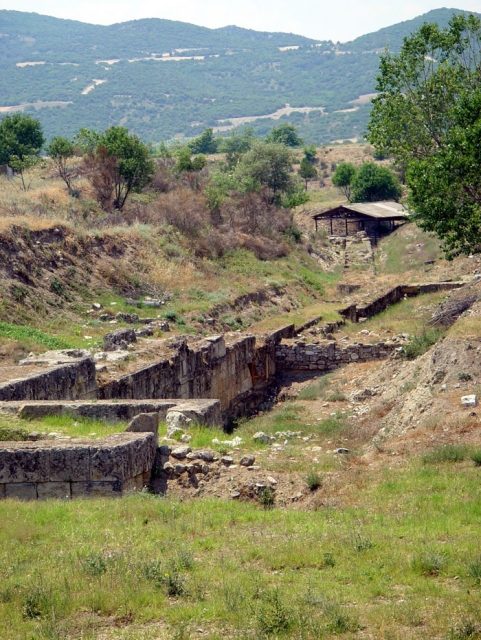
Amphipolis was an ancient Greek polis that evolved into a center in Thrace. Its location on the Strymon River and proximity to natural resources made it a coveted site for various ancient powers.
History+
The founding of Amphipolis occurred in 437 BC by the Athenian general Hagnon, on the site of the earlier settlement of Ennea Hodoi. Athens intended to control the gold and silver mines of the region from here. Earlier, in 464 BC, an Athenian attempt to establish a foothold in this area failed when they were defeated by theones in the Battle of Dabreskos. During the Peloponnesian War, Amphipolis gained importance, not only due to access to timber for shipbuilding and revenues from the mines, but also because of its strategic position. In 424 BC, the city surrendered without a fight to the Spartan Brasidas, which forced the Athenian general Thucydides, the later historian, into exile as he arrived too late to save the city. Two years later, in 422 BC, the Athenians under General Cleon attacked Brasidas near Amphipolis. In the battle, which Sparta won, both generals fell. The inhabitants of Amphipolis buried Brasidas within their walls and revered him as a second founder of the city. In 356 BC, Philip II of Macedon conquered the city. The conflict over Amphipolis shaped the relations between Macedon and Athens in the following years. Later, in 316 BC, Cassander imprisoned the underage Alexander IV Aigos, the son of Alexander the Great, and his mother Roxane in Amphipolis and had them murdered there in 310/309 BC, sealing the end of the Argead dynasty. After the defeat in the Battle of Pydna in the Third Macedonian-Roman War, the Macedonian king Perseus fled with his gold to Amphipolis, where he was captured by Aemilius Paullus, marking the end of the Macedonian kingdom. In 167 BC, Amphipolis was declared a Roman protectorate. The city is also mentioned in the Acts of the Apostles as a stop for the Apostle Paul. After a flourishing period in late antiquity, a gradual decline of the city began in the early Middle Ages, caused by Slavic invasions and a population decrease, which eventually led to the loss of urban structures.
Location+
The ancient city of Amphipolis is located in the Amfípolis region in East Macedonia and Thrace, in northern Greece, at an elevation of approximately 112 meters above sea level.
Take Mobile History with you
You are reading this text for free. Premium adds what matters on the road: descriptions read aloud, sites found through your camera, whole regions taken offline.
- Every description, including the ~17,700 Premium sites
- Audio guide: have descriptions read to you on location
- AR finder: see sites through your camera, with distance and bearing
- Unlimited saved sites
14 days free, then from €2.99 a month. Cancel anytime.
Source: Wikipedia · Licence: CC BY-SA 4.0 · Image: http://commons.wikimedia.org/wiki/File:Amphipolis_fortifications.jpg?uselang=de
This description draws on the facts documented in the linked Wikipedia article; Wikipedia content is licensed under CC BY-SA 4.0. Wording and editing: Mobile History.
Location: 40.8204, 23.8474