The remains of the roman Arena can be visited
Ancient City Colonia Pietas Iulia Pola-Theater
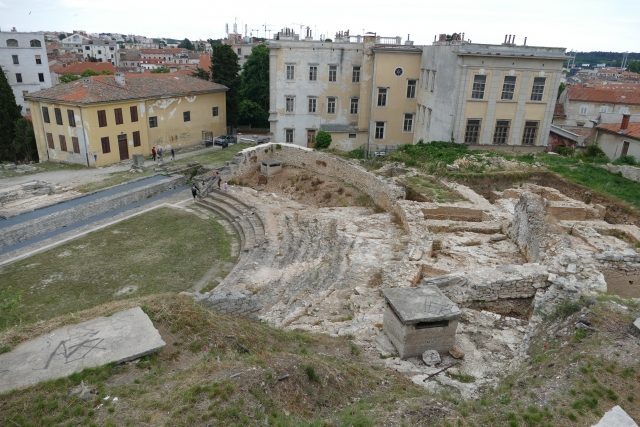
In classical antiquity, it was inhabited by the Histri, a Venetic or Illyrian tribe recorded by Strabo in the 1st century AD The Istrian peninsula was conquered by the Romans in 177 BC, starting a period of Romanization. The town was elevated to colonial rank between 46–45 BC as the tenth region of the Roman Empire, under Julius Caesar. During that time the town grew and had at its zenith a population of about 30,000. It became a significant Roman port with a large surrounding area under its jurisdiction. During the civil war of 42 BC of the triumvirate of Octavian, Mark Antony and Lepidus against Caesar's assassins Brutus and Cassius, the town took the side of Cassius, since the town had been founded by Cassius Longinus, brother of Cassius. After Octavian's victory, the town was demolished. It was soon rebuilt at the request of Octavian's daughter Iulia and was then called Colonia Pietas Iulia Pola Pollentia Herculanea'. Great classical constructions were built of which a few remain. A great amphitheatre, Pula Arena was constructed between 27 BC – 68 AD, much of it still standing to this day. The Romans also supplied the city with a water supply and sewage systems. They fortified the city with a wall with ten gates. A few of these gates still remain: the triumphal Arch of the Sergii, the Gate of Hercules (in which the names of the founders of the city are engraved) and the Twin Gates. During the reign of emperor Septimius Severus the name of the town was changed into "Res Publica Polensis". In 354 AD the town was the site of Gallus Caesar's execution. In 425 AD the town became the centre of a bishopric, attested by the remains of foundations of a few religious buildings.
Take Mobile History with you
You are reading this text for free. Premium adds what matters on the road: descriptions read aloud, sites found through your camera, whole regions taken offline.
- Every description, including the ~17,700 Premium sites
- Audio guide: have descriptions read to you on location
- AR finder: see sites through your camera, with distance and bearing
- Unlimited saved sites
14 days free, then from €2.99 a month. Cancel anytime.
Source: Wikipedia · Licence: CC BY-SA 4.0 · Image: Mobile Geschichte
This description draws on the facts documented in the linked Wikipedia article; Wikipedia content is licensed under CC BY-SA 4.0. Wording and editing: Mobile History.
Location: 44.8701, 13.8470