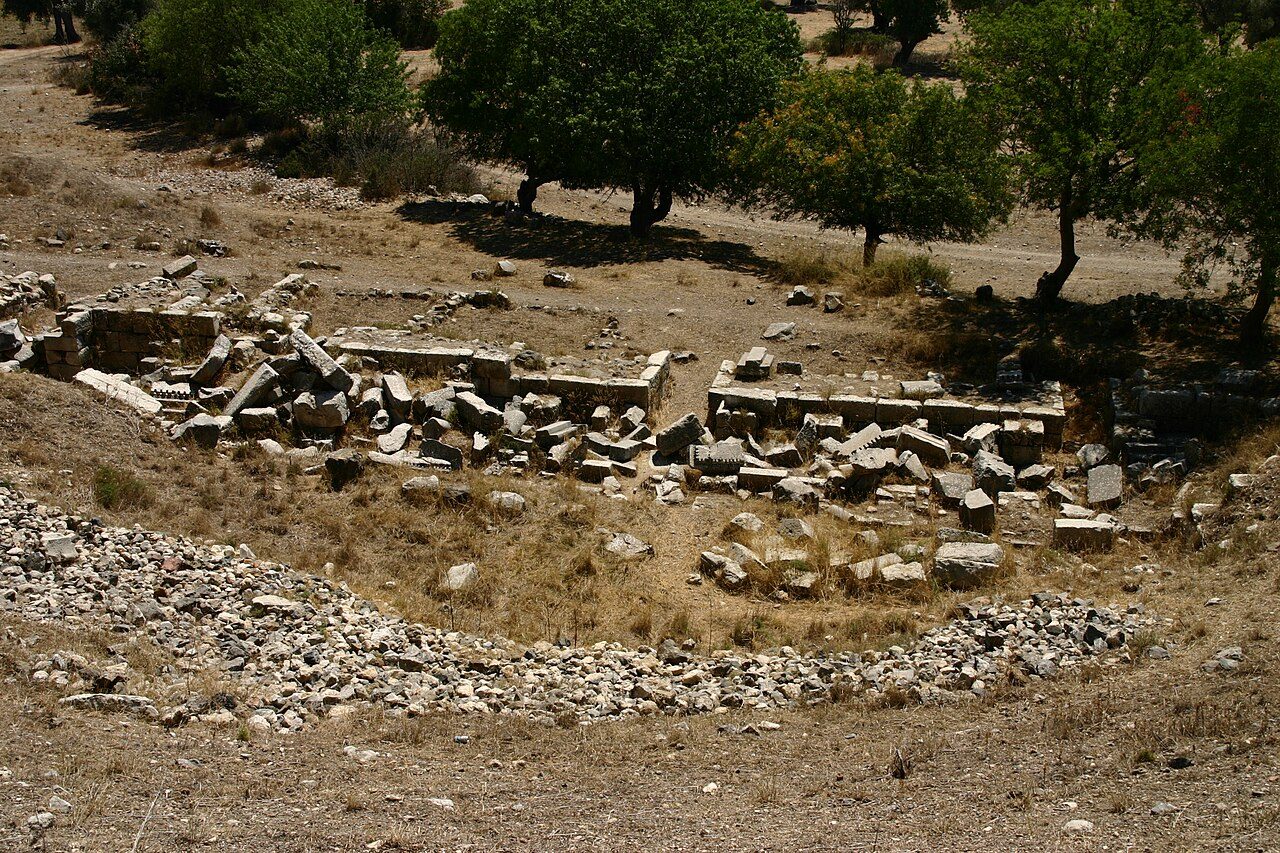
The remains of the ancient town can be visited
Ancient City Teos

Teos (Ancient Greek: Τέως) or Teo was an ancient Greek city on the coast of Ionia, on a peninsula between Chytrium and Myonnesus. It was founded by Minyans from Orchomenus, Ionians and Boeotians, but the date of its foundation is unknown. Teos was one of the twelve cities which formed the Ionian League. The city was situated on a low hilly isthmus. Its ruins are located to the south of the modern town Sığacık in the Seferihisar district of Izmir Province, Turkey.
Pausanias writes that the city was founded by Minyans from Orchomenus under the leadership of Athamas, a descendant of Athamas the son of Aeolus. Later on they were joined by Ionians and more colonists from Athens and Boeotia.
Teos was a flourishing seaport with two fine harbours until Cyrus the Great invaded Lydia and Ionia (c. 540 BC). The Teans found it prudent to retire overseas, to the newly founded colonies of Abdera in Thrace and Phanagoria on the Asian side of the Cimmerian Bosporus. The port was revived by Antigonus Cyclops. During the times of the Roman emperors, the town was noted for its wine, a theatre and Temple of Dionysus. These are positioned near the acropolis, which is situated on a low hill and had fortifications by the 6th century. A shipwreck near Tektaş, a small rock outcrop near Teos harbour, dates from the Classical period (around the 6th to the 4th centuries BC) and implies trading connections by sea with eastern Aegean Islands.
It was a member of the Lydian group of the Ionian League, one of the four groups defined by Herodotus, based on the particular dialects of the cities. It was the birthplace of Anacreon the poet, Hecateus the historian, Protagoras the sophist, Scythinus the poet, Andron the geographer, Antimachus the epic poet and Apellicon, the preserver of the works of Aristotle. Epicurus reportedly grew up in Teos and studied there under Nausiphanes, a disciple of Democritus. Vitruvius notes Hermogenes of Priene as the architect of the monopteral temple of Dionysus at Teos.
The site today+
The modern village of Sığacık is situated close to the ruins of Teos. The interior of what was previously the city has now been intensively farmed, which makes it difficult to excavate the site. Through ploughing, pottery has been brought to the surface of the earth, which has been collected through archaeological survey.
Take Mobile History with you
You are reading this text for free. Premium adds what matters on the road: descriptions read aloud, sites found through your camera, whole regions taken offline.
- Every description, including the ~17,700 Premium sites
- Audio guide: have descriptions read to you on location
- AR finder: see sites through your camera, with distance and bearing
- Unlimited saved sites
14 days free, then from €2.99 a month. Cancel anytime.
Source: Wikipedia · Licence: CC BY-SA 4.0 · Image: Philipp Pilhofer / CC BY-SA 3.0 via Wikimedia Commons
This description draws on the facts documented in the linked Wikipedia article; Wikipedia content is licensed under CC BY-SA 4.0. Wording and editing: Mobile History.
Location: 38.1773, 26.7851