The Gate can be visited
Arco di Tito (Arch of Titus)

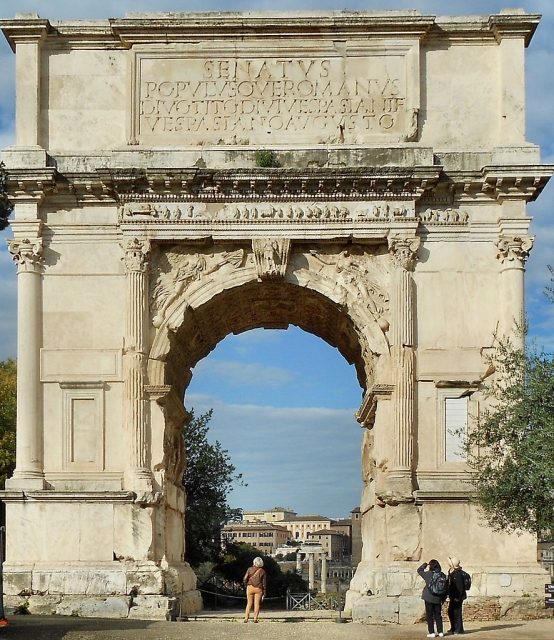
The Arch of Titus (Italian: Arco di Tito) is a 1st-century honorific arch, located on the Via Sacra, Rome, just to the south-east of the Roman Forum. It was constructed in c. 82 AD by the Roman Emperor Domitian shortly after the death of his older brother Titus to commemorate Titus' victories, including the Siege of Jerusalem in 70 AD. The Arch of Titus has provided the general model for many of the triumphal arches erected since the 16th century—perhaps most famously it is the inspiration for the 1806 Arc de Triomphe in Paris, France, completed in 1836.
Based on the style of sculptural details, Domitian's favored architect Rabirius, sometimes credited with the Colosseum, may have executed the arch. Without contemporary documentation, however, attributions of Roman buildings on basis of style are considered shaky.
The Frangipani family turned it into a fortified tower in the Middle Ages. It was one of the first buildings sustaining a modern restoration, starting with Raffaele Stern in 1817 and continued by Valadier under Pius VII in 1821, with new capitals and with travertine masonry, distinguishable from the original. The restoration was a model for the country side of Porta Pia.
Description+
The arch is large with both fluted and unfluted columns, the latter being a result of 19th century restoration. The spandrels on the upper left and right of the arch contain personifications of victory as winged women. Between the spandrels is the keystone, on which there stands a female on the East side and a male on the West side.
The soffit of the axial archway is deeply coffered with a relief of the apotheosis of Titus at the center. The sculptural program also includes two panel reliefs lining the passageway within the arch. Both commemorate the joint triumph celebrated by Titus and his father Vespasian in the summer of 71.
The south panel depicts the spoils taken from the Temple in Jerusalem. The Golden Candelabra or Menorah is the main focus and is carved in deep relief. Other sacred objects being carried in the triumphal procession are the Gold Trumpets and the Table of Shew bread. These spoils were likely originally colored gold, with the background in blue. In 2012 the Arch of Titus Digital Restoration Project discovered remains of yellow ochre paint on the menorah relief.
The north panel depicts Titus as triumphator attended by various genii and lictors, who carry fasces. A helmeted Amazonian, Valour, leads the quadriga or four horsed chariot, which carries Titus. Winged Victory crowns him with a laurel wreath. The juxtaposition is significant in that it is one of the first examples of divinities and humans being present in one scene together. This contrasts with the panels of the Ara Pacis, where humans and divinities are separated.
The sculpture of the outer faces of the two great piers was lost when the Arch of Titus was incorporated in medieval defensive walls. The attic of the arch was originally crowned by more statuary, perhaps of a gilded chariot. The main inscription used to be ornamented by letters made of perhaps silver, gold or some other metal.
Inscription+
The inscription in Roman square capitals reads:
SENATVS
POPVLVSQVE·ROMANVS
DIVO·TITO·DIVI·VESPASIANI·F(ILIO)
VESPASIANO·AVGVSTO
(Senatus Populusque Romanus divo Tito divi Vespasiani filio Vespasiano Augusto)
which means "The Roman Senate and People (dedicate this) to the divine Titus Vespasianus Augustus, son of the divine Vespasian."
The opposite side of the Arch of Titus received new inscriptions after it was restored during the pontificate of Pope Pius VII by Giuseppe Valadier in 1821. The restoration was intentionally made in travertine to differentiate between the original and the restored portions.
The inscription reads:
INSIGNE · RELIGIONIS · ATQVE · ARTIS · MONVMENTVM
VETVSTATE · FATISCENS
PIVS · SEPTIMVS · PONTIFEX · MAX(IMVS)
NOVIS · OPERIBVS · PRISCVM · EXEMPLAR · IMITANTIBVS
FVLCIRI · SERVARIQVE · IVSSIT
ANNO · SACRI · PRINCIPATVS · EIVS · XXIIII
(Insigne religionis atque artis, monumentum, vetustate fatiscens: Pius Septimus, Pontifex Maximus, novis operibus priscum exemplar imitantibus fulciri servarique iussit. Anno sacri principatus eius XXIV)
(This) monument, remarkable in terms of both religion and art,
had weakened from age:
Pius the Seventh, Supreme Pontiff,
by new works on the model of the ancient exemplar
ordered it reinforced and preserved.
• In the year of his sacred rulership the 24th •
Significance+
The Arch provides one of the few contemporary depictions of Temple period artifacts.
The seven-branched menorah and trumpets are clearly depicted. It became a symbol of the Jewish diaspora. In a later era, Pope Paul IV made it the place of a yearly oath of submission. Until the modern State of Israel was founded in 1948, many Jews refused to walk under it. However, when the existence of modern State of Israel was formally declared, many Roman Jews gathered by the arch and in joyful celebration, walked backwards under the arch to symbolize beginning of the long-awaited redemption from the Roman Exile.
The menorah depicted on the Arch served as the model for the menorah used on the emblem of the state of Israel.
Architectural influence+
Works modeled on, or inspired by, the Arch of Titus include:
- Facade of the Basilica di Sant'Andrea di Mantova (1462) by Leon Battista Alberti
- The Arc de Triomphe (1806), Paris, France
- The National Memorial Arch (1910) at Valley Forge National Historical Park, Pennsylvania, USA
- The Soldier's and Sailor's arch at Grand Army Plaza, in Brooklyn
- The arch at Washington Square Park, New York
- The India Gate, New Delhi, India (1931)
- The Fusiliers' Arch, Dublin (1907)
Take Mobile History with you
You are reading this text for free. Premium adds what matters on the road: descriptions read aloud, sites found through your camera, whole regions taken offline.
- Every description, including the ~17,700 Premium sites
- Audio guide: have descriptions read to you on location
- AR finder: see sites through your camera, with distance and bearing
- Unlimited saved sites
14 days free, then from €2.99 a month. Cancel anytime.
Source: Wikipedia · Licence: CC BY-SA 4.0 · Image: http://en.wikipedia.org/wiki/File:TitusbogenFront.jpg
This description draws on the facts documented in the linked Wikipedia article; Wikipedia content is licensed under CC BY-SA 4.0. Wording and editing: Mobile History.
Location: 41.8907, 12.4886