The remains of the ancient town can be visited
Ancient BuildingRom
Auditorium di Mecenate
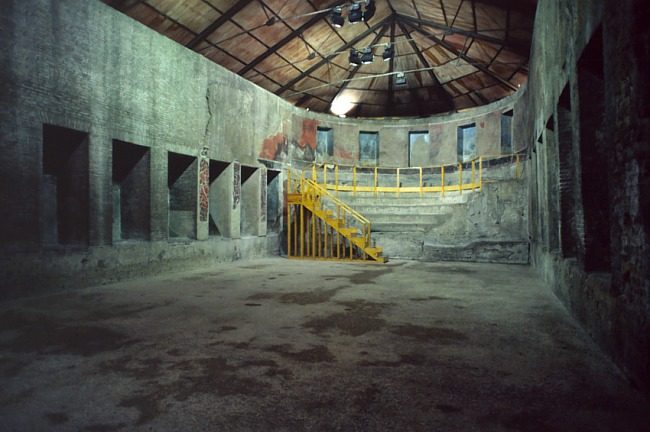
The "Auditorium of Maecenas" (Italian: Auditorium di Mecenate), which is actually more of a nymphaeum than an auditorium, is a monument of ancient Rome located at Largo Leopardi, along Via Merulana, in the Esquilino district of Rome. The site, managed by the Sovrintendenza Capitolina, can be visited by appointment.
History+
The building, which was part of the Gardens of Maecenas (Latin: Horti Maecenatis), was excavated in 1874. It is a large, semi-subterranean rectangular room measuring 24 m x 10.60 m with an apse on one of the short sides. It dates from the time of the construction of Maecenas' villa, which is dated to around 30 BC. Thanks to a passage by Horace, the location of the villa could be identified, rising on a necropolis area and on the leveling of the old Agger. On the side of Largo Leopardi, the building covers the Servian Wall, of which a section has disappeared. We know from Suetonius that Emperor Augustus, when ill, often slept in Maecenas' house. After Maecenas' death in 8 BC, the villa was annexed to imperial possessions and then left to Tiberius after his return from exile on Rhodes. He undertook a restructuring of the buildings with garden paintings in the third style in a nymphaeum, comparable to the frescoes of the underground grotto of Villa Livia, which were created at the same time.
Description+
The front of the hall is wider than the back, where six niches were created on each side, as well as five more niches in the apse above seven circular steps, originally clad in Cipollino marble, to form a kind of small theater cavea. Access was, as it still is today, via a descending staircase. From the highest part of the cavea, pipes brought an abundant amount of water into the room, which is why the building was identified as a nymphaeum, with the steps perhaps adorned with flower vases around which picturesque waters flowed. The whole was further embellished by garden paintings in the niches, forming a magnificent ensemble of an underground park. The surroundings were not isolated but connected to a system of rooms and corridors on which the nymphaeum partially rose. The dating based on the masonry technique (opus reticulatum of rather small form) confirms a period between the end of the Republic and the beginning of the Empire. From the first original phase, a mosaic floor is also preserved, consisting of very fine white tiles with red painted encaustic strips. A marble floor was laid over this. A third phase is perhaps represented by the brick wall resting on the lower part of the cavea.
The Paintings+
The paintings, which are now only preserved in very fragmentary form, can unfortunately only be deduced from the reconstruction drawings published after the excavations of 1874, as no photographic documentation from the time of discovery exists. The decoration is typical of the third style. Each niche was decorated according to a motif with a tree in the center, standing on a marble balustrade, with a central recess containing a fountain or a vase. The trees, moved by the wind, with contour lines, are populated by a large number of flying and resting birds. The presence of real niches forced the artists to invent a way to occupy the higher surfaces, which were decorated with a rain of artificial flowers. The niches are therefore configured as independent elements of the hall's architecture, like window arches with stained glass windows looking out onto a garden, in which carefully elaborated views looked out onto the greenery and decorative elements arranged as if by magic. Here too, as in the preceding examples, neither atmospheric notations nor allusions to an infinite space beyond the perceptible elements are missing.
Take Mobile History with you
You are reading this text for free. Premium adds what matters on the road: descriptions read aloud, sites found through your camera, whole regions taken offline.
- Every description, including the ~17,700 Premium sites
- Audio guide: have descriptions read to you on location
- AR finder: see sites through your camera, with distance and bearing
- Unlimited saved sites
14 days free, then from €2.99 a month. Cancel anytime.
Source: Wikipedia · Licence: CC BY-SA 4.0 · Image: Wikimedia Commons · CC BY-SA 3.0
This description is a machine translation of an excerpt from the linked Wikipedia article. The source text was written by its authors, the translation is by Mobile History; like the original it is licensed under CC BY-SA 4.0.
Location: 41.8940, 12.5014