CastleStuttgart-Vaihingen

Bären Castle

Bären Castle

Restaurant

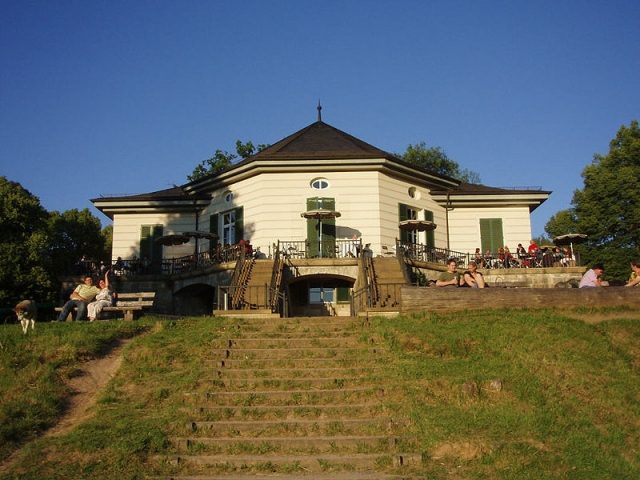
The Bärenschlössle in Stuttgart's Red Deer Park was originally a pleasure palace and now serves as a restaurant. It was named after the Bärenbach (today Bernhardsbach), which flowed nearby.

The First Building: Carl Eugen's Pleasure Palace+

The first Bärenschlössle was built by Reinhard Ferdinand Heinrich Fischer, a student of the French architect Philippe de La Guêpière, under Duke Carl Eugen in 1768 in an "ancient Roman" style from stone. From the two-story oval pavilion, one had a view of the artificially created Bärensee, on which gondolas floated, which Carl Eugen had brought back from a trip to Italy in 1766/67 or had built according to the Italian originals. It was a subsidiary facility to the main work Solitude, connected by a three-kilometer long axis. The area around the Bärensee was a fallow deer park, which belonged to the Solitude wildlife park.

The Venetian lion figures, which mark the former landing stage on the Bärensee, still commemorate this phase. On the ground floor was a hall with murals, on the first floor a salon with a ceiling painting by Nicolas Guibal. An illustration of this first building exists on a coffee pot, which is kept in Ludwigsburg, and an etching by Nikolaus Heideloff, which is located under inventory number B 7485 in the Stuttgart City Archives. It shows a hunt in honor of Grand Duke Paul of Russia, which was held on September 24, 1782.

After Carl Eugen's death in the autumn of 1783, both the palace and the watercraft fell into disrepair. In 1817, the first Bärenschlössle was demolished.

The Second Building: Wilhelm I's Hunting Pavilion+

King Wilhelm of Württemberg had a larger, octagonal hunting pavilion with two wings built in the same year on the site of the previous building. This was translocated from Freudental. The king expanded the park into a large game enclosure to be able to host show hunts on the grounds. The pavilion was built in a classical style on a terrace and had a hall decorated with hunting trophies and hunting paintings by E. Kehrer. Externally, the pavilion was originally clad with bark and also bore hunting trophies.

Two bronze bear statues stood near the pavilion. One of these figures was rediscovered after the Second World War and served as a model for the two bronze bears created in 1964 by Lilli Kerzinger-Werth, which still stand by the building today.

The park and palace were accessible only to annual pass holders until the First World War; in 1919, the fence of the wildlife park was removed and the area became publicly accessible. From 1937, the pavilion was used as a guesthouse by the state and the city of Stuttgart. In the same year, the game enclosure was fenced in again. Since 1939, the red deer park and since 1958 also the wild boar park have been nature reserves.

During the Second World War, Wilhelm's hunting pavilion was destroyed.

The Third Building: Reconstruction After War Damage+

An incendiary bomb almost completely destroyed the old hunting pavilion in 1943. However, it was rebuilt in 1963 on the preserved terrace. The ground floor was designed as a restaurant, the upper floor as an open hall.

The Fourth Building: Reconstruction After Fire+

On November 13, 1994, the Bärenschlössle almost completely burned down. The building was rebuilt true to the original by 1997; a deviation from the two previous buildings are the double doors on the upper floor, which replaced the windows present in the previous buildings.

Usage+

The Bärenschlössle is now used as a restaurant and event venue. Since it is located in a nature reserve, its use is subject to certain restrictions.

Take Mobile History with you

You are reading this text for free. Premium adds what matters on the road: descriptions read aloud, sites found through your camera, whole regions taken offline.

  • Every description, including the ~17,700 Premium sites
  • Audio guide: have descriptions read to you on location
  • AR finder: see sites through your camera, with distance and bearing
  • Unlimited saved sites

14 days free, then from €2.99 a month. Cancel anytime.

Source: Wikipedia · Licence: CC BY-SA 4.0 · Image: http://commons.wikimedia.org/wiki/File:B%C3%A4renschl%C3%B6ssle_2009_1.jpg

This description draws on the facts documented in the linked Wikipedia article; Wikipedia content is licensed under CC BY-SA 4.0. Wording and editing: Mobile History.

Location: 48.7608, 9.0915