Museum
Neschwitz Castle

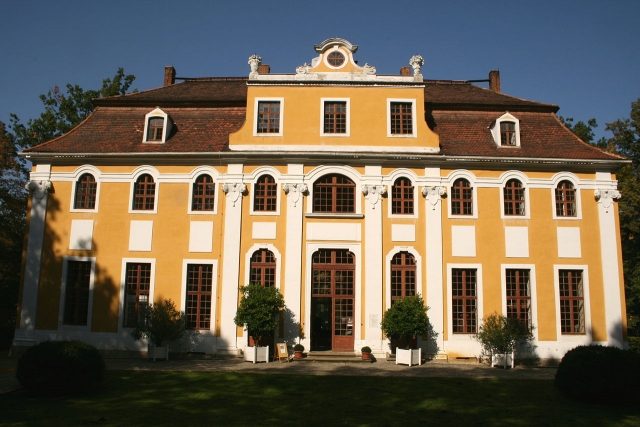
Neschwitz Baroque Palace is located in the town of Neschwitz, about 15 km northwest of Bautzen in Saxony, and together with its palace park, it is one of the culturally and historically significant palace complexes in Lusatia.
The history of Neschwitz Palace can be traced back to the Middle Ages and has always been closely linked to the respective ownership of the former knight's estate as an agricultural unit.
From the beginnings to 1721
When the Ascani Markgraf Otto IV of Brandenburg divided Upper Lusatia into the bailiwicks of Bautzen and Görlitz in 1268, a place called "Nyzwaz", today Neschwitz in the district of Bautzen in Saxony, also appeared in the division deed. At the time of this division, a moated castle located on the Hoyerswerdaer Schwarzwasser already stood here.
Feudal lords of Neschwitz at that time were the Knights of Schreibersdorf, a noble family originally from Jauer in Lower Silesia. The conversion of the old moated castle into a Renaissance palace, recorded for 1454, can be attributed to this family, as a Lucas von Schreibersdorf already appeared in a court record in 1286, Balthasar von Schreibersdorf was district governor of Bautzen in 1474, and in 1492 the brothers Hans, Caspar, and Dietrich von Schreibersdorf were the lords of Neschwitz. The Schreibersdorfs also began fish farming here in 1543; later, Neschwitz became one of the centers of carp production in Upper Lusatia.
At the beginning of the 16th century, the land-owning nobility fell into a prolonged economic crisis, and the large lordships became knight's estates with simple male enfeoffment, meaning they could only be inherited by a direct, male, and adult descendant. When the Bohemian-Hungarian King Ferdinand I failed to fulfill his promises to strengthen the feudal rights of the estates after the so-called Upper Lusatian Pönfall of 1547, ownership of Neschwitz changed more frequently.
Until 1572, the estate remained, with few interruptions, in the hands of the Schreibersdorfs, then Dietrich von Schreibersdorf sold it to the imperial councilor Hans Haubold von Schleinitz, whose family was widespread in Lusatia. Hans Haubold was governor of Upper Lusatia from 1572 until he was deposed by Emperor Rudolph II in 1594 as a result of an intrigue and died in deepest bitterness at Neschwitz Palace on January 1, 1595.
After the death of the governor, Neschwitz passed to Friedrich von Pannewitz, who then sold the estate in 1600 to Hans von Ponickau the Younger, who was district governor in Bautzen in 1562 and also owned the estates in Prietitz, Elstra, Königswartha, and Debra. His successor was Georg Rudolph von Ponickau, who in 1604 donated a Hufner's (peasant's) plot to the parish enfeoffment of Neschwitz and introduced a new school regulation in 1608. Furthermore, in 1615, he stipulated that the respective owner of a certain meadow in the Neschwitz area had to pay 18 Groschen to the school annually. Georg Rudolph von Ponikau's efforts to elevate Neschwitz to a market town failed due to the approval of the Saxon Elector Johann Georg I.
After the Ponickau family, the von Theler family acquired the estate. In 1674, Neschwitz belonged to Anna von Theler, who included a legacy in favor of the pastor, the poor, and the school in her will. Afterwards, her son George Bernhard von Theler became lord of the castle. The last of the Thelers, Conrad Heinrich, sold the property to Schack von Rumohr. Schack owned the property until 1721.
The era of Württemberg to Simonis
With the acquisition of the property by Prince Friedrich Ludwig von Württemberg-Winnental in 1721, the palace grounds underwent a complete transformation.
The prince, who had been in the military service of King August II since 1703, had met Ursula Katharina von Altenbockum, Imperial Princess of Teschen and divorced Princess Lubomirska, who became the king's mistress in the same year, at the Dresden court. Now, almost twenty years later – August II had long since taken other women into his favor and the prince had fought for him in numerous battles – the king apparently took pleasure in a firm connection between Ursula Katharina and Friedrich Ludwig. The latter, in any case, showed the highest interest in the still attractive woman, and so he needed an "appropriate" bridal gift. So he acquired the Neschwitz property and commissioned the then Dresden master builder Johann Friedrich Karcher to completely rebuild it.
Karcher structured the five-and-a-half-hectare site strictly geometrically into a French-style park. The old palace was demolished, except for the old cellar vaults of the former moated castle, which can still be seen today, and a 5-meter high hill was piled up on it. On this hill, Karcher had a baroque, two-story building with a mansard roof, articulated by pilasters, built, surrounded by a two-sided terrace. A large main hall, extending through both floors, became the center of the house. The commissions for the sandstone vases and sculptures, such as the sculptures of Adonis and Venus on the side walls of the palace, went to Johann Benjamin Thomae, a pupil of Permoser.
The longitudinal axis of the palace runs at a 45° angle to the north-south direction from southwest to northeast. Perpendicular to this, the main axis of the palace park was laid out, from the palace in a northwest direction. The main axis extends from the palace to the so-called Blue Gate, a masterpiece of blacksmithing. Perpendicular to the main axis, approximately at the golden ratio of the distance between the palace and the Blue Gate, Karcher laid out a transverse axis, which points exactly to the Neschwitz church in the southwest and is occupied by two gatehouses at the park entrance. In the opposite direction, the view was clear or led to the forest. At the intersection of the main and transverse axes, a rondel of about 35 meters was laid out. Using both main axes as axes of symmetry, 4 small functional buildings were created: a gentlemen's pavilion, a bath and kitchen pavilion, a library, and a theater pavilion.
In line with the two pavilions facing away from the palace, a balustrade running parallel to the transverse axis was added, which follows the circular arc of the central rondel towards the main axis and opens there towards the Blue Gate. The passage is adorned by two larger-than-life statues of Atalanta and Meleagros, also created by Johann Benjamin Thomae.
Furthermore, a new farmyard was built and – after all, a lavish celebration, for which the entire complex was intended from the outset, also included beer and spirits – a brewery with a distillery. A stable for 40 horses and a menagerie with a hunting lodge completed the ensemble.
Since Neschwitz had centuries of experience in pond farming and hydraulic engineering, it was obvious that water features would also play a role in the design of the park. Thus, the palace hill was framed by a moat, and a pond was created within the park, southwest of the palace.
In 1723, the construction project was completed, and Prince Friedrich Ludwig and his newly wedded wife could move into the palace. They used it as a summer and hunting residence. However, the joy of ownership did not last very long. In 1731, the prince, by then promoted to Saxon-Polish cavalry general and imperial general field marshal, received supreme command of Emperor Charles VI's troops in Italy. When, after the death of King August II in 1733, armed conflicts over the Polish succession to the throne with France broke out, Friedrich Ludwig fell on September 19, 1734, in the Battle of Guastalla.
The Imperial Princess, now "von Württemberg" according to the marriage agreement (the Winnental line had since died out), lived very reclusively in Dresden until her death in 1743 and had sold most of her lands to the Saxon Electoral Chamber. However, she sold the Neschwitz properties in 1737 to Alexander Joseph Count Sulkowski, the foreign minister of King August III. In 1757, he sold the palace to Johann Heinrich Simonis, the son of the Secret Russian War Councilor Johann Heinrich Simonis, who had negotiated the Vienna Preliminary Peace between Poland, Russia, and Saxony in 1735.
The time of the von Riesch family
In 1763, a new chapter in the history of this estate began.
The Seven Years' War had also left catastrophic consequences in Neschwitz. Repeated military camps of Austrian and Prussian troops set up near the town led to confiscations, looting, and mistreatment of the inhabitants, so that the estate and palace, but especially the population of Neschwitz, were on the verge of ruin. In this situation, it proved fortunate that Wolfgang Freiherr von Riesch bought the Neschwitz estate in 1763 and chose the palace grounds as his summer residence.
The Rieschs originally came from the Canton of Zurich and were a highly respected and wealthy family in Saxony. Wolfgang von Riesch was an Electoral Saxon Privy Councillor and highly honored with the Swedish Order of the Polar Star. He had also made a career in Vienna, where he was court banker and Imperial Councillor. He used his wealth both for the beautification and expansion of the palace complex and for charitable purposes, but first, he provided the inhabitants of Neschwitz with wages and bread. The park was extended by a part designed in the English style, which was arranged between the balustrade and the Blue Gate. Here, three fountains lying on one axis and a hunting pavilion were created.
In 1766, the Baron decided to settle here permanently with his family and commissioned the Saxon court architect Friedrich August Krubsacius, who had become known for the construction of the Dresden Landhaus, to build a new large palace beyond the Blue Gate. The construction of the New Palace lasted until 1775.
The Baron had several sons. The eldest, Isaak Wolfgang Freiherr von Riesch, born in 1749, was an Electoral Saxon Privy Councillor and Royal Polish Chamberlain in Dresden, and also known for his financial support of the Bohemian composer Johann Baptist Vanhal. Isaak took over the management of the house in 1776 and in 1788 had an obelisk with a relief portrait and a commemorative plaque erected at the end of the park's transverse axis opposite the park entrance, which still exists today, in memory of his father.
He managed the estate and palace with great competence, and from his travels through Europe, he brought many art treasures to Neschwitz, which, housed in the old, no longer inhabited Baroque palace, were arranged into an excellent collection of paintings, books, antiquities, minerals, coins, and shells. In this context, the great hall of the palace was also decorated in the Pompeian style in 1806. He also continuously ensured the beautification of the park facilities and was particularly concerned with the settlement of new tree species. In 1792, Isaak was elevated to the rank of count, and in 1800, he established a majorat to consolidate and secure the family property and bound the property into a family fideicommissum. As part of this foundation, it was also stipulated, among other things, that annually about four hundred and fifty thalers from the proceeds of the majorat should benefit the poor and needy in the villages belonging to the property, and that a doctor should also be appointed for indigent patients.
On March 25, 1810, Isaak Count Riesch died, and his brother, the Imperial Austrian Cavalry General Johann Sigismund Count Riesch, took over the estates. He continued to manage them in the spirit of his father and brother, but could not prevent Neschwitz from being severely affected again as a result of the Wars of Liberation against Emperor Napoleon and the associated battles near Königswartha in 1813. Johann Sigismund died in 1821.
His son from his second marriage, Johann Wolfgang Sigismund Count Riesch, took over the estates in 1843, after his brother Franz Sigismund and his son Franz Theodor had temporarily been the lords of the majorat, but hardly resided in Neschwitz.
Towards the end of the 19th century, due to childlessness, the inheritance of the comital Riesch family fell to a line of the old noble family of Vietinghoff, originating from Livonia, who now called themselves Vietinghoff-Riesch. Arnold Gustav Heinrich (called Harry) Freiherr von Vietinghoff-Riesch, born in Salisburg (Latvian: Maszalaca) in Livonia in 1860, became the owner of the Neschwitz majorat and until 1928 he was also the regional elder of Upper Lusatia. With his wife Marion Concordia Isabell Freifrau von Vietinghoff-Riesch, née von Funcke (1870–1945), he had 5 sons and 4 daughters; one of the sons was Arnold Freiherr von Vietinghoff-Riesch, with whom the last chapter of the Riesch era in Neschwitz began.
Arnold von Vietinghoff-Riesch was born in Neschwitz Palace in 1895, studied forestry at the Royal Saxon Forestry Academy in Tharandt, and after initially assisting his father in managing the estate, he finally took over the entire family property in 1939. In the 1930s, he made Neschwitz a model farm for agriculture and forestry, and he also established the Neschwitz Bird Sanctuary in the New Palace as an institution of the State Association for Saxon Homeland Protection, which existed until 1945. The work of Arnold von Vietinghoff-Riesch made the name Neschwitz known beyond national borders.
In the last days of World War II, the church school of Neschwitz and also the theater pavilion in the palace park were destroyed. The communist mayor of Neschwitz, appointed by the Soviet commandant, had released the New Palace for looting. Consequently, two weeks after the end of the war, on Whit Sunday, May 20, 1945, it was set on fire and burned down to its foundations, destroying the valuable documents of the bird sanctuary. In the same year, Freiherr von Vietinghoff, regardless of his services to land and forest, was expropriated and expelled by the communists in the course of the land reform, and the palace grounds were declared public property. Arnold von Vietinghoff-Riesch published his memoirs "Letzter Herr auf Neschwitz. Ein Junker ohne Reue" (Last Lord of Neschwitz. A Junker Without Regret) in 1958.
The years in the GDR
In 1948, the remains of the theater pavilion were removed. In the same year, the ruin of the New Palace was also demolished, and a new school, urgently needed in Neschwitz, was built on its foundations. On January 2, 1952, classes resumed.
From 1953 to 1970, Neschwitz was again the seat of a bird observatory, whose most famous director was the ornithologist Gerhard Creutz (1911–1993). The station belonged to the German Academy of Agricultural Sciences Berlin and had its offices in the Old Palace, where an exhibition could also be visited. In the years 1958/1959, the two-story ballroom in the Pompeian style from around 1800 was restored. Since 1961, annual concerts have taken place in the ballroom, and since 1978, changing exhibitions of contemporary art have been held in the "Small Gallery" of the palace. Maintenance and care measures in the palace and park were carried out primarily by the Neschwitz Cultural Association group (now Kultur- und Heimatfreunde Neschwitz e.V.) until German reunification. During the GDR era, only the most necessary measures were taken to secure the building fabric of the Old Palace and the pavilions, which were threatened with decay. In the years 1988 to 1990, the facade of the Baroque palace was renewed.
Neschwitz Palace today
With the unification of the two German states in 1990, the municipality of Neschwitz became the owner of the palace and park. It thus took on a difficult legacy, but is making great efforts to preserve and maintain this historic palace complex with the few subsidies provided by the Free State of Saxony.
The park and the pavilions have since been renovated. In 1994, the Neschwitz Nature Conservation Station moved into one of the pavilions, which, among other things, operates a care station for injured birds. The tourist information office of the municipality of Neschwitz and the ice cream parlor at the palace are located in the second, so-called bath and kitchen pavilion. Associations have also moved in as tenants. The Saxon Bird Observatory is located in the third pavilion.
Numerous renovation works still need to be carried out in the Old Palace itself. The roof beams are suffering from infestation by the house longhorn beetle and therefore need to be replaced. The wall and ceiling paintings also require restoration. Exhibitions can be visited in the palace from April to October; the palace hall is used for civil weddings and palace concerts.
Take Mobile History with you
You are reading this text for free. Premium adds what matters on the road: descriptions read aloud, sites found through your camera, whole regions taken offline.
- Every description, including the ~17,700 Premium sites
- Audio guide: have descriptions read to you on location
- AR finder: see sites through your camera, with distance and bearing
- Unlimited saved sites
14 days free, then from €2.99 a month. Cancel anytime.
Location: 51.2731, 14.3314