The first documented mention of Königsdorf Convent occurred in 1136 by Archbishop Bruno II of Cologne. The new foundation, initially referred to as a “cellula” and occupied by nuns, was under the protection of the Archbishop of Cologne and dedicated to Saint Pantaleon, sharing its patronage with the mother monastery of St. Pantaleon in Cologne. The abbots of St. Pantaleon exercised supervision over the Benedictine nuns of Königsdorf until the 14th century. A later founding legend, written in the 16th century, which dated the convent to the time of Charlemagne and claimed its destruction by Normans and re-establishment under Otto I, is considered inaccurate by researchers. From 1144, Saint Mary appeared as a patroness and completely replaced Saint Pantaleon by 1163. From 1355, the interventions of the Cologne abbots ceased. In 1473, the Bursfelde Reform was introduced to the convent, initiated by Archbishop Ruprecht of the Palatinate of Cologne and implemented by the abbot of Brauweiler Abbey. Königsdorf was officially admitted to the Bursfelde Congregation in 1511. Following disputes over the jurisdiction of the commissary abbots, the convent came under the supervision of Gladbach from the mid-16th century until its dissolution in 1802 during secularization, which resulted in the loss of the convent church and parts of the buildings.
Kloster Königsdorf
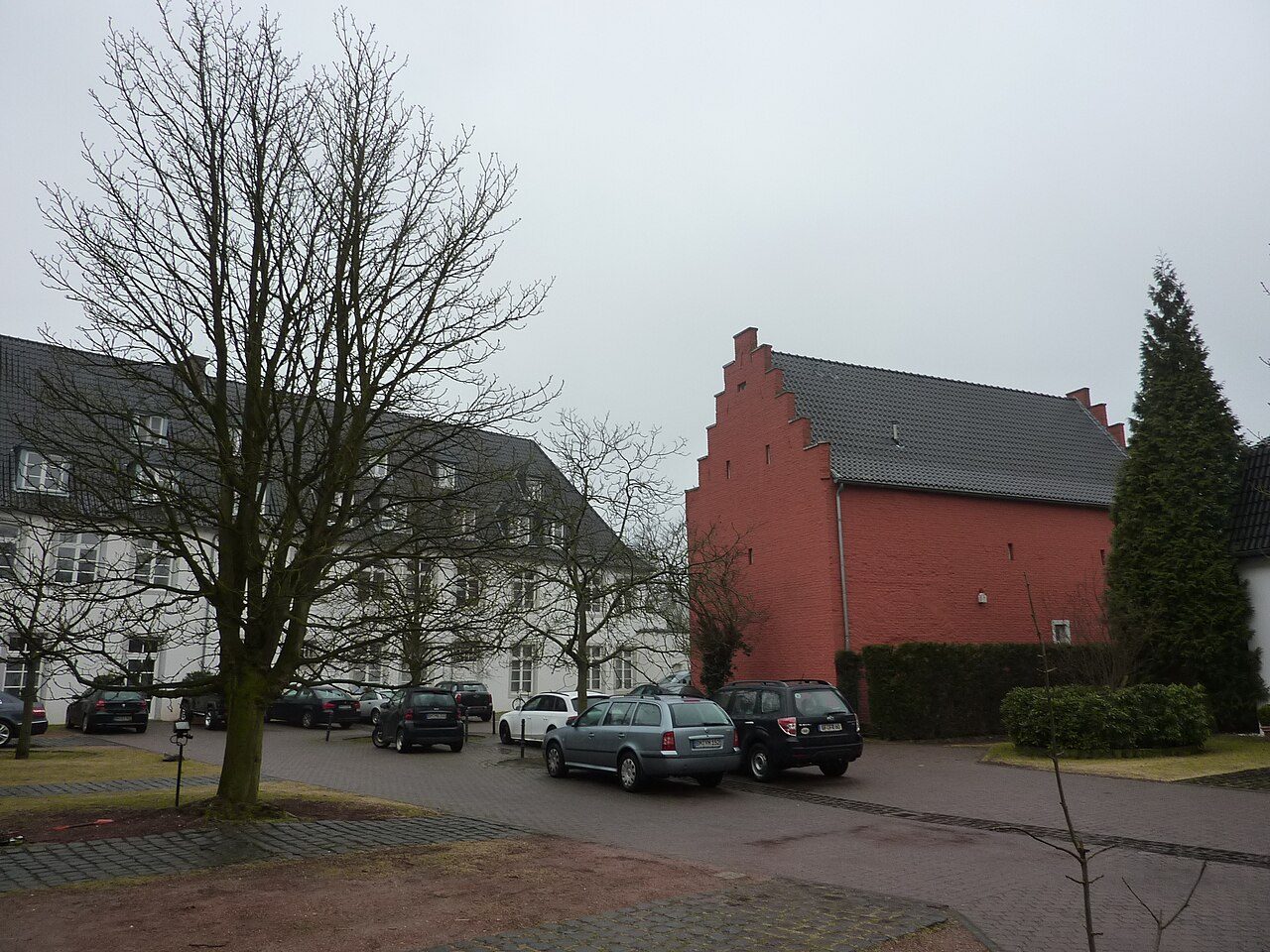
The former Benedictine convent of Königsdorf, located in the Königsdorf district of Frechen in the Rhein-Erft-Kreis, North Rhine-Westphalia, is a historically significant sacred building. Today, it is a protected monument and bears witness to a long monastic tradition in the region.
History+
Location+
The former Benedictine convent is situated in the Königsdorf district of Frechen, nestled within the Rhein-Erft-Kreis in North Rhine-Westphalia, Germany.
On site+
No traces or excavation findings of the original convent church of St. Mary are known. However, within the current convent courtyard, several vaulted rooms, partly in a Gothic stepped-gable house, and parts of the cloister have been preserved. Romanesque structural elements can still be found in the northern wing of the cloister and in the gatehouse. The exact function of the Gothic vaulted hall in the stepped-gable house remains unclear. Also preserved are the crucifixion group of Großkönigsdorf and the Roman Aegidius Chapel on a farm in Hücheln that originally belonged to the convent.
Nearby+
- Brauweiler Abbey (Pulheim) (Sacred building, approx. 3414 m away)
- Freimersdorf Manor (Manor house and estate, approx. 3426 m away)
- Hemmersbach Castle (Horrem) (Castle, approx. 4104 m away)
- Marienburg Manor (Ichendorf) (Manor house and estate, approx. 4412 m away)
Take Mobile History with you
You are reading this text for free. Premium adds what matters on the road: descriptions read aloud, sites found through your camera, whole regions taken offline.
- Every description, including the ~17,700 Premium sites
- Audio guide: have descriptions read to you on location
- AR finder: see sites through your camera, with distance and bearing
- Unlimited saved sites
14 days free, then from €2.99 a month. Cancel anytime.
Location: 50.9353, 6.7567