Abbey
MonasteryMichaelbeuern
Benediktiner Abbey Michaelbeuern
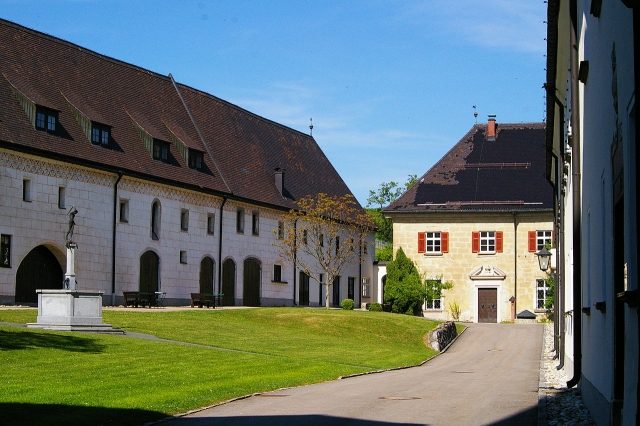
The Benedictine Monastery of Michaelbeuern, an abbey, is situated in the Salzburg region of Austria. It is renowned for its long history, dating back to the 8th century, and its significance as a spiritual and cultural center in the region.
History+
The origins of Michaelbeuern Monastery can be traced back to the 8th century, when a monastic cell existed around 736, listed as "Buria" in the Aachen monastery directory in 817. Following an interruption due to the Hungarian Wars, reconstruction began in 977, supported by a donation of goods from Emperor Otto II. Under Count Palatine Hartwig I, the abbey was refounded and supported by prominent local families in the High Middle Ages. In 1072, the Romanesque pillar basilica was consecrated, and Michaelbeuern briefly developed into a noble double monastery. Werigand, the first abbot known by name, led the monastery from 1072 to 1100. Under Abbot Walther (1161–1190), the monastery experienced a flourishing period, during which, among other things, the Giant Bible was acquired. From the 12th century onwards, the monks increasingly took on pastoral duties in surrounding communities. Despite crises such as the fire of 1364 and the effects of the Reformation, the monastery consolidated from the 17th century. During this time, monks taught at the Benedictine University of Salzburg, and artists such as Meinrad Guggenbichler and Johann Michael Rottmayr created the high altar of the abbey church.
Source: Wikipedia · Licence: CC BY-SA 4.0 · Image: http://commons.wikimedia.org/wiki/File:Abtei_Michaelbeuern.JPG?uselang=de
This description draws on the facts documented in the linked Wikipedia article; Wikipedia content is licensed under CC BY-SA 4.0. Wording and editing: Mobile History.
Location: 48.0203, 13.0294