Hotel
Beningaburg Castle

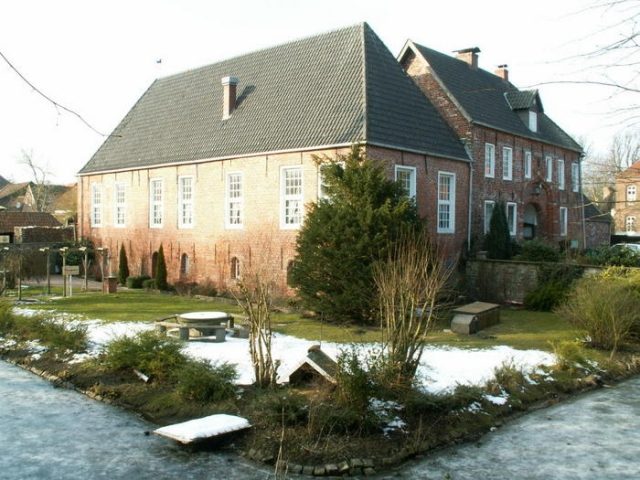
The Beningaburg is a medieval lowland castle in Dornum in the district of Aurich in Lower Saxony, Germany.
As early as 1400, there were three chieftain's castles in Dornum: the Westerburg, Norderburg, and Osterburg – the latter becoming the Beningaburg.
According to legend, olde Hero Attena (of Dornum) built the moated castle between 1375 and 1380. In 1410, his son Enno initially inherited the Osterburg. Enno's son Sibold (olde Sibo) married Frauwa, daughter of Enno Edzardisna and Gela von Manslagt, and thus sister of Ulrich and Edzard Cirksena. Sibet probably died in the Battle of Bargebur in 1433. His son Sibet Attena married Onna von Stedesdorf in his first marriage, who bore him a son, Hero Omken the Younger, among others. Sibet was present at the solemn conferral of the Imperial County to Ulrich in the Gasthauskirche in Emden and was knighted on this occasion. Sibet Attena was a loyal follower of Ulrich. When Ulrich was once again in dispute with Tanno von Wittmund, Sibet advanced, appeared before the Kankenaburg in Wittmund on Christmas Eve 1457, and penetrated the castle. Sibet built a new castle in Wittmund. In the agreement of 1461, Tanne Kankena had to relinquish his castle in Wittmund and received the Osterburg in Dornum as compensation. In 1473, Sibo Attena died, and his son Eger Kankena († 1497) inherited the castle.
Subsequently, Eger's third son, Remmer Kankena, became the new lord of the castle. He remained childless. After his death in 1545 (?), the Osterburg fell to his sister Nona, who was married to Folkmar I. Beninga von Grimersum. In 1512, both died of the plague. Their son Garrelt, who married Cäcilie von Closter in 1533, followed as the new owner but died as early as 1546. Thus, it was his son Folkmar II. Beninga († 1572) who consolidated the Beninga rule on the Osterburg: The Dornum line of the Beninga family subsequently shaped the history of the castle for almost 200 years – until 1717. Since that time, the small castle has borne the name Beningaburg, and the passing street is called Beningalohne. The Lantzius-Beninga family took over the succession.
The east wing, destroyed in 1547, was restored in 1567. In 1669, the south wing was renovated under Boyung Beninga. The joint coat of arms above the door dates from this period: Beninga / Ehrentreuter. The end of the Beninga is linked to the death of Folkmar Eger Beninga, the last male representative, in 1717. Until 1802, the noble character of the castle persisted in the female line. In 1814 and 1817, there was a transition into private hands.
Since 1817, when the castle was sold, numerous private changes of ownership have been recorded. Finally, in 1971, the Dornum merchant Erich Appelkamp was able to purchase the Beningaburg. The restoration and redesign to its current state took almost 8 years and was completed in 1978. Surrounded by old trees and the moat, the Beningaburg is now used as a hotel with a tea room. Pictures of the Beninga family lineage can be viewed in the ancestral hall of the castle.
Take Mobile History with you
You are reading this text for free. Premium adds what matters on the road: descriptions read aloud, sites found through your camera, whole regions taken offline.
- Every description, including the ~17,700 Premium sites
- Audio guide: have descriptions read to you on location
- AR finder: see sites through your camera, with distance and bearing
- Unlimited saved sites
14 days free, then from €2.99 a month. Cancel anytime.
Source: Wikipedia · Licence: CC BY-SA 4.0 · Image: http://www.wehrbauten.de/thread.php?threadid=554
This description draws on the facts documented in the linked Wikipedia article; Wikipedia content is licensed under CC BY-SA 4.0. Wording and editing: Mobile History.
Location: 53.6474, 7.4298