Cultural Events
Bergschlössl

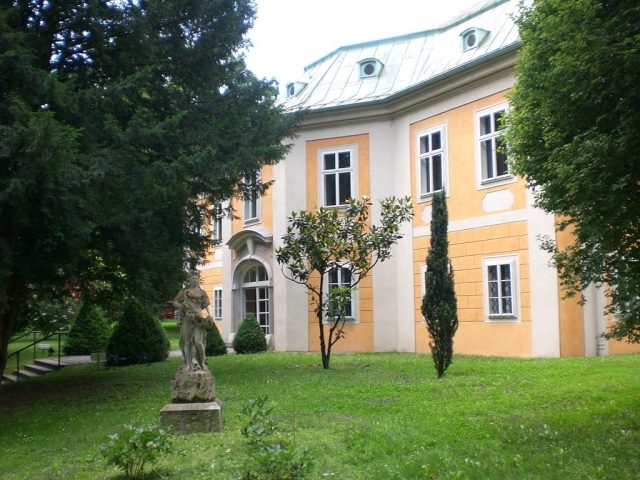
The Bergschlössl is a baroque building in the Linz Volksgarten district, which was erected between 1717 and 1718.
The house, situated in a large park, consists of three floors with 9 rooms. In the 15th century, the property belonged to the so-called Stockhof, a princely fief, and was purchased by the city of Linz in 1708 to extract clay and erect a brick shed.
From 1717 to 1718, the current Bergschlössl was built on part of the area by the Linz-born master builder Johann Michael Prunner, with the responsible client being the syndic and secretary of the estates, the imperial Johann Jakob Mäderer von Ehrenreichscron. A wall with a three-door portal system surrounded the house and garden.
In the past, the building had the house number Linz 743, and the Count of Hohenwart had his seat in the small castle. The baroque building came into the possession of the Jesuit College Nordicum in 1773, under Father Regens (1777 to 1787). The next owner after Father Regens was Count Sigmund Anton von Hohenwart, who again sold it to the Collegium Nordicum. Wall paintings in the Sala Terena, for which the park served as a model, date from the 18th century, from the time of Johann Ignaz Schiffermüller. Paintings also exist in the Octagon room and the Pompeian bath, which are located on the first floor and also date from the 18th century.
Subsequently, the small castle changed hands several more times: Johann Gottfried Graf von Thürheim, Graf Johann Anton von Weißenwolff, Graf Gottfried Clam, Graf Otto von Hohenfeld were successive owners. When the property was bought by Robert Weingärtner in 1902, he had the castle and the park redesigned. The Art Nouveau conservatory at the main entrance dates from this period. Towards the end of the Second World War, the Bergschlössl was no longer inhabited and the garden was no longer cultivated.
In 1986, the city of Linz bought the Bergschlössl, which then almost fell victim to a fire in 1987. Extensive renovation took place between 1992 and 1998, with Peter Riepl as the responsible architect. The building was reopened in 1999.
The Bergschlössl Park+
The park was laid out in the 18th century, under the guidance of one of the most successful natural historians of the time, Ignaz Schiffermüller. The purpose of the complex was a botanical course at the Nordic Abbey (today Aloisianum). The park, designed according to ecological principles and covering approximately three hectares, has been under the supervision and care of the Linz City Gardens of the Magistrate since 1989 and is one of the first "botanical-economic parks" in Upper Austria. The grounds are freely accessible to the public. According to the tree inventory recorded by the City Gardens, the park contained 54 different tree species in 2007. From Schiffermüller's time, some rarities still exist, such as an American tulip tree and Asian yews on both sides of the terrace. Of the 400 individual woody plants, Norway maples and ash trees are the most common. Stone figures of Ceres, putti with fruits, and vases adorn the garden.
Baroque Inscription+
The city-side entrance portal is inscribed with a short Baroque poem. The inscription reads (original spelling):
- One may adorn palaces / With the most beautiful painting Zeuxis may wield the brush / Yet it is only a copy compared to what forest and field / Present in the original
Miscellaneous+
Franz Racher, a professor of physics, launched two balloons with a diameter of two feet from the park of the castle on September 12, 1784, one year after the Montgolfier brothers' balloon launch in Paris, which was reported in the Linzer Ordinari-Zeitung.
Current Use+
The building, which has belonged to the city of Linz since 1986, is managed by the Design Center Linz Betriebsgesellschaft and is leased to the LIMAK Austrian Business School. It is primarily used for receptions, banquets, seminars, etc.
Take Mobile History with you
You are reading this text for free. Premium adds what matters on the road: descriptions read aloud, sites found through your camera, whole regions taken offline.
- Every description, including the ~17,700 Premium sites
- Audio guide: have descriptions read to you on location
- AR finder: see sites through your camera, with distance and bearing
- Unlimited saved sites
14 days free, then from €2.99 a month. Cancel anytime.
Source: Wikipedia · Licence: CC BY-SA 4.0 · Image: http://commons.wikimedia.org/wiki/File:Linzer_Bergschl%C3%B6ssl.JPG
This description draws on the facts documented in the linked Wikipedia article; Wikipedia content is licensed under CC BY-SA 4.0. Wording and editing: Mobile History.
Location: 48.2909, 14.2857