CastleObernzenn

Blue and Red Castle Obernzenn
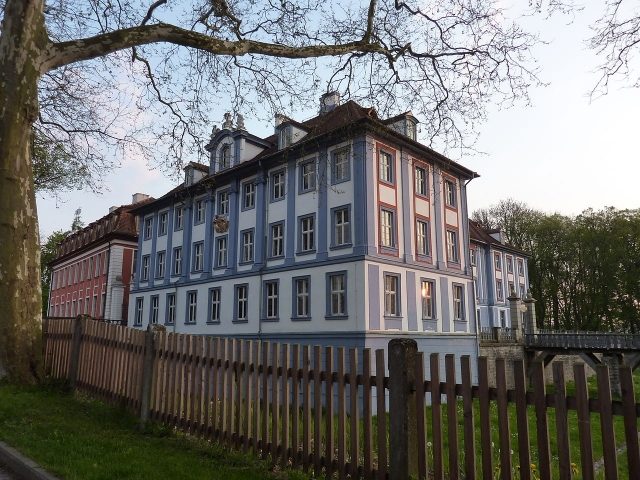
Blue and Red Castle Obernzenn

Museum

The Blue Castle

Already in the Middle Ages, a fortified complex surrounded by a moat stood on the site of the present castle. The Barons of Seckendorff-Gutend used the foundations of the previous building to erect the Red Castle next to the Blue Castle in 1745.

The construction of the Blue Castle, however, had already begun in 1696 by the von Seckendorff-Aberdar family. A second construction phase followed from 1711 to 1718, a third from 1756 to 1758: In 1696, the Ansbach chamberlain Christoph Sigmund von Seckendorff-Aberdar had received the old castle of the Aberdar family and begun the construction of the present north wing of the Blue Castle. The second construction phase goes back to his son Philipp Albrecht, who was also a chamberlain in Ansbach. He probably enlisted the court architect Gabriel de Gabrieli for the planning of the east wing. Christoph Ludwig von Seckendorff-Aberdar, Christoph Sigmund's grandson, finally had the west wing built. He was Prime Minister and Privy Councillor President and, in this function, the most important advisor to Margrave Carl Wilhelm Friedrich von Brandenburg-Ansbach. The building was adorned in 1759 with an alliance coat of arms of the Seckendorff and Cronfeld families, created by the sculptor Philipp Hochstein from Ansbach.

The garden was planned by Christoph Ludwig von Seckendorff-Aberdar and Franz Felix Schack. However, the ideas of the court building director Leopoldo Retty may have been behind the designs. In 1742, the castle moat was spanned by an oak bridge with a cast-iron railing.

The two late Baroque castles in Obernzenn are named after the predominant colors in their facade design.

The east wing of the Blue Castle can be visited as part of guided tours. It contains a picture gallery with family portraits from the 17th and 18th centuries and various reception rooms decorated with stucco. A museum workshop offers projects on themes related to absolutism.

The Red Castle

The Red Castle in Obernzenn is an 18th-century Baroque castle, named after its predominant facade color.
History

From the 13th century, the von Seckendorff family ruled in Obernzenn. Both the Red and the Blue Castle in Obernzenn stand on the remains of a medieval castle complex. While the Blue Castle was built in three construction phases, the Red Castle was built from 1745 by Johann Wilhelm Gottfried Freiherr von Seckendorff-Gutend, who was a Bavarian Field Marshal General and Knight Councillor of the Altmühl Knight Canton. He had the castle built on the occasion of his marriage to his third wife Franziska Friederica von Stain zum Rechtenstain und zu Bächingen. He died two years after construction began.

The plans for the regular three-wing complex, which shares the courtyard with the neighboring Blue Castle, probably came from Leopoldo Retty. The construction was carried out by Johann Jakob Fraas and Johann David Steingruber, who was the Ansbach regional building inspector. Steingruber succeeded Retty in the post of Ansbach court architect.

The Red Castle is a simple and regular building, whose facades are structured by pilaster strips and wall panels. Above the entrance door is the coat of arms of the von Seckendorff family with the year 1745. Inside the castle are further representations of coats of arms. The ceiling paintings in the two staircases show genii holding coats of arms.

The Red Castle now houses a museum education workshop.

Take Mobile History with you

You are reading this text for free. Premium adds what matters on the road: descriptions read aloud, sites found through your camera, whole regions taken offline.

  • Every description, including the ~17,700 Premium sites
  • Audio guide: have descriptions read to you on location
  • AR finder: see sites through your camera, with distance and bearing
  • Unlimited saved sites

14 days free, then from €2.99 a month. Cancel anytime.

Source: Wikipedia · Licence: CC BY-SA 4.0

This description draws on the facts documented in the linked Wikipedia article; Wikipedia content is licensed under CC BY-SA 4.0. Wording and editing: Mobile History.

Location: 49.4504, 10.4643