MonasteryHünfeld

Bonifatius Abbey (Hünfeld)
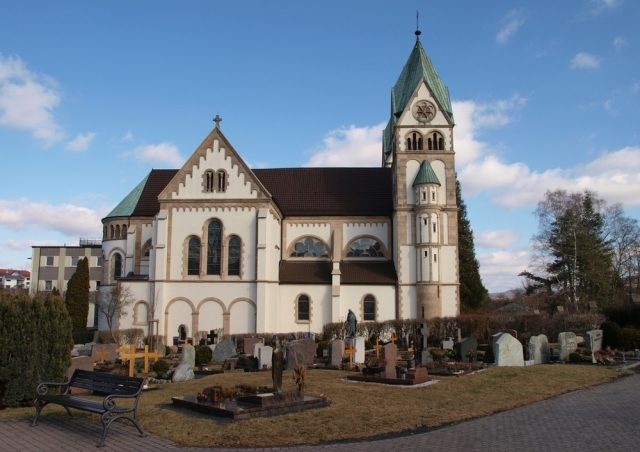
Bonifatius Abbey (Hünfeld)

Monastery operation

The Bonifatius Monastery was founded in 1895 and is a Catholic monastery in Hünfeld in the Fulda district. It is the mother house of the Central European Province of the Oblates (OMI) ("Hünfeld Oblates"), newly founded on May 21, 2007, and a former philosophical-theological university.

In Hünfeld, the first branch of the German Province of the Missionary Oblates was founded in 1895, which is why they are also called Hünfeld Oblates in German-speaking countries.

The church and the monastery complex were designed by the Paderborn Cathedral and Diocesan Master Builder Arnold Güldenpfennig. Construction began in 1896 and was completed in 1900.

The monastery developed steadily and housed a philosophical-theological university and a training center for young religious. At times, over 100 religious students as well as 50 fathers and brothers lived in Hünfeld.

30 years after the new building was completed, an extension was built in 1930.

During the Third Reich, the monastery was expropriated in 1941 and the Missionary Oblates were expelled. Resettlement took place in 1946 after the end of World War II.

The monastery underwent a change in 1971 when the university was closed and the monastery was reoriented to function as a retreat and conference center. Since the mid-1970s, the Bonifatius Monastery has housed the Oblate novitiate.

In 1983, a nursing station was opened where Oblates in need of care live.

Since 2003, the OMI Youth Office has been located in the monastery, coordinating youth work in the Central European Province of the Order.

In 2011, the monastery included 37 Oblate fathers and brothers, 2 novices, and 4 postulants. The monastery is considered a spiritual center and has over 10,000 conference guests annually. The fathers are active in parish, hospital, prison, and retreat pastoral care in the Diocese of Fulda. The brothers work in the workshops and the conference center.

The Monastery Church+

The Neo-Romanesque monastery church was built between 1897 and 1900 as a cruciform, three-aisled basilica. It houses a six-part window cycle by Agnes Mann, depicting the life of Saint Boniface.

The altar area was redesigned with the renewal of the liturgy. Today, the 20-ton stone altar is the dominant center of the choir space.

The monastery possesses a precious cross relic, set in a massive silver cross reliquary, which was donated to the monastery by Landgravine and Prussian Princess Anna of Hesse.

The Organ

In the monastery church is an organ by the Fulda organ builder Fritz Clewig. The two-manual instrument was built in 1903 and had cone chests with mechanical actions. The organ has been restored, rebuilt (including electrification of the actions, installation of combinations), and its disposition changed several times. It now has 29 registers.

Take Mobile History with you

You are reading this text for free. Premium adds what matters on the road: descriptions read aloud, sites found through your camera, whole regions taken offline.

  • Every description, including the ~17,700 Premium sites
  • Audio guide: have descriptions read to you on location
  • AR finder: see sites through your camera, with distance and bearing
  • Unlimited saved sites

14 days free, then from €2.99 a month. Cancel anytime.

Source: Wikipedia · Licence: CC BY-SA 4.0

This description draws on the facts documented in the linked Wikipedia article; Wikipedia content is licensed under CC BY-SA 4.0. Wording and editing: Mobile History.

Location: 50.6743, 9.7691