The church can be visited
ChurchWrocław (Breslau)
St. Ägidius Church
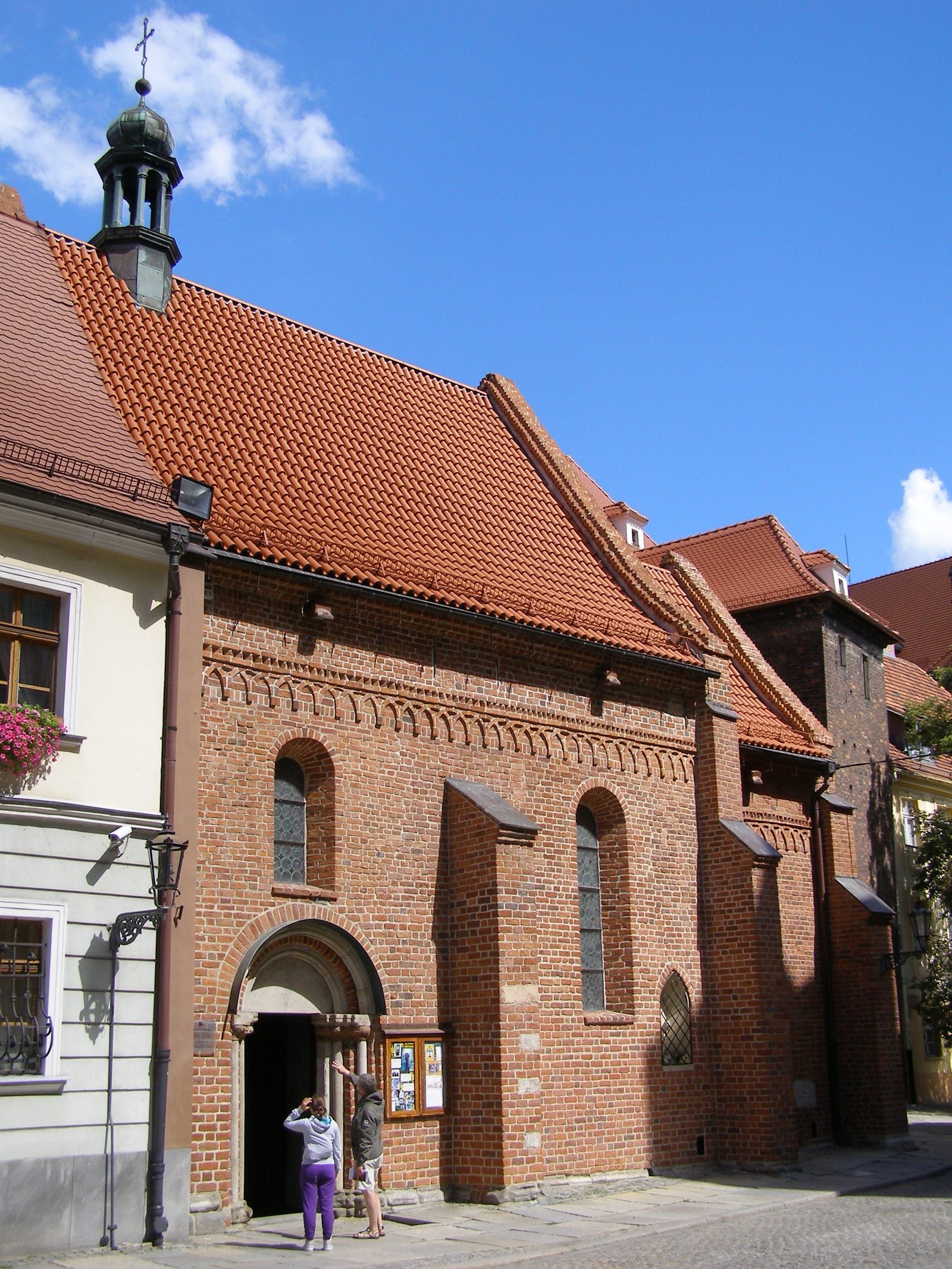
The St. Giles Church in Wrocław (Polish Kościół św. Idziego) is the oldest preserved building in the city. The Roman Catholic church dates from the first half of the 13th century and is named after Saint Giles. Today it belongs to the Parafia św. Jana Chrzciciela (German: Parish of St. John the Baptist). St. Giles Church is located on Wrocław Cathedral Island at Plac Katedralny, in direct proximity to Wrocław Cathedral.
History+
St. Giles Church probably dates from the 1220s, thus before the Battle of Legnica (1241), when Silesia and Wrocław were still largely Polish-speaking. The single-nave church consists of a square presbytery and an apse formed by three sides of a hexagon. In 1329, Bishop Nanker established a third canonry at the church. Around 1500, there were about four altars in the church, three in the nave and choir and the fourth in the sacristy. In the 16th century, a house for twelve clerics who lived together was built next to the church. An archway, the Klösseltor (Polish: Brama Kluskowa or Kluszczana) connected both buildings. In the following centuries, several minor changes were made to the interior. Ornaments were exchanged and reinstalled depending on the epoch.
Franciscan Settlement+
In the 1880s, the Prince-Bishop of Wrocław, Georg von Kopp, had asked the Provincial of the Saxon Franciscan Province (Saxonia), Gregor Janknecht, to send friars to Wrocław to assist in pastoral care, initially as confessors at Wrocław Cathedral. On May 24, 1888, the first Franciscans began this task. On October 30, 1889, the Cathedral Chapter granted them the house at Domplatz 18 for living and the neighboring St. Giles Church for their services. In 1911, the resulting monastery passed from Saxonia to the newly founded Silesian Franciscan Province (Silesia). Initially, two confessors worked in the cathedral, from 1917 three, one of whom had to be proficient in Polish. One friar began confessional service daily at five in the morning, later in the morning there were two. Before and on Sundays and holidays, they offered confession from 4 p.m. to 10 p.m. St. Giles became an important confessional monastery also for clerics, including the Prince-Bishop. The poor and students received a meal at the monastery gate, and the free monastery cells were usually occupied by Franciscans studying at the University of Wrocław. In addition to confessional service, the Wrocław Franciscans also looked after the local group of the Third Order, which by 1939 had grown to 2080 members, making it the largest group in East Germany. From 1918, the Franciscan youth movement also emerged at the monastery, which quickly developed beyond Wrocław in Germany. Under the leadership of Father Norbert Bombis, the Third Order group initiated extensive family aid from the monastery starting in 1924. Two full-time and more than 120 volunteer helpers supported poor families, helped when mothers were ill, and cared for single and helpless elderly people. After slight damage in World War II, renovation work was carried out on the church, during which many Baroque ornaments were removed to restore the church's Romanesque appearance. The Polish diocesan administrator declared that confessional service by Western-oriented Franciscans at the Polish cathedral was inappropriate. This meant the end for the Franciscan settlement.
Take Mobile History with you
You are reading this text for free. Premium adds what matters on the road: descriptions read aloud, sites found through your camera, whole regions taken offline.
- Every description, including the ~17,700 Premium sites
- Audio guide: have descriptions read to you on location
- AR finder: see sites through your camera, with distance and bearing
- Unlimited saved sites
14 days free, then from €2.99 a month. Cancel anytime.
Source: Wikipedia · Licence: CC BY-SA 4.0 · Image: Andrzej Otrębski · Wikimedia Commons · CC BY-SA 3.0
This description is a machine translation of an excerpt from the linked Wikipedia article. The source text was written by its authors, the translation is by Mobile History; like the original it is licensed under CC BY-SA 4.0.
Location: 51.1146, 17.0468