Museum
Brockdorff-Palaisdt)

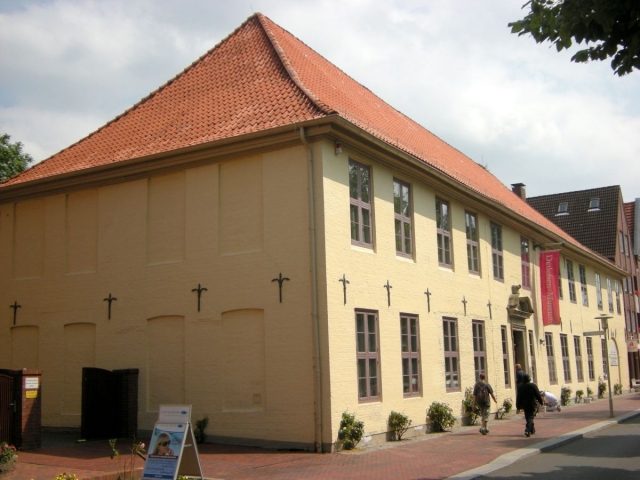
The Brockdorff-Palais in Glückstadt, Schleswig-Holstein, is a former noble residence. Dating from the 17th century, the palace is, along with the Wasmer-Palais, one of the most important secular buildings in the city. It houses the so-called Detlefsen-Museum, a collection on the history of the city of Glückstadt and its surroundings, as well as the city archive.
The Brockdorff-Palais was built during the Thirty Years' War for the then Glückstadt fortress commander Christian Graf von Pentz. Pentz successfully defended the city against Wallenstein's troops in 1627/28 and thus enjoyed the favor of the Danish King Christian IV, who subsequently married the Count to one of his daughters from his morganatic marriage with Kirsten Munk, Sophie Elisabeth. The palace served the Count as a fitting town house in the then flourishing Glückstadt, but due to his drunkenness, he was later dismissed from all offices and died imprisoned at the age of 51.
Subsequently, the house changed owners several times and was converted by its new owners from a late Renaissance town house into a modern Baroque palace. In 1727, it came into the possession of the Chancellor Rheder and from 1802 to 1877, for three generations, it was owned by the ancient noble Holstein family Brockdorff. The head of the Schleswig-Holstein Chancellery in Glücksburg and later president of the Higher Court of Appeal in Schleswig, Cay Lorenz von Brockdorff, gave the house its current name. From 1900, the palace housed the Glückstadt district court for 35 years. Due to increasing structural defects, demolition was threatened in 1962, followed by a first renovation. The current museum found its place in the house from 1969, which was restored again in 1992.
Building History
The palace was built from 1631 to 1632 by the master builders Willem van Steenwinckel and H. Bolten. It is one of the oldest preserved houses in Glückstadt, where many buildings from the time of the city's founding – including Glückstadt Castle – later had to be demolished due to insufficient foundations in the damp building ground. The palace is an elongated, thirteen-axis house, with its eaves side facing the canal. The building was originally completely unplastered; the walls, built from alternating layers of red and yellow bricks, are now only visible on the courtyard side.
In 1727, the originally nine-axis building was extended by four window axes to the west, the rear wing was added, and a chapel facing the courtyard and the stair tower were demolished. In place of the stair tower, a representative staircase with a wooden flight of stairs was inserted behind the main portal, and the portal received its Baroque ornamentation. On the canal side, three en filade rooms with painted wooden ceilings from 1695 have been preserved.
The Museum+
The museum's collections originated in 1893 at the suggestion of the Glückstadt teacher Detlef Detlefsen, who also gave the house its current name. They contain testimonies to the founding of Glückstadt and its development. On display are, among other things, a preserved farmer's parlor, the former city pharmacy, and rooms depicting bourgeois living culture. Furthermore, there are testimonies to the once leading economic sectors here, such as agriculture, herring fishing, and whaling.
Take Mobile History with you
You are reading this text for free. Premium adds what matters on the road: descriptions read aloud, sites found through your camera, whole regions taken offline.
- Every description, including the ~17,700 Premium sites
- Audio guide: have descriptions read to you on location
- AR finder: see sites through your camera, with distance and bearing
- Unlimited saved sites
14 days free, then from €2.99 a month. Cancel anytime.
Source: Wikipedia · Licence: CC BY-SA 4.0 · Image: http://schloesserrundschau.de/schleswig/schloesser/steinburg03.html
This description draws on the facts documented in the linked Wikipedia article; Wikipedia content is licensed under CC BY-SA 4.0. Wording and editing: Mobile History.
Location: 53.7889, 9.4220