Museum
Brömserburg Castle
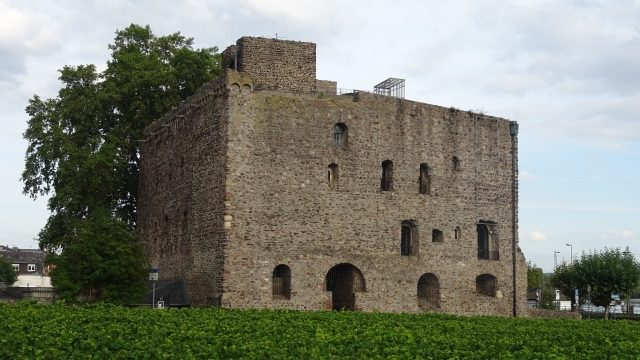
The Brömserburg (also called Niederburg) is located in Rüdesheim am Rhein in the Rheingau-Taunus district in Hesse, near the banks of the Rhine. In its origins, it is probably one of the first permanent castles in the UNESCO World Heritage Upper Middle Rhine Valley.
Older literature (from the 19th century until the 1980s) assumed that the Brömserburg was built on the foundations of a Roman fort. However, no ancient building fabric could be verified, and in particular, it could not be proven that it was, as previously assumed, a watchtower or bridgehead to Bingium (Bingen am Rhein) on the left bank of the Rhine. Since this fort was only built in the 4th century, the thesis is not conclusive, as the Romans had already withdrawn from the right bank of the Rhine at that time after the fall of the Limes.
Two construction phases are documented. Research is not in agreement about the dating of the first phase (the theses range from an early medieval royal Salhof before 980 to a complex from the mid-12th century). The examination of an alder pile from the foundation of the southeast tower, which is considered the oldest part of the castle, showed that the start of the tower construction cannot be dated before 1044 and not after 1216.
The end of the 12th century (1186-1190) has been identified as the conclusive construction period for the second complex.
The shape of the castle already corresponded essentially to its current dimensions in the first construction phase. It was secured by a ring wall with a moat; according to historical engravings, the Rhine flowed directly along the south front at that time – in contrast to today, where a road and a wide bank zone lie between the castle and the water. However, the ring wall was thinner than today (1.6-1.7m) and lower. In the southeast corner, which has since been blown out, there was a residential tower (donjon). The tower still existing diagonally opposite also dates from this first phase and served to defend the gate (gate tower) and as a keep. Its height at that time reached the upper edge of the current battle platform.
In the second construction phase, the outer wall was reinforced, bricked over, and raised. Buildings were added to the donjon up to the same upper edge, which are completely vaulted in up to four stories (a unique construction on the Rhine); thus, a four-winged complex was created. At the same time, a new, massive keep was erected in the middle of the castle courtyard, which was raised, and which was built in conjunction with the adjacent parts of the second phase without joints. This originally had a wall thickness of more than 4 m in the lower section and was estimated to be approx. 35 m high. The entrance situation of the new large keep (the entrance is on the uppermost, still existing floor) makes it clear that it must have been significantly higher than it appears today; it clearly protruded beyond the adjacent parts and thus gave the castle a much less "clumsy" impression than the current complex.
In the 13th century, the Brömser family from the Wispertal is documented as the castle lords, in whose feudal-free property the castle was held by the Archbishops of Mainz.
In 1640, the Rhine-side southeast corner was blown up during the Thirty Years' War by the French troops of Duke Henri II d'Orléans; the upper part of the keep and the donjon were also destroyed. A mine shaft was driven into the keep; however, it was not detonated, so it is still visible today.
The repeatedly read assertion that the Brömser von Rüdesheim family inhabited the castle from 1548 until the extinction of the line in 1668 is incorrect. Rather, it is correct that after the extinction of the main line of the 'von Rüdesheim' family with Melchior von Rüdesheim in 1538, the Brömser gradually came into possession of their Rüdesheim fiefs, which also included the Niederburg. However, the Brömser never lived there, but always in their estate called 'Brömserhof' at Oberstraße 29 in Rüdesheim. After the extinction of the Brömser, the Archbishop of Mainz granted the fief in 1678 to Emmerich von Metternich, an heir of the Brömser von Rüdesheim family. Since the castle remained uninhabited, it fell into ruin in the 18th century and was initially called "Brömser's Dog Kennel", later "Metternich's Dog Kennel".
After 1811, the new owners - the Counts of Ingelheim - carried out a romanticized conversion into a country estate. In the south wing, these "additions" were removed again during a renovation in the 1950s.
The castle was inhabited until 1937; in 1941, the city of Rüdesheim bought it. Since 1950, it has housed the "Rheingau Wine Museum" with exhibits on wine culture from antiquity to the present day. In 1961, the destroyed southeast corner was reconstructed, and the keep was raised again to a height of 27 m in 1969.
Castle Complex+
The current massive, cuboid building consists of four three-story, flat-roofed wings with 4 to 5 m thick masonry and small round-arched window openings around a narrow rectangular inner courtyard. The medieval moats have been filled in. The northwestern defensive tower from the first phase before 1200 is still preserved.
In the southeastern inner corner of the complex, the square keep, rebuilt on its undamaged stump, rises, on which there is now an accessible viewing terrace.
The interior rooms are barrel-vaulted and groin-vaulted. Due to the extensions and alterations in the 19th century, the original layout is no longer traceable.
The complex is surrounded by a small park that is integrated into the museum.
Rheingau Wine Museum+
The operator is the company of the Rüdesheim family Wendel, who also maintains Siegfried's Mechanical Music Cabinet, a collection of historical musical instruments.
The barrel-vaulted entrance area is flanked by two medieval knight's armors, which emphasize the original function of the castle; however, the museum's theme is the equally ancient viticulture in the Rheingau from the Middle Ages to modern times. Using documentary material and tools, grape varieties and cultivation methods, the work of the winemaker, the cooper, and the cellar master are explained. The history of the wine barrel and the wine bottle in their variable designs up to the EU standard bottle since 1977 is also explained. Another collection concerns corks and labels. A special room is dedicated to the oldest Rüdesheim wine and sparkling wine wholesaler Dilthey, Sahl & Co. (1815-1969), which preferentially supplied the Russian tsars until 1917.
The counterpart to the documentation of viticulture and wine trade is a representative ceramic and glass collection of pitchers and drinking vessels for wine from a cultural-historical point of view.
The oldest exhibits include prehistoric and early historical ceramic vases and sculptures from Egypt and the Near East, the Minoan period, and the Villanova culture. Ancient wine was more acidic than the beverage cultivated today and was mixed with water or mead.
From the Roman Empire, in addition to ceramic vessels, there is a small assortment of simple utility glass.
Furthermore, the collection provides a vivid cross-section through all epochs of European glass history:
- Medieval forest glass from the Krautstrunk to the classic Römer of the 18th century with prunts, furthermore historicist Römer in variable colors and decors;
- Glass à la façon de Venise with wing decors, thread and net glass;
- Baroque cut glass and stylistically similar historicist glass (19th century);
- Baroque goblets with enamel painting and historicist glass in this style;
- View glasses of the Biedermeier period, especially with views of the Rhine;
- Little Art Nouveau and Art Deco glass, for example, serially produced utility glass based on designs by Lalique.
The museum has declared a Nuremberg coconut goblet (around 1600) with finely elaborated baroque gold decor and an ivory goblet (around 1800) with putti reliefs as its most art-historically valuable exhibits.
During the tour through the exhibition rooms, several staircases provide access to the various wings within the massive masonry around a small inner courtyard. One ascends the keep with a viewing platform to the south over the Rhine to Bingen with its Rochusberg, as well as upstream into the Rheingau.
The museum also includes the castle garden, where historical wine presses (the oldest from 1594), barrels and transport equipment, as well as a sandstone sculpture of a winemaker carrying a grapevine, are exhibited.
Take Mobile History with you
You are reading this text for free. Premium adds what matters on the road: descriptions read aloud, sites found through your camera, whole regions taken offline.
- Every description, including the ~17,700 Premium sites
- Audio guide: have descriptions read to you on location
- AR finder: see sites through your camera, with distance and bearing
- Unlimited saved sites
14 days free, then from €2.99 a month. Cancel anytime.
Source: Wikipedia · Licence: CC BY-SA 4.0 · Image: Jörg Heldt
This description draws on the facts documented in the linked Wikipedia article; Wikipedia content is licensed under CC BY-SA 4.0. Wording and editing: Mobile History.
Location: 49.9776, 7.9177