The church can be visited
ChurchBraunau am Inn
Bürgerspital Church
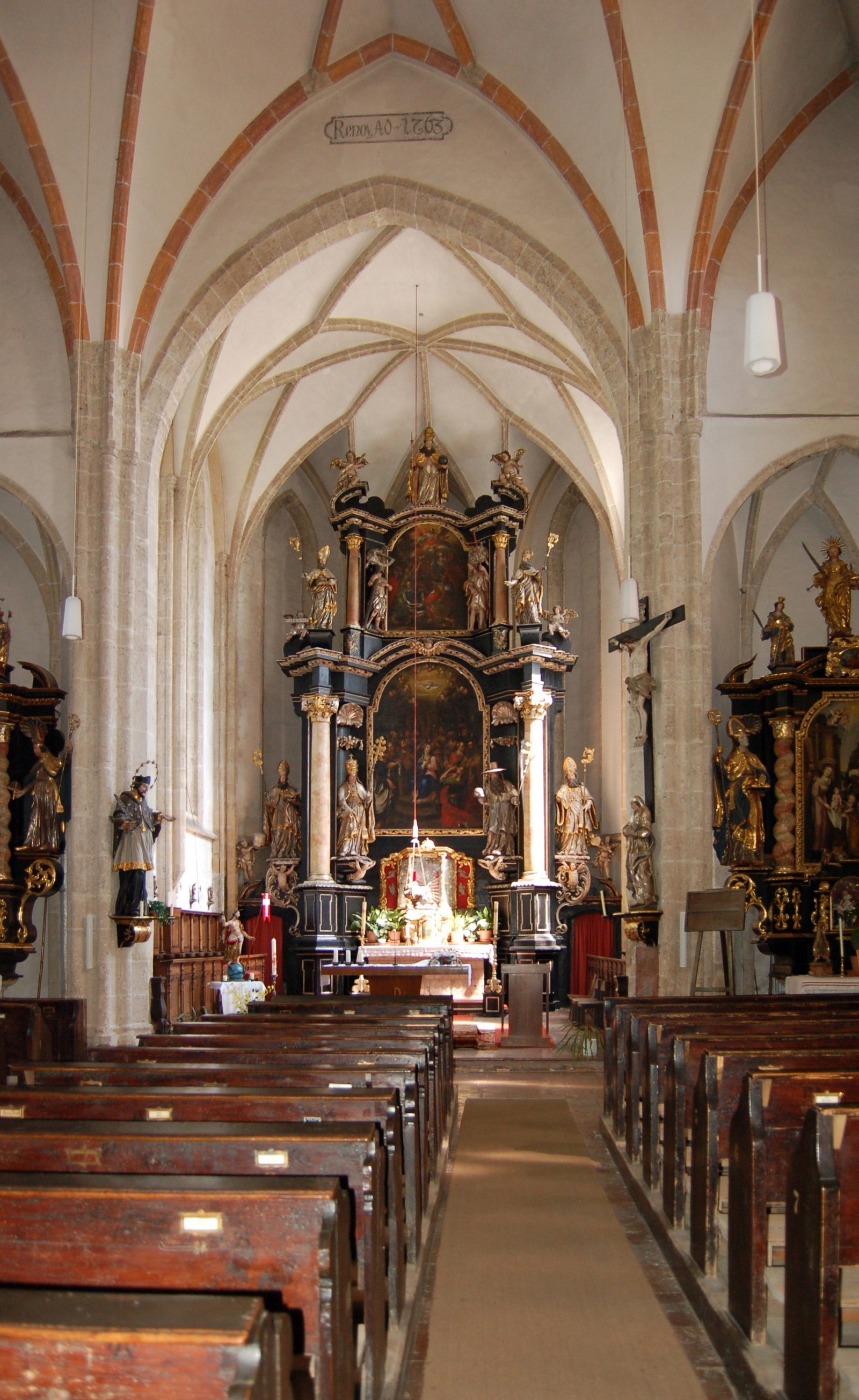
The Bürgerspitalkirche is the medieval hospital church of the city of Braunau am Inn. The Braunau Bürgerspital was founded in 1417 by the nobleman Hartprecht Harskircher of Zangberg Castle, chamberlain to Duke Frederick the Wise of Bavaria-Landshut, and Nikolaus Auer von Lichtenau. The construction of the hospital and church was completed around 1430 and served as a home for the elderly until 1956.
Architecture+
The interior of the Bürgerspitalkirche is designed as a so-called three-pillar building, in which a western pair of pillars supports the gallery system and a central pillar, which was removed in 1687 for improved sightlines to the choir, supported the nave vault. The space is enclosed by a stellar vault formed by three-ribbed stars, as Hans Krumenauer had previously used in the choir of St. Martin's Church in Landshut. The involvement of the Landshut master builder Hans von Burghausen is assumed for the construction of the Braunau church, who had first experimented with similar spatial solutions in the Holy Spirit Church in Landshut or the choir of the Franciscan Church in Salzburg. The Bürgerspitalkirche is considered a prototype for a series of similar three-pillar buildings, such as the parish church of Eggelsberg and the parish church in Anger. Adjoining the church building on the north side is a tower with a square footprint, which transitions into slender octagonal stories accompanied by pinnacles at the height of the church roof. West of the church building is the actual hospital wing, which contained the two common rooms on the ground floor and the individual rooms of the gentlemen pensioners on the upper floor, from which there was direct access to the gallery. The rooms of the hospital are consistently cross-rib vaulted.
Furnishings+
The furnishings mainly date from around 1700. The altars were built using late Gothic altar tables. The high altar is formed by a mighty column retable with a corresponding altar extension, attributed to Sebastian Högenauer; the paintings were created in 1697 by Johann Froschauer. The altarpiece depicts the Pentecost event with Mary in the midst of the apostles, and the Ascension of Christ can be seen in the extension. The statues depict the Church Fathers. The side altars were erected in 1689 and 1691 in front of the side apses. Uniform baroque retables with twisted columns show segmental pediments with coat of arms cartouches above the central field. The left altarpiece depicts the Fourteen Holy Helpers, the right Epiphany altar shows the Adoration of the Magi. The pulpit from around 1690 consists of a rectangular basket with pilasters and projecting columns at the beveled corners and is also attributed to Högenauer; the sounding board bears a figure of Saint Michael. Among the individual figures, the triumphal arch statues of Saint John of Nepomuk and a crucifix with a Mater Dolorosa are also works from the end of the 17th century; a baroque group of the Throne of Grace is attached to the gallery between the central arcades; Högenauer's authorship is also suspected here.
Organ+
In 1912, Albert Mauracher (1856–1917) from Salzburg created a new organ with 7 registers. He housed it in a baroque organ case from around 1700. The original disposition was:
Couplers: Pedal coupler, super and sub-octave coupler in the manual and pedal octave coupler. 4 collective pedals: Piano, Mezzoforte, Pleno and various hand registers. Later, Gamba 8′ and Dolce 8′ were replaced by Octave 2′ and Quinte 1 1⁄3′.
Bells+
The peal is something very special; both bells date from the Middle Ages and still have their original clappers in the medieval bell frame, and another special feature is that both bells are still rung by rope. The bells sound in the notes B♭′ and D♭″ and were cast in 1477 by Jörg Gloppitscher in Salzburg.
Take Mobile History with you
You are reading this text for free. Premium adds what matters on the road: descriptions read aloud, sites found through your camera, whole regions taken offline.
- Every description, including the ~17,700 Premium sites
- Audio guide: have descriptions read to you on location
- AR finder: see sites through your camera, with distance and bearing
- Unlimited saved sites
14 days free, then from €2.99 a month. Cancel anytime.
Source: Wikipedia · Licence: CC BY-SA 4.0 · Image: Michael Kranewitter · Wikimedia Commons · CC BY-SA 3.0
This description is a machine translation of an excerpt from the linked Wikipedia article. The source text was written by its authors, the translation is by Mobile History; like the original it is licensed under CC BY-SA 4.0.
Location: 48.2575, 13.0370