Hotel
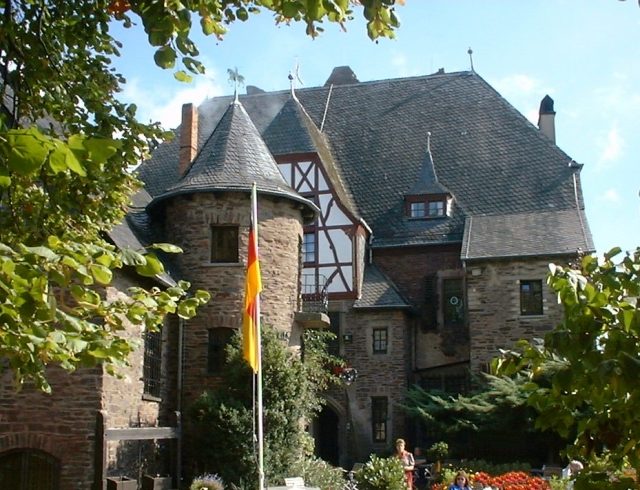
Arras Castle

Arras Castle is a hilltop castle founded in the early 12th century on the Moselle, not far from the municipality of Alf in the Cochem-Zell district of Rhineland-Palatinate.
During late antiquity, a late Roman fortified hilltop settlement was built on the site of the later hilltop castle. Similar structures are common in the Eifel and Hunsrück regions. After the withdrawal of the Romans, only a wasteland remained for several centuries.
Arras Castle was first mentioned in writing in 1120, when it appeared as "castrum atrebatum" in a document on the occasion of the consecration of the castle chapel. Alleged mentions from the 10th century are probably to be attributed to the realm of legend. Late medieval legends report of the castle's construction during the Hungarian invasions. The frequently encountered assertion that the keep was probably completed around the year 936 cannot be entirely ruled out.
Around 1140, the castle reappears in written tradition. On the occasion of a division, several buildings are mentioned, including a gate, the chapel, and a well, which were used communally, as well as the curtain wall, moat, and a tower belonging to Count Friedrich I of Vianden.
The castle was initially owned by the Palatine Counts, later by the Archbishops and Electors of Trier. In 1137, the castle was conquered by the Lords of Entersburg. The Archbishop of Trier, Albero, subsequently successfully besieged the complex and regained it for the Trier territory. A knightly family named themselves after the castle and resided here.
On October 2, 1439, the castle was granted in equal parts by Archbishop Raban as a fief to the family of Metzenhausen and to the Zandt von Merl.
During the War of the Palatine Succession, the castle was completely destroyed by explosions in October 1689 by the French, who were stationed in the Mont Royal fortress.
In October 1794, the ruin and the associated lands were summarily declared French property by the French revolutionary administration and sold as such.
In 1826, the industrialist Ferdinand Remy from Bendorf acquired the ruin along with 70 hectares of associated forest property.
After Remy's death, the castle passed as an inheritance to his three daughters, who sold it around 1850 to the winery owner Barzen from Alf.
Thereafter, in 1895, the castle passed to the mining director Traugott Wilhelm Dykerhoff from Herne, who had it rebuilt starting in 1907. The monument protection authority of the then Rhine Province approved the reconstruction, including the keep and the remaining wall fragments. The building plans for this came from the Trier church architect Peter Marx (1872-1952).
In November 1838, Dyckerhoff's heirs sold the building to Messrs. Ernst Rademacher, art dealer from Bochum, and Dr. Theo Homburg.
In 1954, the annex known as the Cavalier Wing was rebuilt.
After the death of the two owners (1979 and 1885), they were buried in the castle cemetery. This was possible because a documented, castle-owned right of burial existed from the Middle Ages, which was officially confirmed in 1952.
Thereafter, the castle passed to the Keuthen family from Briedel, who established a hotel and restaurant there, which still exist today.
A part of the estate of the former Federal President Heinrich Lübke is presented by his grandnephew at the castle. In the "Heinrich and Wilhelmine Lübke Memorial Room," visitors can view photos, documents, and guest gifts, among other things.
Keep+
The keep has a rectangular floor plan and is 20 meters high. It was a defensive and residential tower from the Salian period. The walls of the tower are four meters thick and constructed of carefully layered masonry. It originally had only one access on the upper floor, which led to the upper floor of the residential building. This opening is now walled up. Below the tower is a cistern with a capacity of 3.6 m³, which was fed with rainwater from the roofs. This was necessary because the 34-meter-deep castle well is located outside the walls. According to the results of the latest castle research by Stefan Ulrich, due to the bossed ashlar, it is much more likely to consider the keep "as a new building of the mid-13th century, with the period under the building-enthusiastic Archbishop Arnold II (1242 to 1259) offering itself as the period of origin.
Under one of the wall towers was the two-story castle dungeon, which is still well preserved today.
Take Mobile History with you
You are reading this text for free. Premium adds what matters on the road: descriptions read aloud, sites found through your camera, whole regions taken offline.
- Every description, including the ~17,700 Premium sites
- Audio guide: have descriptions read to you on location
- AR finder: see sites through your camera, with distance and bearing
- Unlimited saved sites
14 days free, then from €2.99 a month. Cancel anytime.
Source: Wikipedia · Licence: CC BY-SA 4.0 · Image: http://de.wikipedia.org/wiki/Datei:Burg_Arras1.jpg
This description draws on the facts documented in the linked Wikipedia article; Wikipedia content is licensed under CC BY-SA 4.0. Wording and editing: Mobile History.
Location: 50.0526, 7.1058