CastleBaesweiler

Baesweiler Castle

Baesweiler Castle

Restaurant
Cultural center
Public library

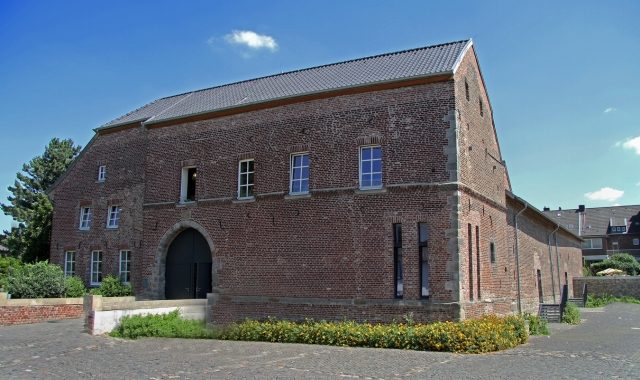
Baesweiler Castle is a castle complex in the town center of Baesweiler in the Aachen city region. The former moated castle has been a protected monument since 1988 and has been used as a cultural center since March 2006, along with a city library, a collection of knight's armor, and a gastronomy area with regular events such as cabaret, concerts, exhibitions, and a municipal cinema. The landmark of the castle and the city is a metal lion sculpture.

Baesweiler Castle is a two-story, four-wing brick complex on a trapezoidal floor plan and an example of a typical Rhineland four-sided farm. The fact that its former residential building is structurally directly connected to the former farm buildings indicates that the complex was formerly the seat of a family of lower nobility, as spatial separation of the manor house and economic buildings was common in high noble residences.

A stone bridge leads to the pointed-arch main portal of the castle complex, which is framed by a bluestone surround and crowned with the coats of arms of the "von Randerath" (formerly "von Randeradt") and "von Schilling" families. Located to the side of the inner courtyard, above the archway, is a gallery providing access to the rooms on the upper floor of the castle.

The oldest part of the current complex is a simple residential house with corner quoins from the 16th century, which adjoins the entrance portal to the north. Attached to it is an octagonal stair tower, located on the courtyard side, which still bore a slender onion dome in the 18th century. The remaining wings of the castle complex – the former farm buildings – largely date from the 18th and 19th centuries in their building fabric.

The origins of the castle lie in a fortified manor, which was a Jülich fief. Its builders were the Lords of Baesweiler, who, as was customary at the time, named themselves after their residence. After their extinction, the property first passed to the "Broich von Husen" family and in the subsequent two centuries to numerous other owners.

At the beginning of the 16th century, Johann von Hillensberg sold the estate to Johann von Randerath, a descendant of the former noble lords of Raderath and already in possession of the neighboring fief of Floverich. His younger son Jacob, together with his wife Anna von Schilling, had the manor expanded and converted into a moated castle in the 1560s, as evidenced by their joint marital coat of arms above the current gateway. Their only son Johann achieved the conversion of the property from a male fief to a common fief in 1567/68, thus ensuring that female family members would also be entitled to inherit from then on, before he exchanged Baesweiler Castle, together with Floverich House, in 1578 for Horrig House in Süggerath, which belonged to his uncle Herrmann von Randerath.

However, with Hermann's son Johann, who was enfeoffed with Baesweiler Castle by Duke Johann Wilhelm von Jülich-Kleve-Berg in October 1596, the gradual decline of the von Randerath family and thus their property began in 1608. Reasons for this are primarily to be found in the numerous warlike entanglements of Baesweiler as part of the Jülich region. Both the Jülich-Cleves War of Succession and the Thirty Years' War repeatedly led to looting of the castle and its associated lands, which resulted in ever-increasing debts for the castle owners.

After Johann von Randerath's death in 1633, his son Werner inherited an already heavily indebted estate and had to take on further pledges on the Baesweiler and Floverich properties to provide for his family's livelihood. After his death in 1659, he left behind five underage children, for whose support his widow Elisabeth Stück had to sell off piece by piece of the land.

After Elisabeth's sons Ludger Hermann and Jost Emund von Randerath came of age, they were forced to sell the Floverich fief to the Carthusian monastery of Vogelsang near Jülich in 1682. However, the remaining Baesweiler fief was too small to provide them with a livelihood. They entered foreign military service to earn an income, while leasing out the castle and its associated lands.

Ludger Hermann von Randerath fell in battle against the Turks on Morea, and so Jost Emund became the sole owner of Baesweiler Castle. He tried to keep the family property, but ultimately without success, because after his death in 1711, his heir Reiner de Mathajon sold the castle complex in February 1713 to Baron Franz Carl von Nesselrode zu Ehreshoven.

From 1715, he had the severely dilapidated and outdated castle renovated and redesigned to call "a permanent and the noblest Halffmansguth, to be found in the country" his own, and then to lease it out profitably for agricultural purposes.

Two ink wash drawings by the painter Renier Roidkin from 1726, dating from shortly after the renovation, provide information about the condition of the complex at that time. According to these, the gable-end manor house at that time had narrow loopholes with ashlar surrounds facing the castle gate, which were later replaced by windows. On the north side of the residential building, there were three large cross-mullioned windows on the ground floor. They were positioned below a block frieze, which is only partially preserved today, as it was partially removed in later years to accommodate larger windows. On the upper floor of the residential building, three narrow, divided windows with ashlar surrounds provided daylight. The current east wing also dates from the 18th-century renovations; as does the courtyard-side gallery above the gateway, which was probably rebuilt on old foundations.

During the renovation work, the castle pond was partially reduced in size to create space for larger farm buildings. To the south of the castle complex, the pond expanded into a larger body of water with a small island in its center. Both the castle pond and the larger pond were still preserved in the mid-19th century, but are now completely filled in.

The original cadastre of Baesweiler from 1813 still shows a second castle access with a bridge to the east of the complex, which is no longer preserved today.

Until 2002, Baesweiler Castle was used for agricultural purposes, before it was converted into a municipal cultural center in 2005 and 2006. The necessary work included, among other things, the demolition of non-listed extensions, the gutting of the living areas, the barn and the stables, the fundamental renovation of the masonry, as well as the creation of numerous parking spaces and a greening concept. The opening of the cultural center took place in March 2006. There is also a city library there.

Take Mobile History with you

You are reading this text for free. Premium adds what matters on the road: descriptions read aloud, sites found through your camera, whole regions taken offline.

  • Every description, including the ~17,700 Premium sites
  • Audio guide: have descriptions read to you on location
  • AR finder: see sites through your camera, with distance and bearing
  • Unlimited saved sites

14 days free, then from €2.99 a month. Cancel anytime.

Source: Wikipedia · Licence: CC BY-SA 4.0 · Image: http://www.zeche.org/

This description draws on the facts documented in the linked Wikipedia article; Wikipedia content is licensed under CC BY-SA 4.0. Wording and editing: Mobile History.

Location: 50.9082, 6.1831