CastleLennestadt-Bilstein

Bilstein Castle
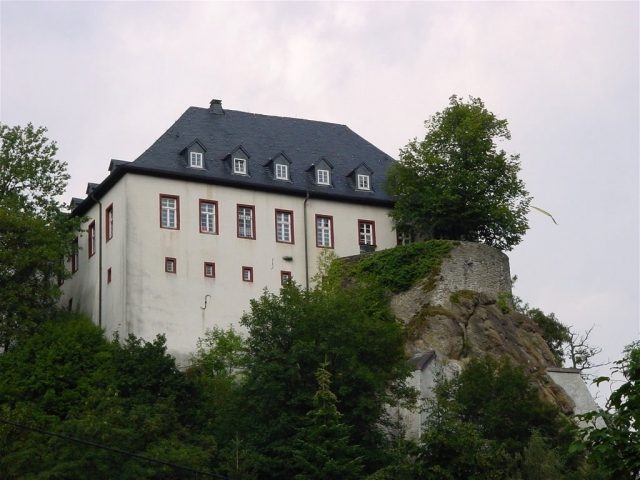
Bilstein Castle

Youth hostel

Bilstein Castle is a hilltop castle in the Sauerland region. It is located in the Bilstein district of the town of Lennestadt. Since 1927, the building has served as a youth hostel.

Origin of the Name+

The word Bilstein (as well as linguistically related terms such as Beilstein, Bielstein, etc.) is not uncommon as a field and place name. According to Förstemann, it means "a steeply rising or prominent stone." This description undoubtedly applies to the rocky spur of Bilstein Castle Hill. Thus, the name of the mountain, consisting of keratophyre (greenish volcanic rock), presumably passed to the castle and the adjacent settlement. Alternative explanations, however, attribute the name to a hunting ground, an idol, or the Old High German term billi for sword.

Castle Complex+

Bilstein Castle is a spur castle on an outcrop of the adjacent Rosenberg. This drops steeply on three sides, so the castle's defensive structures had to be oriented solely towards the mountain in the northeast. The appearance of the castle is therefore dominated by the two round towers, each with a diameter of about eight meters: the Chapel Tower in the northwest and the Hohnekamp Tower in the southeast. The towers are connected by a tunnel running under the castle courtyard, while above ground, an archway built in the early 20th century spans between them.

The northwestern wing of the main castle and the central building in the southwest are historical structures. The wing in the southeast, however, was built in 1978 to expand the youth hostel. A balcony (Söller) is situated in front of the central building on the valley side, on which a widely visible lime tree grows.

Today, a brick bridge connects the main castle and the outer bailey over the partially filled-in, approximately 15 m wide neck ditch. The latter comprises three buildings, which are referred to as the gatehouse, half-timbered house, and celebration hall.

The Beginnings

Bilstein Castle was built between 1202 and 1225 on the Rosenberg under the direction of the nobleman Dietrich II von Gevore. The oldest known mention of Bilstein Castle is found in a document from 1225. In it, Count Gottfried von Arnsberg declares that nobleman Dietrich von Bilstein sold his own property Seringhausen near Erwitte to Rumbeck Monastery.

The seat of the Lords of Gevore was originally Peperburg Castle in Grevenbrück, a few kilometers away, which was abandoned in the mid-12th century for unknown reasons. One theory suggests that the nobility had retreated to their hunting grounds. Dietrich II von Gevore henceforth called himself Dietrich I von Bilstein.

In 1363, the castle passed into the possession of the Counts of Mark.

Electoral Cologne Period

During the Soest Feud, Electoral Cologne was able to take the castle without a fight on October 24, 1445, after a siege lasting several weeks. A ceasefire had already been concluded a week earlier. On the very day of the capture, Archbishop Dietrich II von Moers confirmed the Bilsteiners' ancestral rights and freedoms. The castle remained in Electoral Cologne's possession until the secularization in 1802 and became the seat of the Bilstein office. The Amtmann (bailiff) resided there as a representative of the Archbishop of Cologne. The important Paderborn Prince-Bishop Ferdinand von Fürstenberg was born at Bilstein Castle in 1626.

Prussian Period

In 1802, the area around the castle was initially assigned to Hesse after the dissolution of Electoral Cologne. Later, from 1816, it belonged to Prussia. From January 16, 1817, to December 31, 1818, the castle was the seat of the Bilstein district, before the administration was moved to Olpe in 1819. The forest administration was still housed there until 1820.

Today

Since 1927, the castle building, which has been owned by the German Youth Hostel Association since 1979, has housed a youth hostel. In 1978, the left side wing was completely rebuilt. It accommodates most of the guest rooms and two common rooms.

In addition to the youth hostel operations, Bilstein Castle has also regularly hosted fantasy role-playing events such as LARP, conventions, and similar events for years. These include, for example, events for the tabletop role-playing game The Dark Eye, where characters from the DSA universe are embodied by DSA authors and amateur actors.

Surroundings+

The castle is accessible by a road from the western entrance of Bilstein. A parking lot for cars and buses is located at the foot of the castle. A pedestrian path with a 99-step staircase leads hikers to the castle.

Several hiking trails pass by the castle, for example, the Siegerlandweg (X5) and the Robert-Kolb-Weg (X6). Both routes are main hiking trails of the Sauerland Mountain Association. Furthermore, there is the Rosenberg circular trail with the sign "O" and a hiking trail to Jäckelchen with the sign "U".

The village community Freiheit Bilstein e.V. has also published a leaflet showing six different hiking routes through the Bilstein region.

Take Mobile History with you

You are reading this text for free. Premium adds what matters on the road: descriptions read aloud, sites found through your camera, whole regions taken offline.

  • Every description, including the ~17,700 Premium sites
  • Audio guide: have descriptions read to you on location
  • AR finder: see sites through your camera, with distance and bearing
  • Unlimited saved sites

14 days free, then from €2.99 a month. Cancel anytime.

Source: Wikipedia · Licence: CC BY-SA 4.0 · Image: Roland Neubert, Halle (Saale)

This description draws on the facts documented in the linked Wikipedia article; Wikipedia content is licensed under CC BY-SA 4.0. Wording and editing: Mobile History.

Location: 51.0962, 8.0193