School camp
Bischofstein Castle

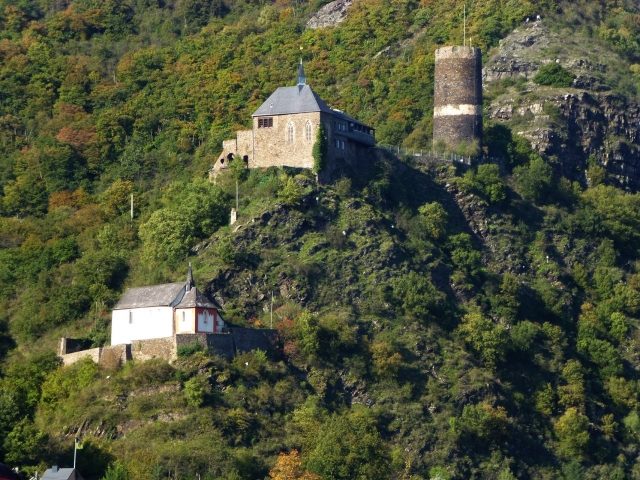
Burg Bischofstein, a spur castle, is located on the western bank of the Moselle between Moselkern and Hatzenport in the municipality of Münstermaifeld. Directly opposite on the other side of the Moselle is the community of Burgen. Destroyed by French troops in 1689, it was rebuilt as a holiday home in the 1930s. Since 1954, it has housed a school country home. The castle's most characteristic feature is a white plaster stripe about halfway up the keep.
Still on the edge of the southern high plateau of the Eifel, the Maifeld, situated at 100 m above sea level, the castle towers visibly from afar at half mountain height on a rocky spur above the Moselle valley. Below runs the B 416, which in this section is called Moselschiefer-Straße. The nearest larger towns are Cochem, about 25 km upstream, and Koblenz, which is 35 km downstream.
Opposite the castle, the Baybach flows into the Moselle, having carved gorges and wide valleys into the Hunsrück. The neighboring villages of Moselkern and Hatzenport, both about 2 km away, are typical wine-growing villages of the Moselle. Moselkern is the mouth of the Elzbach, in whose valley Burg Eltz is located. The Hatzenport winemakers press a white wine from the Burg Bischofstein vineyard.
13th Century to 1880
The construction of Burg Bischofstein was begun by Archbishop Arnold II of Trier between 1242 and 1259. Another mention of the castle dates from 1262, when the Trier archdeacon Heinrich von Bolanden resided at Bischofstein. This is evident from a document dated June 10, 1262, in which he promises at Bischofstein to pay off debts to the monasteries of Laach and Rommersdorf.
The exact start of construction is unknown. It is certain that Heinrich von Bolanden bought the half-finished castle at an unknown time and completed it at his own expense. This is evident from what is probably the most important document for Bischofstein, dated September 11, 1273. At this time, Heinrich von Bolanden gifted the Burg Bischofstein, completed by him, to the Trier Cathedral Chapter. The conditions for the donation were: a lifelong right of residence and the stipulation that he and all subsequent office holders should be enfeoffed with the castle.
His successor Hermann von Weilnau granted Archbishop Peter von Nassau the right of access to Bischofstein in 1303. Now, in case of war, Bischofstein was at the Archbishop's disposal. Heinrich von Pfaffendorf, the third archdeacon enfeoffed with Bischofstein, committed himself in 1329 to:
- not tolerate any opponents of the Archbishop in the castle,
- protect the crossings over the Moselle, and
- not admit any vassals or castellans without the Archbishop's permission.
Heinrich's successor Gottfried von Brandenburg finally had to commit to refraining from damage, meaning he could only use Bischofstein with the Archbishop's consent. After Friedrich, Count Palatine of the Rhine, who was enfeoffed with Bischofstein in 1501, no further enfeoffment is known.
In 1552, Margrave Albrecht von Brandenburg is said to have besieged Bischofstein in vain. However, this cannot be substantiated.
The Thirty Years' War caused great damage on the Moselle, for example on October 26, 1631, when Louis XIII had nearby Münstermaifeld destroyed. A detailed visitation protocol of the castle chapel's furnishings from 1680, however, suggests that the castle survived the war unscathed. In the War of the Palatine Succession in 1689, the castle was finally destroyed by the French troops of Louis XIV.
In the territories on the left bank of the Rhine annexed by the French in 1794, most ecclesiastical possessions were dissolved by the decree of 1802 and placed under French administration as national property. This also affected the ruin of Bischofstein, which belonged to the St. Castor Collegiate Church in Karden. It was sold on September 29, 1803, at an auction by the Departmental Administration for 330 Francs to the winemaker Nicolaus Artz from Burgen.
In 1824, a dwelling house with seven inhabitants at Burg Bischofstein is reported. After that, the ownership conditions are obscure.
1880 to Today
In 1880, Johann Franz Bienen from Rheinberg bought the castle. On April 11, 1930, his heirs sold it for 8000 Reichsmark to the Darmstadt merchant Erich Deku, who soon rebuilt it as a holiday home. It was not reconstructed but rebuilt using the existing walls. For this, an access road for construction vehicles also had to be created, partly realized by rock blasting. Deku assembled an extensive art collection to furnish the castle. This included a winged altar from 1530.
The reconstruction in its current form was completed by the Neuerburg family from Trier in 1937/38. The widow Aenny Neuerburg had bought the castle at auction from the Decku family after bankruptcy proceedings were opened against Erich Deku in 1936, which also claimed the entire art collection.
From 1941-46, Burg Bischofstein served as a convalescent home for soldiers, a military hospital, and a refugee home under the direction of Aenny Neuerburg. Afterwards, her son Raymund Neuerburg and his family took over the management of the castle and turned it into a guesthouse. After Aenny's death in 1953, the Neuerburg family offered the castle for sale in 1954.
On June 29, 1954, the Schullandheimverein of the Fichte-Gymnasium Krefeld acquired the castle for 80,000 DM and began its expansion into a school country home.
Burg Bischofstein is now a protected monument, not as an 800-year-old castle, but as an example of the 1930s architectural style in which it was rebuilt.
Since the early 1950s, the Fichte-Gymnasium Krefeld had been striving to acquire its own school country home. Of all the properties offered for sale to the newly founded "Schullandheim Fichte-Gymnasium e. V.", Burg Bischofstein on the Moselle proved to be the most suitable in terms of structural condition and spatial arrangements.
On June 29, 1954, a purchase agreement for the acquisition of the castle was concluded with the executor of the late Mrs. Neuerburg. The transfer of possession took place on July 1, 1954.
Today, the castle features a 12-bed dormitory and other dormitories, as well as two teacher's rooms, a common room, a dining and classroom, a table tennis and foosball room in the former knight's hall, a kitchen, and storage rooms.
Keep+
The 20-meter-high keep is noticeable from afar due to its white ring about halfway up. This is a remaining piece of plaster. In the Late Middle Ages, it was common in Central Europe for keeps to be plastered throughout. Due to weathering, this plaster has largely disappeared over the centuries.
Renovation
In 1997, the keep was renovated. The battlements were rebuilt, and the tower platform was re-cast. A new wooden staircase was installed in the castle tower, following a medieval model. This makes the tower easily climbable again, and every visitor can enjoy the view of the Moselle. In 2012, an infestation of house longhorn beetles was discovered throughout the castle, after which the castle underwent extensive renovation in 2014. For this, the residential wing had to be completely wrapped in a special aluminum foil and heated to 70 degrees Celsius.
Legends surrounding the tower
Over time, some legends and conjectures have spun around the keep and its white ring.
One tells that robber gangs regularly ambushed merchants on the trade route that the castle was supposed to protect. To put an end to this, the Bishop of Trier had a ring plastered onto the castle tower, and every captured robber was hanged there as a warning to his kind.
Another legend tells of a gigantic flood, the high-water mark of which the ring represents.
Another version claims that the Bishop of Trier rescued the lord of the castle from a difficult situation. In gratitude, the lord had a ring, symbolizing the bishop's ring, affixed to the tower at the height of the Trier Moselle gauge.
Castle Chapel St. Stephen+
Burg Bischofstein, like every medieval castle, has a castle chapel. It is dedicated to Saint Stephen. The chapel was also rebuilt in the 1930s. In 1995, the chapel was completely renovated in medieval style.
The showpiece of the chapel is a door that comes from the outstanding Baroque choir stalls of the Mainz Charterhouse. These were made between 1723 and 1726 under the direction of the Hamburg master cabinetmaker Johann Justus Schacht. It is adorned with rich inlays. After the dissolution of the Charterhouse, it was acquired for Trier Cathedral in 1787. Most of it can still be admired there today in the east and west choirs. However, in 1890, the Cathedral Chapter had 18 parts of the back panels (dorsals) sold through art dealers to the Berlin banker Adolf von Rath. After the auction of the Rath art collections in 1933, 17 eventually ended up in the Metropolitan Museum of Art in New York. Three are displayed there, 14 were returned to Trier Cathedral in 1952. The aforementioned collector Deku acquired a part of the choir stalls from the Rath collection for Burg Bischofstein in 1933. However, he only acquired the architectural frame; the inner door paneling, an inlay work, is of different origin. When the entire castle inventory was auctioned at Hahn in Frankfurt in 1937, only the chapel door remained. In 1994, the owner of the castle planned to sell this important testimony of Middle Rhenish art history via Sotheby's or Christie's, which would probably have led to it disappearing inaccessible into a private collection. However, the State Office for Monument Preservation, which had provided significant subsidies for the castle's upkeep, was able to avert the auction.
Miscellaneous+
- The Schoppenstecher hiking trail and the local hiking trail 7 to Burg Eltz and back via Moselkern run through the grounds of Burg Bischofstein. The WeinWetterWeg hiking trail of the municipality of Hatzenport ends here, a section of the Camino de Santiago is in Moselkern, 2 km away.
- Entering the castle grounds for tourist purposes is only possible by prior arrangement with the castle administrator. However, Burg Bischofstein opens its doors annually for the "Open Castle Day" in spring and for the Open Monument Day in autumn.
- Halfway up to Burg Bischofstein lies the Pauluskapelle, built around 1200.
- The British painter William Turner visited the Moselle on his travels through Germany in 1824 and 1839. He made numerous pencil sketches, which he later used as a free basis for paintings. Two paintings deal with Burg Bischofstein.
- Burg Bischofstein is the endpoint of the TorTour every year in late summer, a 1
Take Mobile History with you
You are reading this text for free. Premium adds what matters on the road: descriptions read aloud, sites found through your camera, whole regions taken offline.
- Every description, including the ~17,700 Premium sites
- Audio guide: have descriptions read to you on location
- AR finder: see sites through your camera, with distance and bearing
- Unlimited saved sites
14 days free, then from €2.99 a month. Cancel anytime.
Source: Wikipedia · Licence: CC BY-SA 4.0 · Image: Edgar Leyendecker
This description draws on the facts documented in the linked Wikipedia article; Wikipedia content is licensed under CC BY-SA 4.0. Wording and editing: Mobile History.
Location: 50.2136, 7.3839