CastleLeinefelde-Worbis - Wintzingerode

Bodenstein Castle
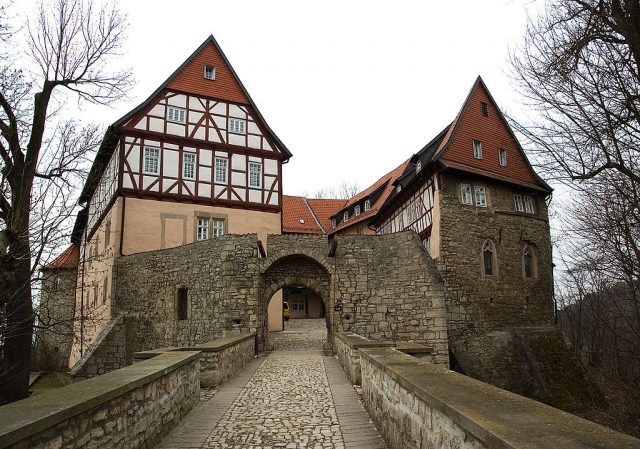
Bodenstein Castle

Cultural center of Church

Bodenstein Castle is a medieval castle above the village of Wintzingerode, today a district of Leinefelde-Worbis in the Eichsfeld district of Thuringia, after which the family of the later lords of the castle named themselves. It is the best-preserved castle in the Eichsfeld region. The hilltop castle is located in the Ohm Mountains in northern Eichsfeld. In the valley in front of the castle lies the village of Wintzingerode. The nearest town is Leinefelde-Worbis.

Today, the castle houses a family recreation and meeting center of the Evangelical Church in Central Germany. Thematic leisure activities are offered, especially during holidays and festive seasons. In addition, the castle provides space for cultural events in the Eichsfeld region, such as castle concerts, cabaret evenings, and political discussion evenings.

Originally probably a border post between the tribes of the Saxons and the Franks, the castle was presumably a Liudolfing family estate under the early Saxon emperors, after it had been expanded by Henry I as a fortification against the Hungarian invasions. During the time of the Salian Emperor Henry IV, Bodenstein belonged to the possessions of Count Otto of Northeim, a relative of the Liudolfings and leader of the Saxon noble opposition. Subsequently, a dynastic family of Bodenstein emerged, presumably a collateral line of the Northeimers, who named themselves after their new ancestral seat. For a time, this lineage played a leading role in the region, which they documented primarily through the foundation of Beuren Monastery in the Leine Valley. However, in the course of the 13th century, they lost influence, and the lordship of Bodenstein fell to the Welfs in 1275. In 1293, the castle was sold by Duke Henry I to the Counts of Honstein, from whom it was redeemed again in 1322 as agreed. In 1327, the Welfs ceded it again to the Honsteiners, who sold it in 1337 to Hans von Wintzingerode, Otto von Rusteberg, Berthold von Worbis, and Heinrich Wolf with all rights and revenues (including high and low jurisdiction, high and low hunting, mining regale), but remained their liege lords until their extinction in 1593. The close connection between the Counts of Honstein and the Lords of Wintzingerode was strengthened in the 14th century by the marriage of Dietrich von Wintzingerode to Bertrade Countess of Honstein. By 1448, the Lords of Wintzingerode bought out their co-owners of Bodenstein and remained sole owners of the castle from then until 1945. First mentioned in 1209 with Bertholdus de Wincigeroth, they were possibly a collateral line of the Lords of Bodenstein themselves. In 1525, large parts of the castle were destroyed by the march of the peasant leader Thomas Müntzer and subsequently rebuilt in a contemporary style. From 1530, the Lords of Wintzingerode officially introduced the Reformation in their territories, which brought them into conflict with the Honsteiners and Kurmainz.

In 1573, Count Volkmar Wolf of Honstein ceded the overlordship of Bodenstein to Mainz in the Bleicheröder Treaty. Berthold XI von Wintzingerode considered this a breach of feudal loyalty and declared the castle and lordship his free property. In 1574, 2000 men conquered the castle and imprisoned the lord of the castle. In the conflict with his Scharfenstein cousins, Berthold had shot their partisan and henchman Arnold Geilhaus the year before. This incident was now held against him. Despite extensive defense and without entering into evidence, Berthold was sentenced to death for this in 1575 and beheaded on September 19. The castle and lordship of Bodenstein then fell to Hans and Bertram von Wintzingerode, his cousins who were at odds with Berthold, whose heirs in turn lost the pledged lordship of Scharfenstein in 1582.

After the extinction of the Counts of Honstein in 1593, the Welfs' claim to overlordship and territorial sovereignty and their protection saved the lordship of Bodenstein from a forced Counter-Reformation. As a result of the Thirty Years' War, the Protestant confession and the position of the Lords of Wintzingerode in the territory were further strengthened. Until 1803, they were the only non-princely family of the Old Empire to hold all sovereign rights there without being an Imperial Estate. Particularly noteworthy was the exercise of episcopal rights, which made the small lordship the ecclesiastical center for Protestants in the Lower Eichsfeld. In 1668, a chapel was added to the castle. Towards the end of the 18th century, the Landgravine Dowager Philippine of Hesse-Kassel, a niece of Frederick the Great, stayed at the castle several times for extended periods, marrying its owner, her long-time chief court master, in a morganatic marriage in 1794. In 1803, the lordship was incorporated into the Kingdom of Prussia. Due to Prussia's Coalition Wars against Napoleon I and the defeat at the Battle of Jena and Auerstedt, Eichsfeld and the lordship of Bodenstein belonged to the Kingdom of Westphalia from 1807 to 1813. In 1815, it returned to Prussia. From 1801, the castle housed a significant art collection, which was amassed by the Württemberg Prime Minister Georg Ernst Levin, Imperial Count of Wintzingerode. The stained glass windows in the lords' gallery of the chapel were created around 1835 by the Göttingen glass painter Heinrich Friedrich Wedemeyer. During the unrest in the spring of 1848, the lord of the castle, Count Heinrich Levin von Wintzingerode, had to flee to Göttingen from the threat of insurgents.

Countess Gisela von Wintzingerode+

From 1914, Gisela Countess von Wintzingerode, née Countess von der Schulenburg (1886–1972), administered the Fideikommiss Bodenstein, established in 1876, for her underage son. During the Third Reich, she was heavily involved in the Confessing Church. Bodenstein was a center of ecclesiastical resistance against the National Socialist church struggle around the later regional bishops Hanns Lilje, Hugo Hahn, and Ludolf Hermann Müller.

In 1945, the Wintzingerode family was dispossessed and expelled by the communists without compensation as part of the "Democratic Land Reform." From the West, Countess Gisela used her church contacts to achieve a transfer of the castle to the Evangelical Regional Church of the Church Province of Saxony, which happened in 1948.

Take Mobile History with you

You are reading this text for free. Premium adds what matters on the road: descriptions read aloud, sites found through your camera, whole regions taken offline.

  • Every description, including the ~17,700 Premium sites
  • Audio guide: have descriptions read to you on location
  • AR finder: see sites through your camera, with distance and bearing
  • Unlimited saved sites

14 days free, then from €2.99 a month. Cancel anytime.

Source: Wikipedia · Licence: CC BY-SA 4.0 · Image: https://de.wikipedia.org/wiki/Datei:0702247011_bodenstein.jpg

This description draws on the facts documented in the linked Wikipedia article; Wikipedia content is licensed under CC BY-SA 4.0. Wording and editing: Mobile History.

Location: 51.4536, 10.3425