Festival performances
CastleRöttingen
Brattenstein Castle
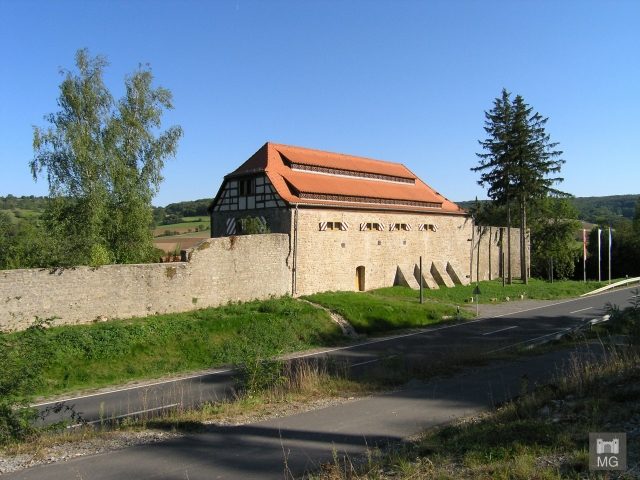
Brattenstein Castle is a high medieval castle complex at the northeastern corner of the city wall in Röttingen in the Bavarian district of Würzburg in the Tauber Valley.
The castle, presumably built in the 12th–13th century, was first documented in 1230. Between 1230 and 1345, the castle was owned by the Lords of Hohenlohe, who sold it to the Prince-Bishopric of Würzburg in 1345. In 1438, the castle was conquered and the existing wall ring was extended. In 1440, the castle complex, located outside the town, was incorporated into the city fortifications. Around 1500, a tithe barn was built in the southern corner of the castle complex. From 1520, the castle was the seat of a prince-episcopal bailiff, who was considered an extended arm of the Würzburg Prince-Bishop. In the early 17th century, extensions and alterations took place. In 1803, the prince-episcopal office of Röttingen was abolished, and the castle served as the seat of the Bavarian Rentamt until World War I. During this time, the keep at the northeastern corner of the castle was demolished. During World War II (1939–1945), the castle was used by the Reich Labour Service. After 1945, the castle served as a refugee camp and later housed an Aschaffenburg clothing factory. On November 5, 1971, the east wing of the castle collapsed.
Source: Wikipedia · Licence: CC BY-SA 4.0 · Image: Mobile Geschichte
This description is a machine translation of an excerpt from the linked Wikipedia article. The source text was written by its authors, the translation is by Mobile History; like the original it is licensed under CC BY-SA 4.0.
Location: 49.5084, 9.9655