Museum
Brome Castle
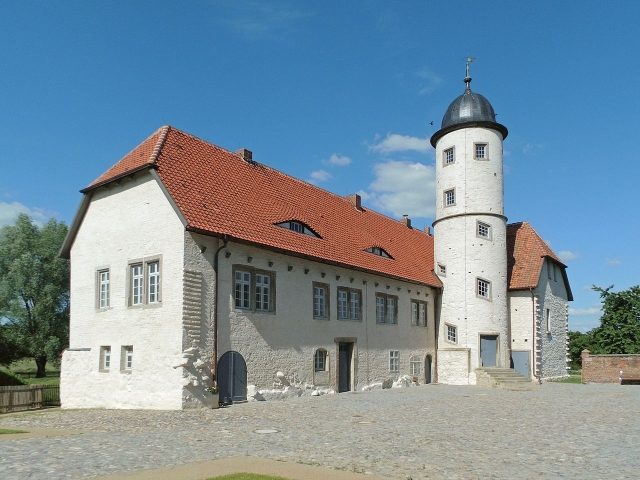
Brome Castle is a partially well-preserved medieval moated castle in the municipality of Brome in Lower Saxony. Along with Gifhorn Castle, it is one of the most important historic fortifications in the Gifhorn district. The listed castle, used as a local history museum with a focus on rural self-sufficiency and old crafts, has regional tourist significance.
Origin+
Brome Castle was built as a lowland castle near the settlement of Brome in the swampy lowlands of the Ohre river. It was laid out in a loop of the Ohre. The waterway protected it from two sides, and on the other sides, it was also surrounded by a moat. The castle was probably initially a wooden structure with a tower around 1200, surrounded by a moat, palisades, and an embankment. In its history, it was destroyed several times during armed conflicts. The current structure was only built in the 16th century and presumably based on the foundations of older predecessor buildings.
The Merian engraving from 1654 shows the main castle (right), which was separated from the outer bailey (left) with its outwork by a drawbridge over a moat. The defensive tower is depicted significantly higher than it is today. At that time, it still had a surrounding battlement. The castle building was also two stories higher than the existing north wing. At that time, its roof had two dormer gables. In the 17th century, the castle included a gate tower and other outbuildings, which made the castle a self-contained complex from all sides.
Architectural Description+
Today, the castle complex consists of the smaller east wing and the elongated northern main wing. In between, the stair tower rises in the inner courtyard, about 23 m high. The two-story main building measures 37 x 9 m and dates from the 16th century. It has been restored with bricks in the old monastery format. In its basement, two rooms feature a cross vault.
Since 1979, the castle has been used as a local history museum, focusing on the depiction of rural self-sufficiency and old crafts (including blacksmith, shoemaker, turner, carpenter) in the Brome region. Other offerings include a medieval herb garden, a skep beekeeping, and a museum cafe as a restaurant. The annual castle festival, held every August since 1981, is a magnet for many visitors from the region.
The castle was first mentioned in a document in the inheritance contract of Henry the Lion in 1203. In it, the paternal inheritance was divided among the three sons. In the Treaty of Paderborn, Count Palatine Henry confirmed his brother William's possession, including Brome. The castle was one of over 70 border fortresses in the Duchy of Brunswick-Lüneburg. Its task was to protect against the neighboring power spheres of the Electorate of Brandenburg and the Archbishopric of Magdeburg.
The medieval history of Brome, in which the castle and town were passed back and forth between various rulers, was turbulent and eventful. Owners at different times included the noble families of Bartensleben, Schulenburg, and Knesebeck. In its history, the castle served as a defensive structure, a court, the vogt's residence, and an economic building.
Around 1214, the knight and ministerialis Friedrich von Karow resided at Brome Castle. From here, he administered the Brome region. As early as 1219, the town's castle was destroyed in a conflict between the Welfs and the Archbishop of Magdeburg. In 1292, Brome fell to the Margraves of Brandenburg, but due to childlessness, it returned to the Welf branch. Around 1300, the castle was destroyed again. In 1360, its ruler, Duke Magnus of Brunswick, pledged the castle and town to the Bartensleben family. In 1492, Fritz von der Schulenburg took over the rule, only to return it to the Bartensleben family in 1583. After the line died out, the castle returned to the Schulenburgs, who owned it until its sale to the municipality of Brome in 2001.
The centuries-old pile foundation of the castle was in disrepair. From 2009 to 2014, the castle underwent extensive renovation and reopened in September 2014 with a renewed museum exhibition.
Take Mobile History with you
You are reading this text for free. Premium adds what matters on the road: descriptions read aloud, sites found through your camera, whole regions taken offline.
- Every description, including the ~17,700 Premium sites
- Audio guide: have descriptions read to you on location
- AR finder: see sites through your camera, with distance and bearing
- Unlimited saved sites
14 days free, then from €2.99 a month. Cancel anytime.
Source: Wikipedia · Licence: CC BY-SA 4.0 · Image: http://de.wikipedia.org/wiki/Datei:Brome_Burg_2014.JPG
This description draws on the facts documented in the linked Wikipedia article; Wikipedia content is licensed under CC BY-SA 4.0. Wording and editing: Mobile History.
Location: 52.6031, 10.9487