CastleBurgjoss

Burgjoß Castle

Burgjoß Castle

Forestry Department

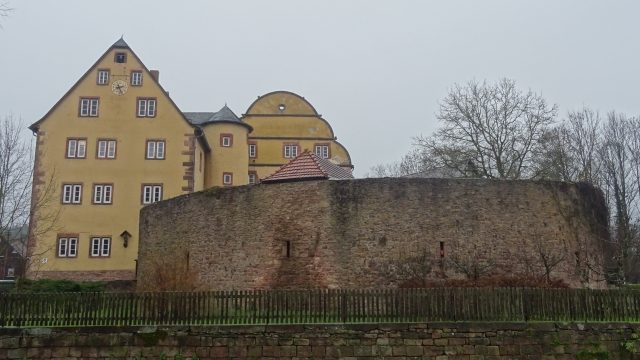
Burg Burgjoß (also Schloss Burgjoß, Burg Jossa) is a castle on the site of an older moated castle on the outskirts of Burgjoß (Main-Kinzig-Kreis) in the Hessian Spessart.

The castle "Jazaha" on the Jossa river, according to its architectural features, was likely built as a Fulda fiefdom towards the end of the 12th or beginning of the 13th century. At this time, the Lords of Jossa, a collateral line of the Lords of Steckelberg, who called themselves "von Jasza," became identifiable in the much older town (first mentioned in the 9th century). The valley castle served to control an older road. It was originally a castle-like wooden structure, resting on piles and surrounded by a moat. Around 1160, a sandstone castle complex was built in place of the wooden construction.

In 1176, Fulda enfeoffed the Lords of Jossa with the castle and court, but as they settled on the Bergstraße in the 13th century, their estates were gradually sold. Thus, the castle and court changed hands several times. Already in 1326, the Isenburgs owned a quarter of the castle. With the extinction of the Lords of Jossa before 1367, the complex became a Ganerbenburg (a castle owned jointly by several families). Shares in the property changed hands multiple times between various minor nobles of the region, such as the Lords of Hutten, the Lords and Counts of Hanau, and also higher-ranking nobles, such as the Counts of Rieneck and the Electors of Mainz.

In 1451, the Counts of Hanau-Münzenberg owned half, the other part was owned by the Lords of Thüngen and von Hutten. The von Hutten family eventually acquired the entire village, but sold all their possessions in the Jossa valley in 1541 to the Archbishopric of Mainz.

A major renovation followed until 1573 under Elector Daniel Brendel von Homburg, transforming it into a Renaissance moated castle. Electoral Mainz used the castle as a cellarage. It remained the administrative center in the Jossatal as "Kellerey Burgjoßa," with the villages of Burgjoß, Mernes, Oberndorf, and Deutelbach. With the secularization in 1803, the Jossgrund became part of the newly created Principality of Aschaffenburg, in 1810 part of the Napoleonic Grand Duchy of Frankfurt, in 1814 part of Bavaria, in 1867 part of Prussia, and finally in 1945 part of Hesse. Since its affiliation with Bavaria (1814–1866), the castle has housed a forestry office, which still exists today.

Layout+

The moats of the former moated castle have been leveled and are only faintly visible. The oldest, medieval parts are a semicircular, shield-wall-like tower structure and parts of the oval curtain wall. The tower structure was built with ashlar blocks, and stonemason marks found here suggest a simultaneous construction with the Imperial Palace of Gelnhausen. The walls of the tower structure are up to four meters thick.

Partially built on the older masonry are the now dominant Renaissance buildings from the 16th century. On the foundation of the semicircular tower, a three-story building with a gable facade facing the inner courtyard was erected. The three-story main building on a rectangular floor plan dominates the complex. A four-story stair tower is attached to the courtyard side. The portal there and a window of the building bear the year 1573. The portal also features a four-part coat of arms with the Mainz wheel. Since 1973, a larger garden complex, the Burgwiesenpark, adjoins the castle.

Take Mobile History with you

You are reading this text for free. Premium adds what matters on the road: descriptions read aloud, sites found through your camera, whole regions taken offline.

  • Every description, including the ~17,700 Premium sites
  • Audio guide: have descriptions read to you on location
  • AR finder: see sites through your camera, with distance and bearing
  • Unlimited saved sites

14 days free, then from €2.99 a month. Cancel anytime.

Location: 50.2040, 9.4801