CastleBurglengenfeld

Burglengenfeld Castle
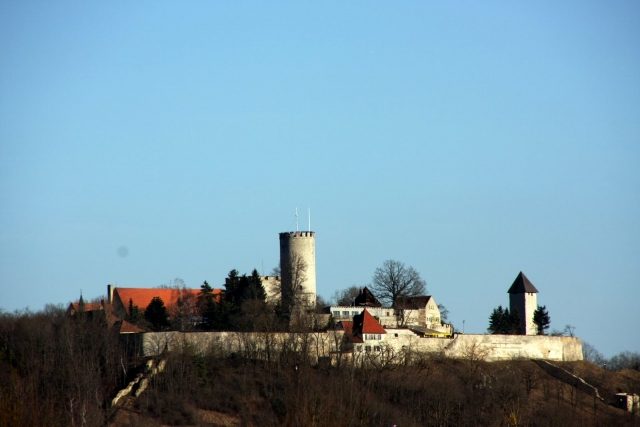
Burglengenfeld Castle

To be privately owned

Burglengenfeld Castle, or historically Lengenfeld Castle, is a castle above the present-day town of Burglengenfeld in the Upper Palatinate. It is "Bavaria's best-preserved castle complex" from the Salian period. The privately owned complex now houses a "therapeutic educational center."

The stone castle visible today was probably preceded by an earthwork of ramparts and palisades. Early indications of the Lords of Lengenfeld in the 9th and 10th centuries are still unconfirmed, but they are documented from 1050 onwards. Under them, around 1100, the central round tower and the curtain wall with the gate system were probably built first. In 1119/1120, Count Friedrich III of Lengenfeld died, whereupon the castle fell to the Wittelsbach family. Palatine Count Otto V of Bavaria, in particular, had the castle further fortified shortly after its acquisition and probably had the Sinzenhofer Tower built to secure the gate system. After the castle was damaged in the Landshut War of Succession, it was assigned to the newly created Wittelsbach Duchy of Palatinate-Neuburg. In 1777, the Palatinate-Neuburg line inherited the Bavarian line of the House of Wittelsbach, making the castle the property of the Bavarian Duke.

In 1806, after the sale of the complex, its demolition began, which claimed the core castle, among other things. However, in 1814, this was stopped at the instigation of Crown Prince Ludwig I. In 1967, Erich Heuser bought the castle and established a "therapeutic educational center" there.

Description+

The castle complex is located on a ridge. The entire complex covers approximately 1.8 to 2.36 hectares. The preserved parts of this complex include two residential towers, a central round tower, the so-called "tall, round tower," and the rectangular "Sinzenhofer Tower," both presumably from the Salian period, making them Bavaria's best-preserved towers of this era. The Sinzenhofer Tower stands directly next to the eastern gate system. In addition, the 800-meter-long curtain wall has also been preserved. The gate system and curtain wall are also of Salian origin. In the south, there is the smaller "Powder Tower" from the Staufer period. In addition, the later built "Granary" and other farm buildings are preserved. Of other buildings from later times, some foundations and cellars still exist.

Take Mobile History with you

You are reading this text for free. Premium adds what matters on the road: descriptions read aloud, sites found through your camera, whole regions taken offline.

  • Every description, including the ~17,700 Premium sites
  • Audio guide: have descriptions read to you on location
  • AR finder: see sites through your camera, with distance and bearing
  • Unlimited saved sites

14 days free, then from €2.99 a month. Cancel anytime.

Source: Wikipedia · Licence: CC BY-SA 4.0

This description draws on the facts documented in the linked Wikipedia article; Wikipedia content is licensed under CC BY-SA 4.0. Wording and editing: Mobile History.

Location: 49.2088, 12.0446