To be privately owned
Calenberg Castle

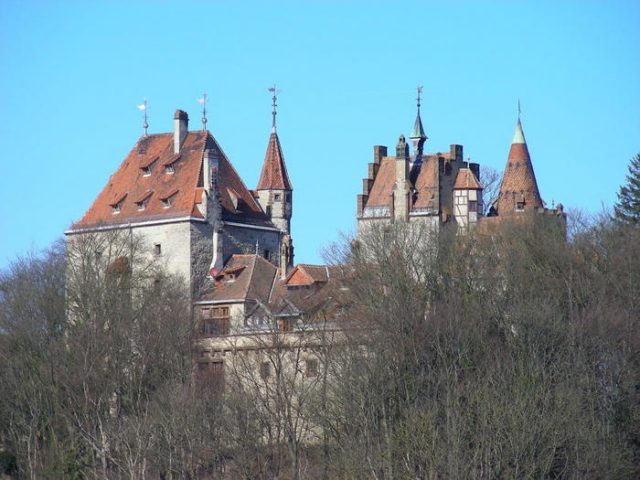
Calenberg Castle (Kalenberg) is a castle on the Calenberg in the middle of the Calenberg district of the city of Warburg in the district of Höxter in North Rhine-Westphalia.
The hilltop castle was built around 1250 by the Lords of Berkule and mentioned in 1299. In 1307, Bishop Otto of Paderborn enfeoffed the Westphalian family of Papenheim with the castle, who soon called themselves Rave von Calenberg. In 1326, Calenberg Castle was again enfeoffed to the Papenheims in a contract. In the contract, the place is referred to as a city.
After the last Rave von Calenberg died in 1464, a feud erupted between Landgrave Ludwig II of Hesse and the Bishop of Paderborn over the inheritance of Calenberg. The Hesse-Paderborn Feud was only settled in 1471.
In 1868, the Barmen merchant Hugo Schuchard, who had acquired a considerable fortune with his company "J. Grisar, Schuchard & Ko." in Valparaíso, Chile, acquired the "Calenberg Estate", which also included the castle. The castle, with its associated farm buildings, occupied almost half of the conical hill. Schuchard had these buildings demolished, with the exception of a house converted into service apartments, and had a new manor house, "Neu Calenberg", built down in the field. The castle, still well preserved in its walls and roofing, was then completely rebuilt between 1880 and 1884 by the Cologne architect Heinrich Wiethase in the style of a romantic "fairy tale castle", the two main parts connected by an intermediate building, and a massive stair tower with a peculiar circular walk was added to facilitate access, from which one has a wide panoramic view over the entire surroundings. The rest of the area was converted into gardens and the slopes of the hill were planted with trees.
Hugo Schuchard, the father-in-law of the painter Adolf Erbslöh and uncle of the painter Felix Schuchard, died two years after the completion of the castle. Until her death in 1927, Calenberg was the favorite residence of his widow Luise, née Erbslöh, who only lived in her property in Barmen during the winter months.
In 1927, the castle was taken over by his son Hugo Schuchard, jun., who was by then living at "Neu Calenberg" and was the builder and operator of the neighboring Welda hydroelectric power plant. However, he only allowed the castle to be partially inhabited. In 1938, he had a coal central heating system installed, and from 1945, the castle served as accommodation for refugees from the German eastern territories. After Schuchard's death, it was acquired in 1972 by the merchant Heinz Rehkopf and faithfully restored.
Take Mobile History with you
You are reading this text for free. Premium adds what matters on the road: descriptions read aloud, sites found through your camera, whole regions taken offline.
- Every description, including the ~17,700 Premium sites
- Audio guide: have descriptions read to you on location
- AR finder: see sites through your camera, with distance and bearing
- Unlimited saved sites
14 days free, then from €2.99 a month. Cancel anytime.
Source: Wikipedia · Licence: CC BY-SA 4.0
This description draws on the facts documented in the linked Wikipedia article; Wikipedia content is licensed under CC BY-SA 4.0. Wording and editing: Mobile History.
Location: 51.4655, 9.1646