To be privately owned
Cultural Events
Museum
Clam Castle

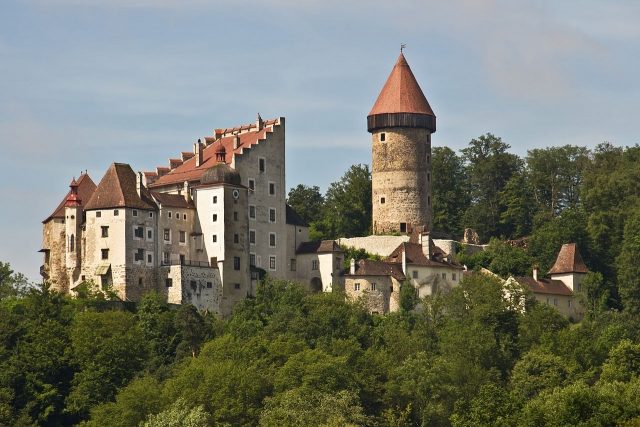
Clam Castle is a residence of the Clam-Martinic family and is located in the municipality of Klam in the Perg district in the Lower Mühlviertel region of Upper Austria. The castle complex stands on a wooded ridge above the market town of Klam, which on one side drops steeply into the Klam Gorge.
First mentioned in a document in the mid-12th century, the castle was owned by Otto von Machland and his brother Walchun in 1149. With Walchun's heiress Adelheid, the castle passed into the possession of the Velburgers and, with the death of Ulrich von Clam-Velburg in the Damietta Crusade, fell to the sovereign. At that time, a second castle stood on the opposite ridge, of which there are no written records, but remains of its fortifications are still preserved.
The Holzers appear as feudal lords of Clam from 1234 to 1324, and the Hausers from 1250 to 1413. After Wilhelm der Hauser, Christian and Christoph von Zinzendorf are believed to have been the owners. From 1416, Gilg, Ortaker, Gilg, and Wolfgang Wolfstein first owned the castle; after Wolfgang's death, it passed to Jörg Seusenecker and then to Prüschenk, or from 1454, to the Counts Hardegg.
In 1524, Christoph Perger bought "Schloss und Veste Clam together with the tower" from the Counts Hardegg. Christoph Perger I was followed by Christoph Perger II, his son Hanns Enoch Perger, and Johann Gottfried Perger. Johann Gottfried Perger zu Clam was considered the greatest patron of the market town of Klam and its citizens. He had the old freedoms of the market confirmed and built a church, founded the hospital and the Krautäcker (cabbage fields). In 1640, Emperor Ferdinand III bestowed upon him the title "Edle Herrn zu Clam" (Noble Lords of Clam), and in 1655 he was elevated to the rank of Baron. In 1759, Empress Maria Theresia granted the family the title "Erbländisch-österreichischer Graf" (Hereditary Austrian Count).
The Clam family divided into the lines Clam-Clam, Clam-Gallas, and Clam-Martinic. After the Clam-Clam family died out in 1815, the Clam-Martinic family, who had significant possessions in Bohemia, took over the old family estate. Clam Castle is inhabited year-round by the comital family. The current lord of the castle is Carl Philip Clam-Martinic. The most prominent representatives of the family were Heinrich Clam-Martinic, Austrian Prime Minister and military officer, Heinrich Jaroslav Clam-Martinic, Bohemian politician, Georg Clam Martinic, Austrian engineer, farmer, author, and monument conservator.
The Castle Complex+
The castle complex is a castle inhabited year-round by its owners. Through an outer bailey with a large, irregular courtyard formed by administrative buildings, garages, and the palas, one passes through a wrought-iron gate into the castle courtyard, bordered by a stone balustrade and surrounded by arcades. The rock on which the castle was built extends to the first floor. From the courtyard, sgraffiti can be seen on the wall of the palas, built in the 16th century. The ensemble is completed by a keep with a conical roof, located somewhat apart from the castle.
The castle has been in the possession of the same family for about half a millennium and has never been destroyed. This is why many furnishings and a large number of historical treasures have been preserved.
Within the castle is a chapel dedicated to the Holy Cross and another chapel from the 14th century, rediscovered in 1934 on the fourth floor of the palas.
The Ancestral Hall of the castle contains family portraits, various furnishings, a Gothic house altar, and more. From the balcony of the Ancestral Hall, directly above the steep drop to the Klam Gorge, there is a view of the opposite castle site. In addition to the family's living quarters, the castle includes a castle pharmacy, an armory, an extensive archive, and a library established in the 17th century.
Clam Castle Museum+
Among the accessible attractions of the castle are the three-story arcaded courtyard, the armory with equipment for defending the castle, the Gothic castle chapel built in 1422, the castle pharmacy with a medicine chest from 1603, and the living quarters of the Counts of Clam, including the breakfast room with a porcelain collection and several sumptuously furnished guest rooms, the lord's kitchen, a music room, and a large set banquet table in the landscape room.
Current Use+
Next to the actual castle complex is an associated castle brewery (decommissioned) and a manor farm. The riding hall and riding arena of the castle are operated by the Burg Clam Riding Club. Since 1990, the Clam Concerts, featuring internationally renowned musicians, have taken place annually in the brewery garden and on the manor farm meadow.
In 1923, Heinrich Graf Clam-Martinic had a power plant built in the Klam Gorge. The electricity supplied the residents of the municipalities of Klam, Saxen, Baumgartenberg, and Mitterkirchen im Machland. Georg Clam-Martinic had another power plant built in 1963, for which the hammer mill was demolished and the Bergmayr mill and sawmill ceased operations.
Take Mobile History with you
You are reading this text for free. Premium adds what matters on the road: descriptions read aloud, sites found through your camera, whole regions taken offline.
- Every description, including the ~17,700 Premium sites
- Audio guide: have descriptions read to you on location
- AR finder: see sites through your camera, with distance and bearing
- Unlimited saved sites
14 days free, then from €2.99 a month. Cancel anytime.
Source: Wikipedia · Licence: CC BY-SA 4.0 · Image: http://commons.wikimedia.org/wiki/File:Burg_Clam_2013.jpg
This description draws on the facts documented in the linked Wikipedia article; Wikipedia content is licensed under CC BY-SA 4.0. Wording and editing: Mobile History.
Location: 48.2208, 14.7783