Apartments
Museum
Dringenberg Castle

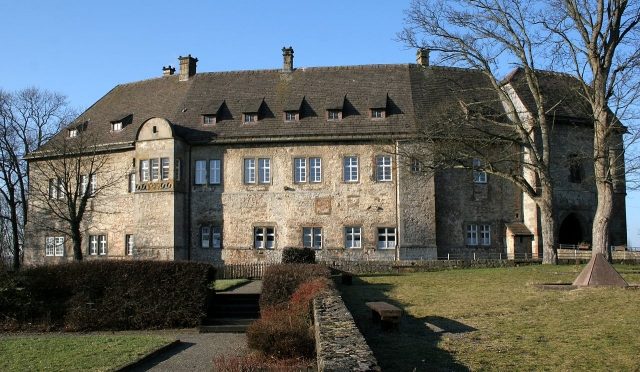
Dringenberg Castle is a medieval castle in Dringenberg, a district of Bad Driburg in the district of Höxter, North Rhine-Westphalia. It was one of the most important state castles of the Prince-Bishopric of Paderborn.
Castle Description+
The medieval hilltop castle has a strong defensive wall with a defensive tower (Hungerturm). To the north, the mountain drops steeply, providing an unobstructed view over the valley below from the castle. Today, this mountainside is overgrown with trees and bushes.
On the southern side is the castle gate, to which a massive bridge leads over the moat built in front of it.
In the castle courtyard there is a spacious well with a depth of 38.60 m, which served to supply water to the castle and village inhabitants. The still preserved gear mechanism apparently dates from 1835, this year is embossed there. In the inner courtyard, a plaster surface was dated to the year 1551. It shows a brazen serpent and the Lippische Rose. A plaster inscription from the early construction phase was discovered at the cellar entrance, warning against descending into the cellar.
After Bishop Bernhard V zur Lippe acquired the Free County of Dringen from the Count of Everstein in 1316, he had the mountain spur, located 298m above sea level, cleared in 1318 and built the fortified castle there by 1323, whereupon the first settlers soon gathered at its foot. Thus, the village of Dringenberg was created at about the same time.
Extensive construction work and restorations were commissioned by Prince-Bishop Simon III zur Lippe in the years 1463-1498. Only in 1488/98 was the gatehouse with the castle chapel and the southeast wing with the defensive tower built. This construction work was supervised by the Dringenberg Landdrost Otto Arndt von der Borch zu Detmold.
During the Thirty Years' War, the castle was burned down by the troops of the Swedish Major General Duclas. Reconstruction began in 1651 under Prince-Bishop Adolph von der Reck.
Further reconstruction and renovation work was finally carried out by Franz Arnold Freiherr Wolff-Metternich zur Gracht in the years 1710-1712.
Until the 19th century, the castle served as the summer residence of the bishops of the Paderborn diocese.
The Legend of Knight Teudebert+
According to legend, the castle well was driven into the rock by Knight Teudebert, who was imprisoned there.
He was promised freedom as soon as he had dug the well deep enough to see groundwater. But when that day finally came and the knight stepped into freedom, he was struck down (so the legend says), and he died on the same day.
Current Use+
Today, the castle houses a local history museum. The rooms in the southeast wing are used as club and rehearsal rooms by various associations from Dringenberg. The southwest wing is still inhabited today.
Weddings, among other events, are now performed in the historic castle chapel.
Take Mobile History with you
You are reading this text for free. Premium adds what matters on the road: descriptions read aloud, sites found through your camera, whole regions taken offline.
- Every description, including the ~17,700 Premium sites
- Audio guide: have descriptions read to you on location
- AR finder: see sites through your camera, with distance and bearing
- Unlimited saved sites
14 days free, then from €2.99 a month. Cancel anytime.
Source: Wikipedia · Licence: CC BY-SA 4.0
This description draws on the facts documented in the linked Wikipedia article; Wikipedia content is licensed under CC BY-SA 4.0. Wording and editing: Mobile History.
Location: 51.6720, 9.0537