CastleBad Düben

Düben Castle

Düben Castle

Museum

Dübener Castle, formerly also known as Dibni, rises on a small hill to the right of the Mulde river, directly on its bank. The castle is located directly at the B 2 bridge over the Mulde within the town of Bad Düben (Neuhofstr. 3) in the Nordsachsen district.

Dübener Castle is first mentioned in 981 during the dissolution of the Diocese of Merseburg, still under its Slavic name "Dibni". The location for the construction of the castle was favorable due to the ford over the Mulde on an old trade route. A Slavic settlement also developed next to the castle.

In the course of the German eastward colonization, Flemish immigrants founded the community of Neumark next to the castle around 1200; later, Frankish and Saxon settlers took over the old Slavic farmsteads, thus forming the town of Düben. In 1017, Dübener Castle was owned by Count Albi, who was shortly followed by Count Friedrich of Eilenburg. In connection with the Battle of Welfesholz, Wiprecht von Groitzsch conquered the castle in 1115 and from here took several manors in the surrounding area. Margrave Otto the Rich was also imprisoned here for a time. Through an inheritance contract, the castle came into the possession of the Thuringian Landgraves in 1291, who granted it as a fief to their followers.

In 1450, the castle was completely destroyed during a noble feud between the brothers Friedrich and Wilhelm of Thuringia. From 1530, the castle housed the Electoral Saxon official seat of the Düben office. The castle gained supra-regional fame during the Kohlhase affair, which began in 1532 with the nobleman von Zaschwitz and the state of Saxony, and lasted until 1540 (negotiation in Düben 1533). The most famous head of office was probably Philipp Melanchthon junior in 1554. During the Thirty Years' War, on September 15, 1631, the Swedish King Gustav II Adolf, the Brandenburg Elector Georg Wilhelm, and the Saxon Elector Johann Georg I concluded an alliance here against the Catholic Emperor Ferdinand II and then defeated the imperial troops of Field Marshal Tilly in the Battle of Breitenfeld. The alliance did not help the town of Düben; it was destroyed three more times in 1631, 1637, and 1641 by passing mercenary armies.

One of the last witch trials in Germany also took place in Dübener Castle.

During the Seven Years' War, Prussian King Frederick II stayed in the castle and established the largest supply depot for his army in Saxony here, which was guarded by 5,000 soldiers. This led to the Battle of Torgau on November 3, 1760, which Frederick II was able to decide in his favor despite heavy losses.

During the Wars of Liberation from October 10, 1813, to October 14, 1813, Napoleon established his headquarters in Dübener Castle. Here, he is said to have spent the most terrible days of his life due to the uncertainty of the military and political situation, according to his own statements. After 1815, the castle, like the town of Düben, came to Prussia. The Justice and Rent Office, which existed in the castle in 1780, was dissolved in 1942.

After the Second World War, under the leadership of the well-known local historian Willy Winkler, a landscape and local history museum about the town of Bad Düben and the Dübener Heide was established by 1953. Exhibits on the history of Düben Castle and town, as well as on the economic development of the region, can be seen, among other things.

Structure+

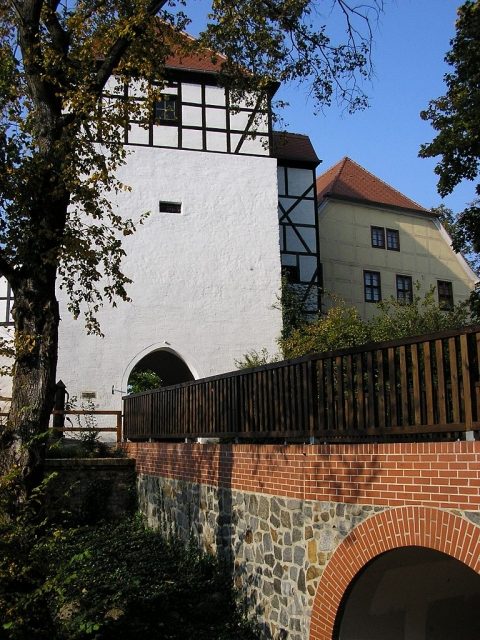
The keep represents the oldest building (from 1206) in the castle area. The so-called Hexenkeller (Witches' Cellar) is also located here. Behind it stands the main building, which was built as the official seat of the town of Düben and now houses the local history and landscape museum. Next to the main building is the so-called Burgwärterhäuschen (Castle Warden's House), which now houses a small cafe. All buildings were extensively renovated between 1997 and 1999. At the foot of the castle is the also restored Bergschiffsmühle (Mountain Ship Mill).

Take Mobile History with you

You are reading this text for free. Premium adds what matters on the road: descriptions read aloud, sites found through your camera, whole regions taken offline.

  • Every description, including the ~17,700 Premium sites
  • Audio guide: have descriptions read to you on location
  • AR finder: see sites through your camera, with distance and bearing
  • Unlimited saved sites

14 days free, then from €2.99 a month. Cancel anytime.

Source: Wikipedia · Licence: CC BY-SA 4.0 · Image: http://de.wikipedia.org/wiki/Datei:Burgfried-dueben.jpg

This description draws on the facts documented in the linked Wikipedia article; Wikipedia content is licensed under CC BY-SA 4.0. Wording and editing: Mobile History.

Location: 51.5921, 12.5805