CastleEgeln

Egeln Castle

Egeln Castle

Cultural Events

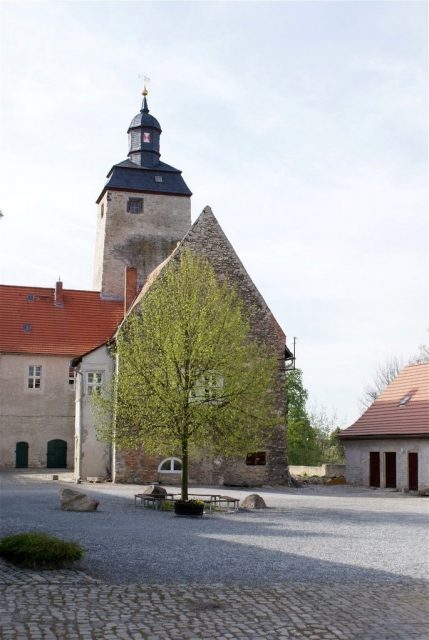
Egeln Water Castle is a water castle near Egeln in the Salzlandkreis district in Saxony-Anhalt. Egeln Water Castle is located about 250 m east of the town center of Egeln, a small town in the Magdeburger Börde. It stands in the fertile low-lying part of the Egelner Mulde, a depression of the Bode, a tributary of the Saale. The water-filled moat is fed by the Hundegraben (Hunnengraben) coming from the northwest, which drains into the Bode via the mill stream running east-southeast near Unseburg. The castle stands at a maximum elevation of about 75 m above sea level.

The village of Egeln was first mentioned in a document in 941, in which King Otto I gifted the places "Osteregulun", Westeregulun and a part of the Hakelwald forest to Siegfried, the son of Margrave Gero, whom Otto I had baptized. Siegfried died early in a campaign against the Slavs, and Margrave Gero founded the Gernrode monastery to secure his daughter-in-law Hathui, into whose possession Egeln now came.

In that first document, a new castellum is mentioned. This served to protect the ford across the Bode river, where the military roads from Erfurt, Quedlinburg, and Goslar converged, uniting into one road that continued to Magdeburg, the first capital of the Holy Roman Empire of the German Nation. Craftsmen and merchants settled in front of this castellum, and a market settlement emerged, frequented by many travelers. Since the castellum, with its extensive defensive structures located between two arms of the Bode, hindered the further development of the settlement, the Ascanians established a planned new town northeast of the Bode in the 10th/11th century, with a market and church under the protection of a new castle.

This was conquered in 1250 by the nobles of Hadmersleben, who moved their main seat to Egeln Castle and now called themselves Lords of Egeln. They fortified the town with a strong wall and granted it market and town rights. On the grounds of the old castellum, which was now outside the town gates, they founded the Marienstuhl monastery in 1259 at the request of Otto the Elder's wife, Jutta von Blankenburg.

When Count Curd von Hadmersleben zu Egeln died without male offspring in 1416, Egeln came into the possession of the Cathedral Chapter of Magdeburg Cathedral in 1418 via the Counts of Barby. The Chapter converted the castle into a palace and used it as a summer residence and Tafelgut (estate providing provisions). The castle captain or Vogt appointed by the Cathedral Chapter also had jurisdiction over the seven villages belonging to the Egeln district.

Under Archbishop Günther II von Schwarzburg (1403–1445/45), the castle was converted into a late Gothic complex, the outer bailey was expanded and built with additional barns and stables. During the Thirty Years' War, it temporarily served as the headquarters of the Swedish Army and the residence of Field Marshal Johan Banér. Afterwards, it became a Prussian domain and was leased to deserving officers.

After 1945, the complex was a state-owned enterprise, but interest in preserving the historic buildings was low, leading to a period of increasing decay. In 1987, Hans Grube, a watchmaker from Egeln, managed to win over the director of the estate for the "Water Castle Campaign" and thus prevent a city council resolution to completely fill the already silted-up moat with construction debris.

In 1993, the keep and the gatehouse were restored and have since housed the Egeln Museum for Prehistory, Early History, and Urban History. In October 1995, the castle complex came into the possession of the city of Egeln and is planned to become the cultural center of the city in the long term.

Current Use+

On the upper castle, with its open-air stage, creative center, and cellar theater, various events take place throughout the year. Civil ceremonies can be held in the museum's foyer. The Romanesque vault offers the opportunity to host celebrations. Since 2008, accommodation has been available in the Palas.

Take Mobile History with you

You are reading this text for free. Premium adds what matters on the road: descriptions read aloud, sites found through your camera, whole regions taken offline.

  • Every description, including the ~17,700 Premium sites
  • Audio guide: have descriptions read to you on location
  • AR finder: see sites through your camera, with distance and bearing
  • Unlimited saved sites

14 days free, then from €2.99 a month. Cancel anytime.

Source: Wikipedia · Licence: CC BY-SA 4.0 · Image: Roland Neubert, Halle (Saale)

This description draws on the facts documented in the linked Wikipedia article; Wikipedia content is licensed under CC BY-SA 4.0. Wording and editing: Mobile History.

Location: 51.9439, 11.4374